
Exyn Technologies Q2 2026: Post-IPO Growth and Defense Expansion Supported by Solid Liquidity
Exyn Technologies reports continued autonomous robotics market expansion and strategic defense initiatives in Q2 2026, backed by a strong liquidity position post-IPO.
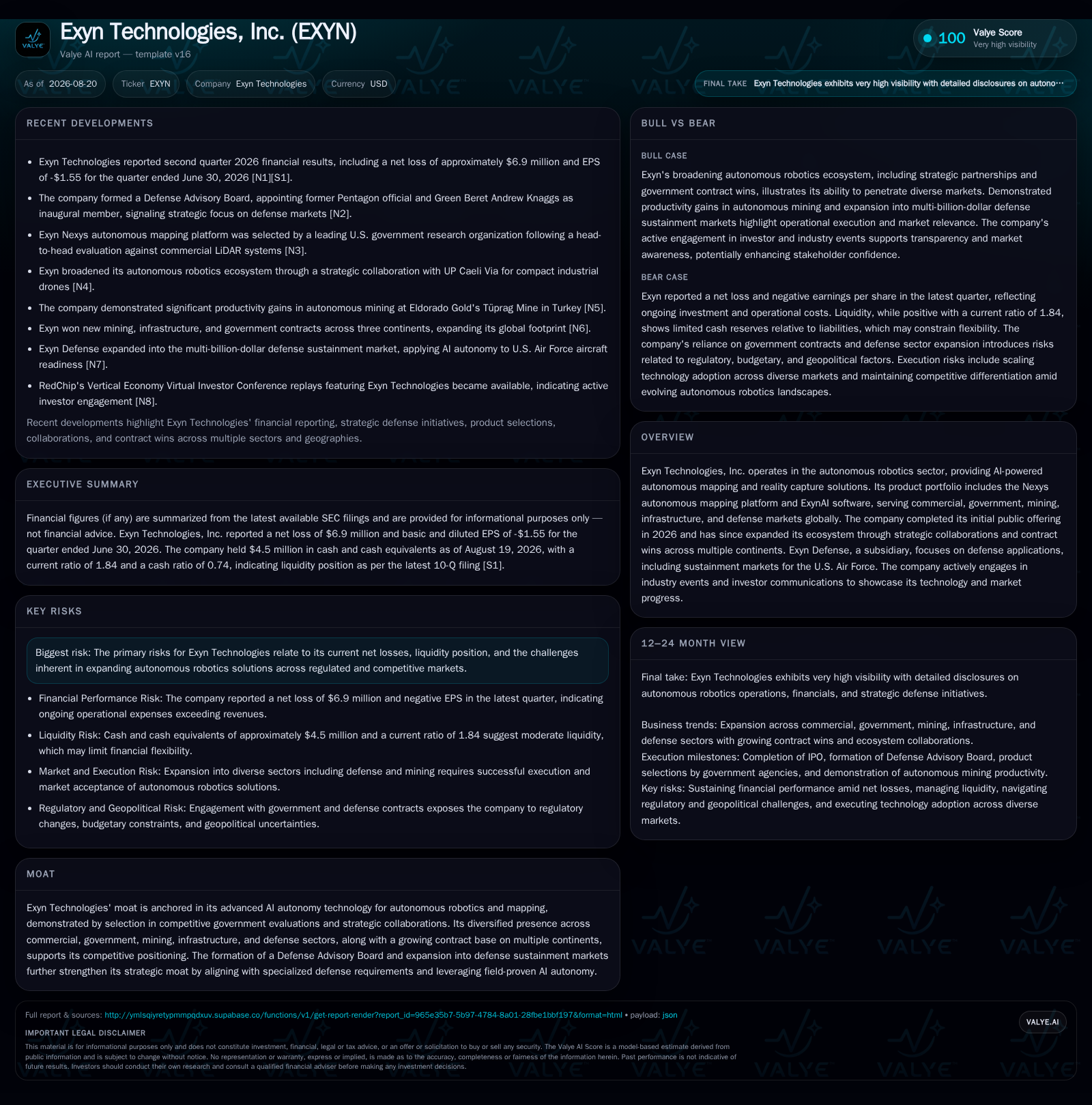
Exyn Technologies completed its IPO in May 2026, raising approximately $19.4 million in gross proceeds. In Q2 2026, the company expanded its autonomous robotics ecosystem with new contracts across mining, infrastructure, government, and defense sectors. A Defense Advisory Board formation and key appointments highlight a strategic push into defense sustainment markets. The company maintains solid liquidity with a current ratio of 1.84 as of June 30, 2026, supporting ongoing R&D and market growth despite operating losses typical for early-stage autonomous robotics firms.
Q2 2026 Operating and Financial Overview
Exyn Technologies, Inc. reported its Q2 2026 operating and financial results in its August 19, 2026, 10-Q filing, reflecting the company’s continued growth trajectory following its May 2026 initial public offering (IPO). The IPO generated approximately $19.4 million in gross proceeds before underwriting discounts and expenses, providing fresh capital to support expansion efforts [S17][S19]. As of June 30, 2026, Exyn held $4.49 million in cash and equivalents and maintained total debt of about $1.69 million, resulting in a current ratio of 1.84 based on $11.22 million in current assets against $6.10 million in current liabilities [F1]. This liquidity position supports ongoing investments in research and development (R&D) and operational growth despite the company remaining in a net loss position typical of early-stage autonomous robotics firms [S2].
Post-IPO Capital Deployment and Market Expansion
Following the IPO, Exyn Technologies has actively deployed capital to broaden its autonomous robotics ecosystem and penetrate multiple industry verticals. In Q2 2026, the company secured new contracts across mining, infrastructure, government, and defense sectors spanning three continents, reflecting diversified customer adoption of its autonomous mapping and AI autonomy platforms [N3][N8]. These contracts underscore Exyn’s ability to leverage its AI-powered robotic platforms and software solutions, such as ExynAI, to deliver operational efficiency and reality capture capabilities tailored to complex environments. The company’s revenue generation model includes product sales, software licensing, and service contracts, with contract wins playing a critical role in building backlog and recurring revenue streams [S2].
Strategic Defense Sector Initiatives
A notable development in Q2 2026 was Exyn’s focused expansion into defense sustainment markets, particularly with the U.S. Air Force. The formation of a Defense Advisory Board and the appointment of former Pentagon official and Green Beret Andrew Knaggs as its inaugural member signal a strategic alignment of Exyn’s AI autonomy technology with specialized government requirements [N4][N5]. This development reflects the company’s engagement with the multi-billion-dollar defense sustainment market through autonomous solutions aimed at aircraft readiness and operational safety. These defense sector initiatives coincide with efforts to deepen government contract relationships [S2].
Business Model and Competitive Positioning
Exyn Technologies operates within the autonomous robotics and AI solutions industry, serving a diverse customer base that includes commercial enterprises, government agencies, mining companies, infrastructure operators, and defense organizations. Customers purchase integrated autonomous mapping platforms, AI software licenses, and related services designed to improve data accuracy and operational efficiency in hazardous or complex environments [S2]. The company’s revenue mechanics rely on a mix of hardware sales, software licensing, and service contracts, with margins influenced by R&D intensity, contract scale, and billing terms. Competitive advantages stem from advanced AI autonomy technology, a diversified sector presence, and strategic defense collaborations. However, the company faces constraints such as market adoption challenges and evolving regulatory compliance requirements.
Risks and Financial Outlook
Exyn Technologies reports liquidity and debt levels post-IPO, with a net loss position reflecting ongoing investment in technology development and market expansion [S2]. Key risks include the ongoing cash burn rate and the need to convert contract wins into sustainable revenue growth. Monitoring quarterly revenue progression, contract backlog updates, and the impact of defense advisory initiatives will be essential to assess the company’s financial trajectory. Additionally, execution on stock option compensation plans and potential dilution effects warrant attention in upcoming quarters.
Conclusion
Exyn Technologies’ Q2 2026 results illustrate a company utilizing IPO proceeds to support expansion across commercial and defense sectors within the autonomous robotics market. The company’s liquidity position, reflected in a current ratio of 1.84 and $4.49 million cash on hand as of June 30, 2026, provides resources for ongoing R&D and market development efforts [F1][S2]. Strategic moves into defense sustainment markets, including the formation of a Defense Advisory Board and targeted contract wins, reflect alignment of its AI autonomy solutions with specialized government needs [N4][N5][S2]. Going forward, key watchpoints include quarterly revenue growth, contract backlog evolution, cash burn trends, and the execution of defense sector initiatives.
Disclaimer: This is research-only, informational analysis and not investment advice. It may include AI-generated interpretation and general industry context. Always verify important details using primary sources.

Comments