
Regenerative Medical Technology Group Q2 2026: Education and Manufacturing Growth Offset by Critical Liquidity Challenges
RMTG advances its integrated regenerative medicine platform with global education and biologics manufacturing expansion, while facing severe liquidity constraints in Q2 2026.
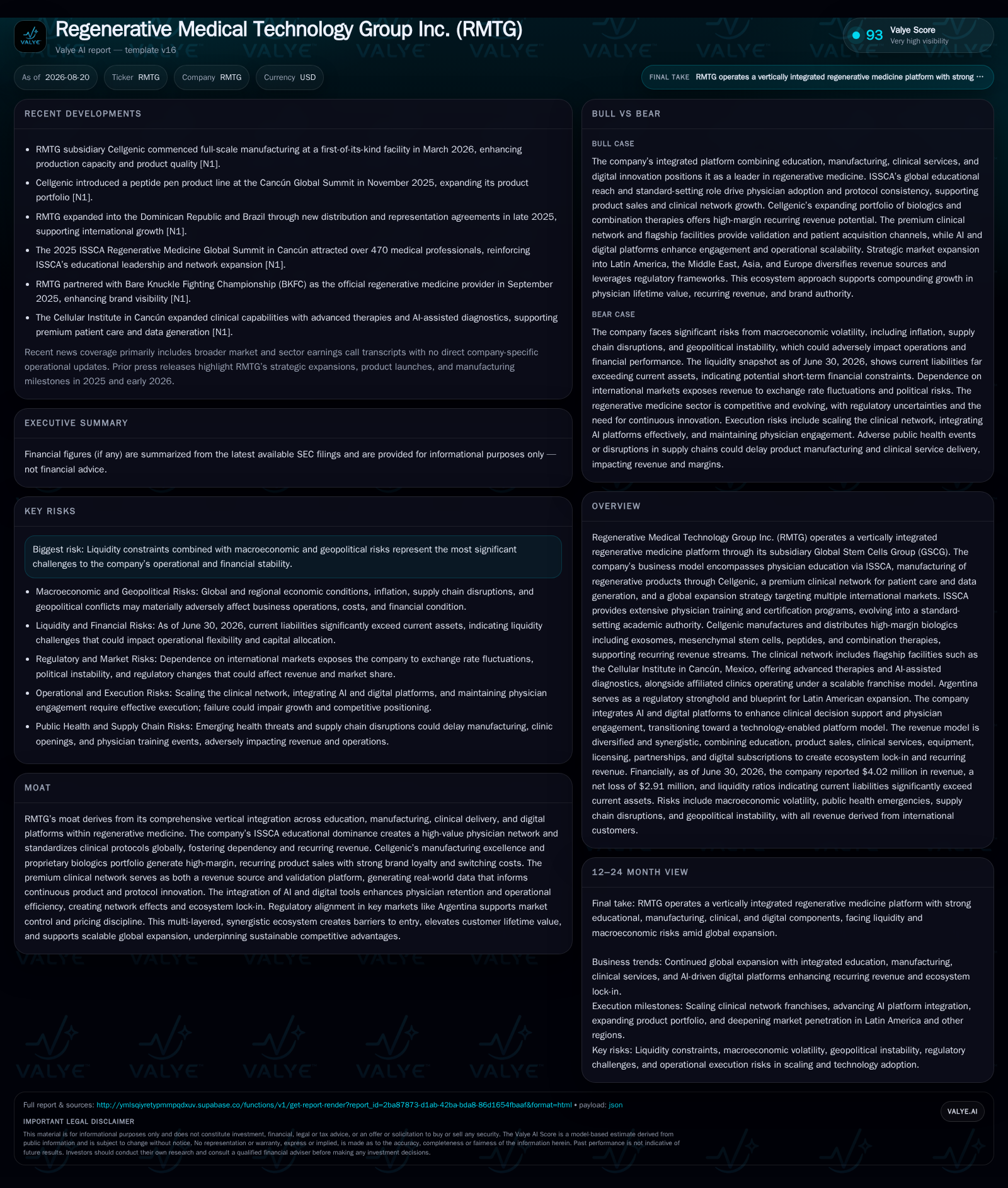
Regenerative Medical Technology Group Inc. (RMTG) reported significant operational progress in Q2 2026, expanding its physician education programs and biologics manufacturing through its subsidiary Global Stem Cells Group. The company’s vertically integrated model spans physician training, high-margin biologics production, clinical network development, and digital enablement. However, despite these strategic advances, RMTG’s liquidity position remains critically strained, with a current ratio of 0.05 and a working capital deficit exceeding $40 million, posing substantial risks to its near-term operational sustainability. The platform’s structural strengths contrast sharply with acute financial challenges that require close monitoring.
Q2 2026 Operating Update: Platform Maturation and Global Expansion
Regenerative Medical Technology Group Inc. (RMTG), through its subsidiary Global Stem Cells Group (GSCG), continues to advance its vertically integrated regenerative medicine platform in Q2 2026 [S11]. The company’s core operations include physician education via the International Society for Stem Cell Applications (ISSCA), biologics manufacturing through Cellgenic, clinical network development, and digital enablement tools. In the second quarter, ISSCA conducted 15 international educational events across five continents, expanding physician training and certification programs. These events included hands-on certifications, specialty-focused curricula in orthopedics, aesthetics, and longevity, and plans for postgraduate-level diplomas and fellowship-style training to deepen clinical protocol standardization and physician engagement.
Cellgenic maintains its role as the high-margin biologics manufacturing engine, producing and distributing regenerative products such as exosomes, mesenchymal stem cells, peptides, and combination therapies [S1][S5]. These products support recurring revenue streams by supplying physicians and affiliated clinics with quality-controlled therapeutics aligned with ISSCA protocols.
RMTG’s global expansion strategy targets key high-growth regions including Latin America (notably Argentina, Brazil, Mexico), the Middle East (UAE, Saudi Arabia), Southeast Asia (Indonesia), South Asia (Pakistan), and Europe (Portugal, Spain, Italy). This "land and expand" approach leverages ISSCA’s educational programs to establish physician networks and protocol adoption before introducing Cellgenic products and clinical partnerships, enabling capital-efficient market entry and network effects that build brand recognition and revenue diversification [S4][S5]. The company also integrates digital platforms such as ISSCA AI and the ISSCA App, which provide clinical decision support, protocol research views, patient management tools, and a global physician networking community. The company reported cash and equivalents of approximately $1.32 million and negligible total debt of $4, reflecting minimal long-term leverage [F1]. However, current liabilities exceed current assets by over $40 million, with current liabilities totaling approximately $42.6 million against current assets of about $2.28 million. This imbalance results in a critically low current ratio of 0.05, indicating a severe working capital deficit and a significant cash flow mismatch [F1].
Additionally, the company has unsecured promissory notes with an aggregate principal amount exceeding $1.15 million that have matured and are currently in default. While management reports ongoing debt restructuring discussions and lender forbearance, the risk of acceleration and demand for payment remains a material threat to operational continuity [S2][S3]. This liquidity constraint represents a critical risk to RMTG’s ability to sustain growth initiatives, meet financial obligations, and fund ongoing platform development.
Business Model and Competitive Positioning
RMTG’s business model is distinguished by its comprehensive vertical integration across the regenerative medicine value chain. It serves physicians, medical providers, affiliated clinics, and patients seeking regenerative therapies by offering a synergistic suite of products and services. These include physician education and certification programs through ISSCA, recurring sales of Cellgenic’s biologic products, premium clinical treatments at affiliated centers, equipment and kits, digital subscriptions and licensing, and franchise or partnership arrangements [S1][S5][S11]. Revenue is generated through multiple synergistic streams: fees for physician training and certifications, recurring biologics product sales, clinical service revenues, digital platform subscriptions, and franchise fees. High-margin biologics manufacturing and standardized clinical protocols foster recurring revenue predictability and margin expansion. Digital platforms further enhance cash conversion by introducing subscription-based revenue and network effects.
This vertical integration creates sustainable competitive advantages by locking in physicians within a closed-loop ecosystem that elevates customer lifetime value. Network effects arise as more physicians adopt standardized protocols and utilize Cellgenic products, while proprietary clinical data assets generated through the clinical network inform continuous product innovation and protocol refinement [S1][S5][S11]. These elements collectively reinforce physician dependency and ecosystem resilience.
Risks and Outlook
While RMTG’s integrated platform strategy is structurally sound and positions the company as a consolidated category leader in regenerative medicine, its severe liquidity constraints pose a substantial operational risk [F1][S2][S3]
These metrics will provide insight into whether RMTG can translate its strategic platform maturation into sustainable financial performance amid challenging liquidity conditions.
In summary, RMTG’s Q2 2026 update reveals a dual trajectory: significant operational advancement in education, manufacturing, and global expansion underpinning a strong structural business model, contrasted by acute financial constraints that require vigilant monitoring to ensure ongoing viability and growth.
Disclaimer: This is research-only, informational analysis and not investment advice. It may include AI-generated interpretation and general industry context. Always verify important details using primary sources.

Comments