
Datavault AI Q2 2026: Merger Completion and Liquidity Pressures Amid Heavy Operating Losses
Datavault AI finalized its merger with NYIAX in August 2026 while reporting significant operating losses and strained liquidity in Q2 2026.
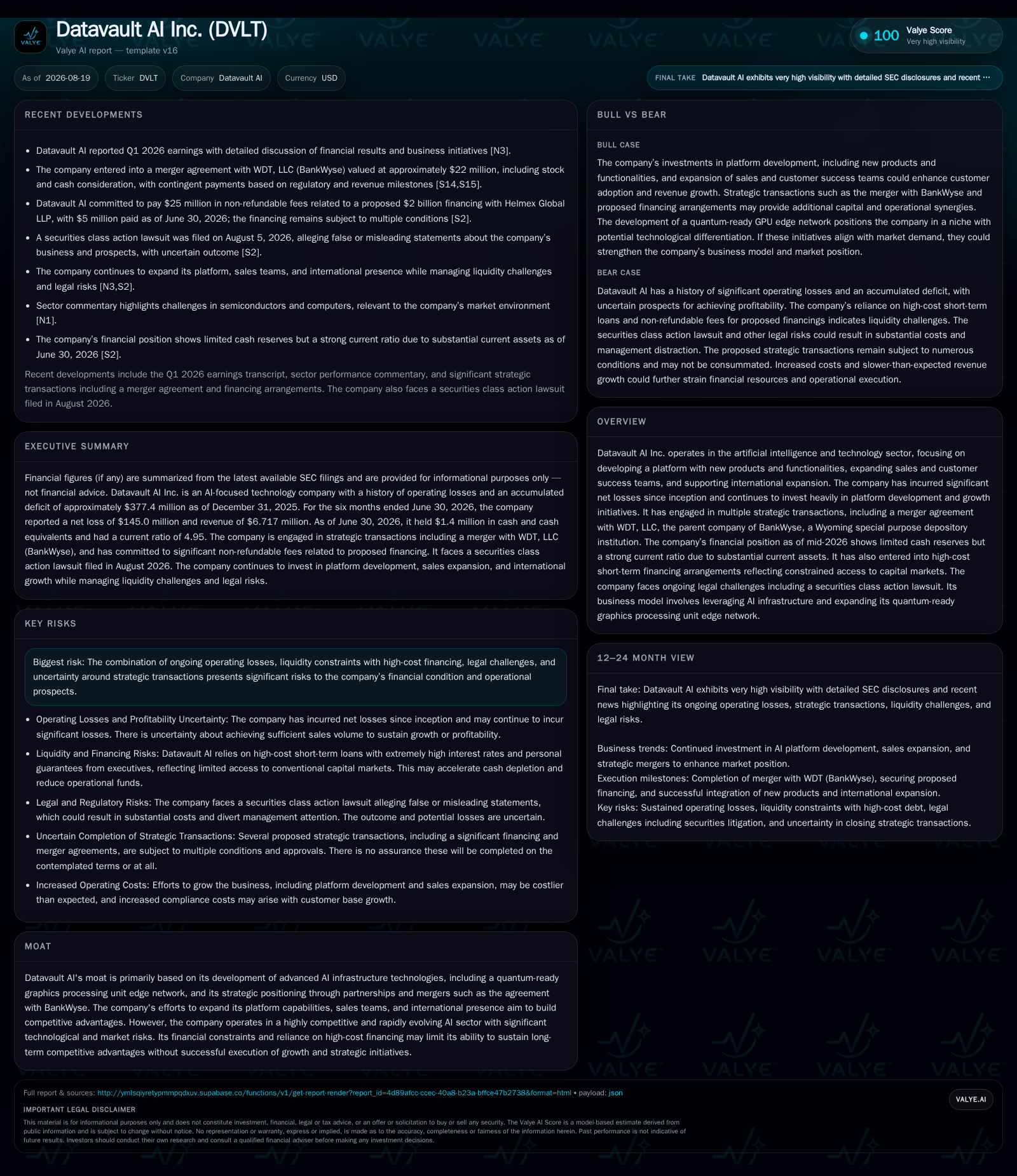
Datavault AI Inc. completed a merger with NYIAX on August 18, 2026, marking a key corporate milestone. Despite this, the company reported a net loss of $145 million in the first half of 2026 and consumed $80 million in operating cash, leaving cash reserves critically low at $1.4 million as of June 30, 2026. Although the reported current ratio was strong at 4.95, this was driven by large current assets rather than liquid cash, and the company’s reliance on a $2 million short-term loan with an annual interest rate of approximately 183.5% underscores significant financing challenges. Ongoing investments in platform development and sales expansion add to the cost pressures, raising questions about near-term operational sustainability without additional capital or improved revenue growth.
Datavault AI Inc. completed a significant merger with NYIAX, Inc. on August 18, 2026, pursuant to an Agreement and Plan of Merger dated March 18, 2026 [S3]. This transaction represents a strategic milestone potentially expanding Datavault AI’s product offerings and customer base by integrating NYIAX’s platform capabilities. However, the immediate financial benefits remain uncertain given the company’s distressed liquidity and ongoing heavy operating losses [S3][S2][F1].
As of June 30, 2026, Datavault AI held only $1.4 million in cash and cash equivalents, down from $2.0 million at December 31, 2025, despite reporting a current ratio of 4.95 driven by $134.96 million in current assets against $27.27 million in current liabilities [F1]. This strong current ratio masks the fragile liquidity position because much of the current assets may not be readily convertible to cash, leaving the company vulnerable to cash shortages [F1]. The company’s cash reserves are critically low, and it relies on a $2.0 million short-term loan entered into on May 5, 2026, with an effective interest rate of approximately 183.5% per annum, personally guaranteed by the CEO and CFO, indicating constrained access to conventional capital markets and elevated financial risk [S2]. This high-cost debt accelerates cash depletion and reduces operational flexibility.
For the six months ended June 30, 2026, Datavault AI incurred a net loss of $145.0 million and used $80.0 million in cash from operating activities [S2]. These heavy losses and significant cash burn reflect substantial investments in platform development, sales and customer success team expansion, and international growth initiatives. Despite recent revenue growth, the company remains uncertain about achieving sustainable profitability due to increasing operating expenses and the risk that revenue growth may not offset these costs [S2].
In addition to the short-term loan, Datavault AI has committed to paying $25.0 million in non-refundable transaction fees related to a proposed $2.0 billion financing transaction with Helmex Global LLP and affiliates, having paid $5.0 million as of June 30, 2026. This proposed financing remains subject to significant conditions, including due diligence, regulatory approvals, and valuation acceptance, with no assurance of completion [S7]. Failure to consummate this financing or secure alternative capital on favorable terms could exacerbate liquidity pressures and jeopardize the company’s ability to continue operations.
Datavault AI operates in the AI platform and hardware sector, generating revenue primarily through sales of AI platform products, including semiconductor modules and integrated platform infrastructure [S1][S2][S3]. Customers pay for access to these products and associated technologies, with growth dependent on customer adoption, expanded use cases, and international market penetration. Revenue mechanics rely on selling platform products such as modules and semiconductors; growth depends on increasing customer adoption, expanding use cases and integrations, and penetrating international markets.
Margins are currently negative due to high research and development expenses and sales and marketing costs, which challenge cash conversion and profitability [S2]. Competitive advantage depends on technological innovation, platform compatibility with third-party products, and strategic partnerships. Constraints include financial distress, high-cost debt, ongoing legal risks, and reliance on third-party manufacturers for modules and semiconductors [S1]. Maintaining and expanding compatibility with third-party products is critical to competitive positioning.
The AI infrastructure sector is growth-oriented but highly competitive and capital-intensive. Companies balance heavy R&D investment with scaling sales and customer success teams to drive adoption. Access to capital markets at reasonable cost is critical for sustaining growth and platform development. Mergers and strategic partnerships, such as the recent NYIAX transaction, are common strategies to expand capabilities and market reach.
Datavault AI faces ongoing legal risks, including a securities class action lawsuit filed in March 2026 alleging breach of contract, conversion, and violations of securities laws [S1][S7]. The company intends to defend the action but cannot predict the outcome or reasonably estimate potential losses. While management does not currently believe the litigation will have a material adverse effect, adverse outcomes could impose substantial monetary damages and operational burdens, diverting management attention from business operations [S7]. Additional legal proceedings or claims may arise in the ordinary course of business, potentially increasing costs and management distraction.
The company’s need for near-term financing to support ongoing operations is critical. Failure to raise sufficient capital could force the company to cease operations, liquidate assets, or seek bankruptcy protection [S1][S2]. Existing convertible notes and high-cost short-term loans restrict operating and financial flexibility, increasing the risk of financial distress.
In conclusion, the completion of the merger with NYIAX marks a strategic milestone for Datavault AI. However, the company’s immediate financial condition is precarious, with heavy operating losses, minimal cash reserves, and reliance on extraordinarily high-cost short-term debt [S3][S2][F1]. Sustaining operations and executing growth initiatives will depend on generating sufficient revenue growth or securing additional financing at reasonable cost. Ongoing investments in platform development and sales expansion, while necessary for growth, add to operating expenses and cash burn, increasing financial risk.
Key watchpoints include quarterly revenue growth and gross margin trends to evaluate progress toward profitability; changes in cash flow from operations and cash reserves; success in securing additional financing or capital raises on acceptable terms; integration progress and revenue impact from the NYIAX merger; and developments in ongoing legal proceedings and their financial implications. Monitoring these factors is critical to assessing Datavault AI’s near-term operational sustainability and longer-term prospects in the competitive AI platform and hardware sector.
Disclaimer: This is research-only, informational analysis and not investment advice. It may include AI-generated interpretation and general industry context. Always verify important details using primary sources.

Comments