
BiomX Inc. 2026 Q2: Strategic Pivot to Defense Sector Amid Financial and Listing Challenges
BiomX completes a fundamental shift from phage therapy to defense technology amid liquidity constraints and NYSE non-compliance risks.
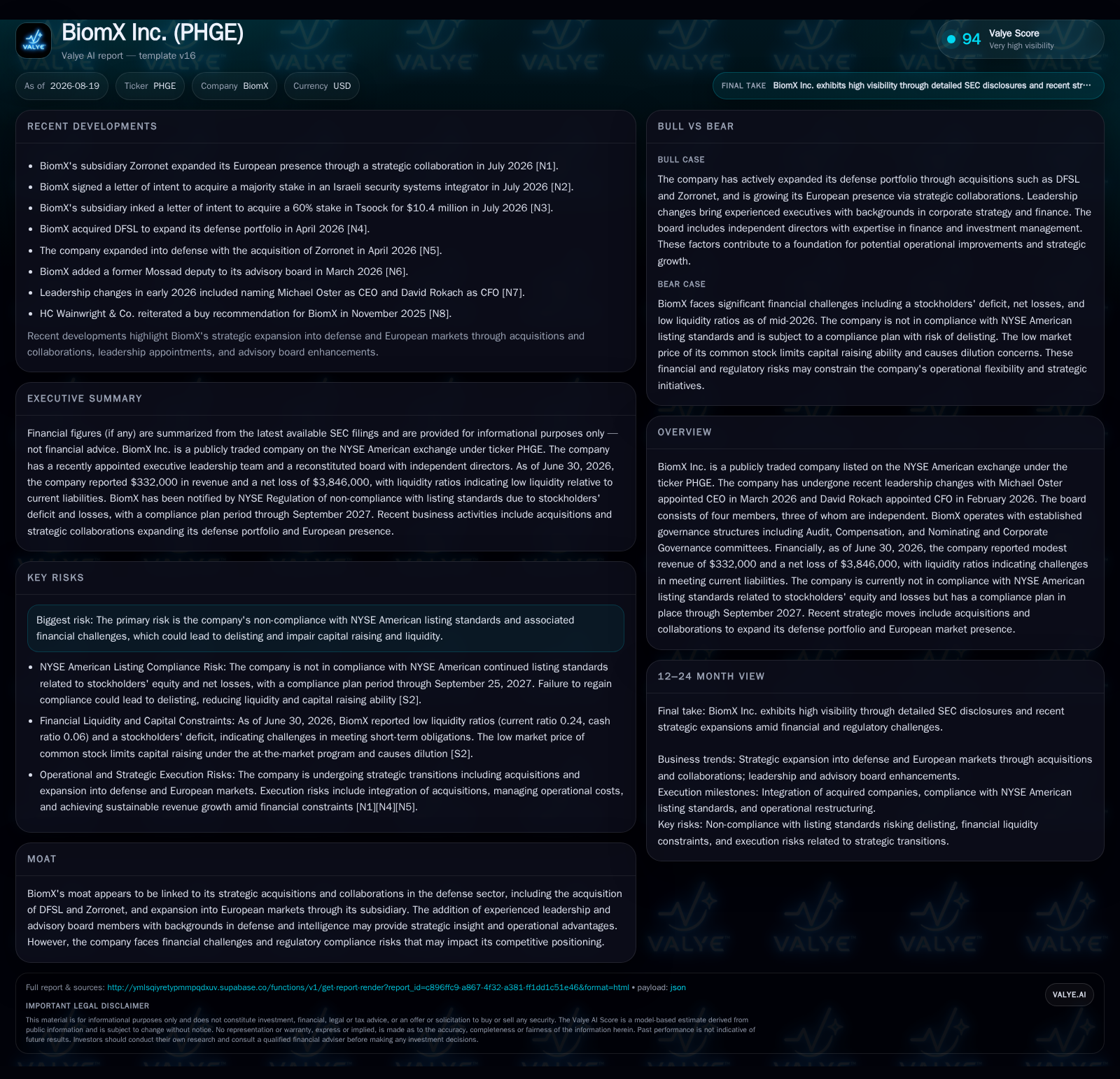
In Q2 2026, BiomX Inc. finalized its transition from its legacy phage therapy business to focus on defense, security, and critical infrastructure markets through key acquisitions. Despite this strategic pivot, the company faces significant financial challenges, including a low current ratio of 0.24, negative stockholders’ equity as of December 31, 2025, and ongoing net losses totaling $3.85 million for the quarter. These financial constraints, coupled with NYSE American listing non-compliance, pose risks to the company’s operational viability and capital raising ability.
Strategic Business Transition and Acquisitions
BiomX Inc. has completed a fundamental transformation of its business model in 2026, discontinuing its legacy phage therapy programs and exiting its former Israeli operating subsidiary, BiomX Ltd., which commenced insolvency proceedings in December 2025 [S1][S11]. This move effectively ended significant revenue sources from the company’s prior biopharmaceutical operations, leaving BiomX with limited ongoing operations outside its new focus areas.
The company’s strategic pivot targets the defense, security, and critical infrastructure sectors. BiomX acquired controlling interests in DR. Frucht Systems Ltd. (DFSL), an Israeli company specializing in LADAR (Laser Detection and Ranging)-based detection systems, and Zorronet, an AI-enabled security platform provider. Additionally, BiomX has expanded its European presence through collaborations involving its subsidiaries, positioning itself as a technology provider and integrator in defense and critical infrastructure protection markets [S1][S3][N1][N2][N3].
This shift changes BiomX’s revenue mechanics from biopharma R&D to product sales of advanced detection systems, software platform subscriptions, and project-based contracts [S1][S3]. However, the transition remains at an early stage, with the acquired subsidiaries still developing their commercial footprints and operational scale.
Financial Position and NYSE Compliance Status
The financial results for Q2 2026 illustrate the challenges BiomX faces during this transition [S2]. Concurrently, it incurred a net loss of $3.85 million, consistent with the early-stage integration costs and ongoing investments required to build its new operating platform [S2]. Liquidity constraints are pronounced [F1]. This results in a current ratio of 0.24, indicating significant difficulty in meeting short-term obligations without additional financing [F1]. The company also remains non-compliant with NYSE American continued listing standards. It reported a stockholders’ deficit of approximately $1.3 million as of December 31, 2025, and has sustained net losses over the past five fiscal years [S2][S11][S14]. NYSE Regulation accepted BiomX’s compliance plan on June 10, 2026, granting a plan period through September 25, 2027, within which the company must regain compliance or face potential delisting.
Capital raising efforts are hampered by a low stock price, which traded below $0.50 per share during Q2 2026 [S2]. This low valuation limits the amount of capital BiomX can raise through its at-the-market program without issuing a large number of shares, resulting in significant dilution. During Q2 and early Q3 2026, the company sold over 9.6 million shares for net proceeds of approximately $2.7 million, underscoring the dilutive nature of its current financing activities.
Leadership and Governance Update
In early 2026, BiomX installed a new leadership team aligned with its strategic pivot [S2]. Michael Oster was appointed CEO and David Rokach CFO, supported by a board of four members, including three independents. The board has established governance committees for audit, compensation, and corporate governance, aiming to support the company’s transition and compliance efforts.
Risks and Operational Challenges
The acquisitions of DFSL and Zorronet introduce operational and financial risks. BiomX holds a 60% controlling interest in DFSL but faces limited operational control due to minority shareholder protective rights held by Dr. Yaacov Frucht. This governance structure may complicate strategic decision-making and integration efforts [S5].
Zorronet, an early-stage technology company with limited revenue history, carries uncertainty regarding its ability to achieve projected revenues and commercial viability.
Business Economics and Sector Context
BiomX’s pivot to defense and security technology aligns with industry dynamics where revenue streams typically combine hardware product sales, recurring software subscriptions, and project-based contracts. Success in this sector depends on technology integration, customer diversification, and scaling operational capabilities. However, BiomX’s limited operating history in these markets and financial constraints place it at a competitive disadvantage relative to established defense technology firms.
Key sector performance indicators include revenue growth in defense/security markets, recurring revenue from software platforms, cash burn rates, and compliance with listing standards, all of which directly affect capital access and operational viability. While the acquisitions provide technology and market entry, the transition remains nascent with limited revenue and operational scale [S1][S3]. The company’s financial position, marked by a low current ratio of 0.24, negative stockholders’ equity as of December 31, 2025, and a net loss of $3.85 million in Q2 2026, constrains its ability to invest in growth and meet short-term obligations [F1][S2][S11][S14].
Monitoring these factors will be critical to assessing BiomX’s ability to navigate its strategic transition and financial challenges in the coming quarters.
Disclaimer: This is research-only, informational analysis and not investment advice. It may include AI-generated interpretation and general industry context. Always verify important details using primary sources.

Comments