
Picard Medical Q2 2026: Continued Listing Compliance Efforts Amid Tight Liquidity and Operating Losses
Picard Medical reports a $5.66 million Q2 net loss and faces NYSE American compliance challenges with a narrow liquidity buffer.
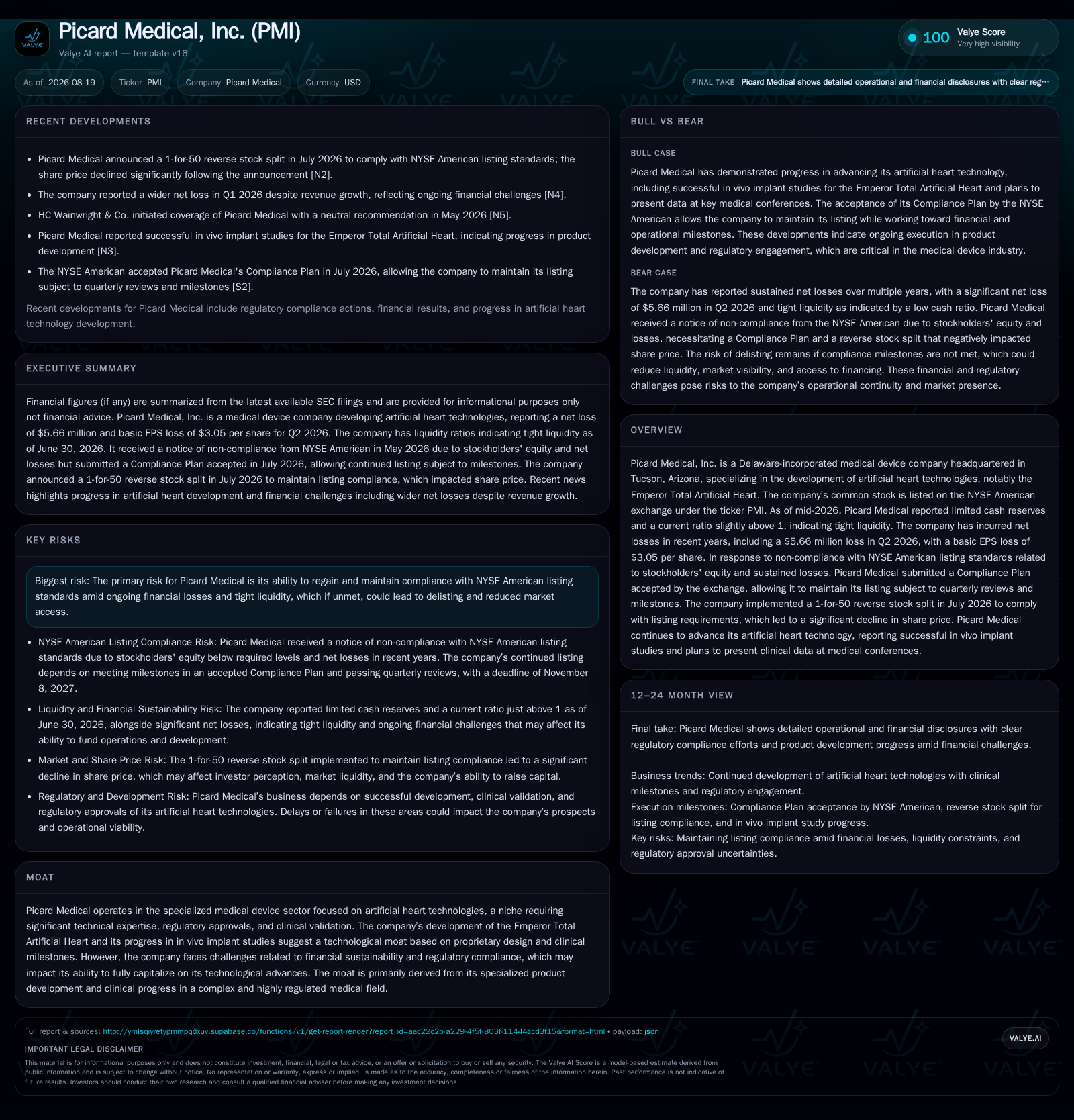
In Q2 2026, Picard Medical, Inc. recorded a net loss of $5.66 million and maintained a current ratio of 1.02, reflecting tight liquidity conditions. The company’s Compliance Plan to address NYSE American listing standards related to stockholders’ equity and sustained losses was accepted in July 2026, with a deadline to regain compliance by November 8, 2027. While advancing its proprietary artificial heart technology, Picard Medical’s financial constraints and regulatory risks pose significant challenges to its operational sustainability and future financing capacity.
Q2 2026 Financial and Liquidity Update
Picard Medical, Inc. reported a net loss of $5.66 million during the second quarter of 2026, translating to a basic loss per share of $3.05 [S2]. The company did not report any revenue in this period, consistent with its status as a pre-commercial medical device developer focused on the Emperor Total Artificial Heart. Operating margins remain negative due to ongoing research and development and clinical trial expenses associated with advancing its proprietary artificial heart technology.
Liquidity metrics highlight significant financial constraints. As of June 30, 2026, Picard Medical held only $38,000 in cash and cash equivalents, while its current assets totaled approximately $7.59 million against current liabilities of $7.45 million, yielding a current ratio of 1.02 [F1]. This narrow liquidity buffer indicates limited working capital, restricting the company's ability to absorb unexpected expenses or delays without securing additional financing. Such tight liquidity is a critical concern for pre-commercial medical device companies, where capital intensity and long development cycles are standard.
NYSE American Listing Compliance Status
Picard Medical remains subject to a Compliance Plan accepted by the NYSE American in July 2026, following the company’s failure to meet stockholders’ equity listing standards as of December 31, 2025, when equity was reported at $3.8 million [S3][S2]. The Compliance Plan requires the company to regain compliance with Sections 1003(a)(i) and (ii) of the NYSE American Company Guide by November 8, 2027. This plan involves quarterly reviews by the exchange and sets a firm deadline to address the sustained losses and equity deficiencies.
Failure to meet these requirements risks delisting from the NYSE American. Delisting would likely reduce market quotations and liquidity for the company’s common stock, diminish news and analyst coverage, and impair Picard Medical’s ability to raise additional financing in the future [S2]. For a capital-intensive, pre-commercial company, maintaining exchange listing is vital to accessing capital markets necessary to fund ongoing development and eventual commercialization.
Business Model and Technological Positioning
Picard Medical develops the Emperor Total Artificial Heart, a proprietary device designed to address advanced heart failure. The company is currently in the pre-commercial stage, with no reported revenue in Q2 2026, as it focuses on research, development, and in vivo implant studies to advance clinical milestones [S2]. Hospitals and healthcare providers are the anticipated end customers once regulatory approval and market adoption occur.
Revenue generation depends on successful regulatory clearance and subsequent sales, which remain uncertain and subject to lengthy approval processes typical in the medical device industry. Meanwhile, the company incurs substantial operating losses, reflected in a net loss of $5.66 million in Q2 2026, driven by R&D and clinical trial costs [S2]. The current ratio of 1.02 and the critically low cash balance of $38,000 limit the company’s ability to sustain operations without additional capital infusion [F1][S2]. Combined with ongoing net losses, these factors heighten the risk of failing to meet NYSE listing standards and threaten the company’s operational viability.
The acceptance of the Compliance Plan by NYSE American provides temporary regulatory relief but introduces ongoing risk. The company must meet quarterly milestones and regain compliance by November 8, 2027, or face delisting consequences that would materially impair liquidity, market access, and financing options [S3][S2]. This regulatory timeline imposes a strict framework within which Picard Medical must improve its financial position or secure financing.
Watchpoints
Key developments to monitor include quarterly updates on the company’s progress toward Compliance Plan milestones and NYSE reviews. Changes in liquidity ratios and cash balances in subsequent quarters will be critical indicators of financial health. Progress in regulatory approvals or clinical trial milestones for the Emperor Total Artificial Heart will also influence the company’s valuation and financing prospects. Finally, any capital raises or financing events will be essential to extend the company’s runway and support ongoing development efforts.
In summary, while Picard Medical advances its innovative artificial heart technology, its tight liquidity and sustained losses present significant structural challenges. The company’s ability to regain NYSE listing compliance and secure additional financing will be pivotal to its future operational sustainability and eventual commercial success.
Disclaimer: This is research-only, informational analysis and not investment advice. It may include AI-generated interpretation and general industry context. Always verify important details using primary sources.

Comments