
LanzaTech Advances Carbon Fermentation Commercialization Amid Capital Challenges
LanzaTech focuses on scaling its proprietary gas fermentation technology through six commercial plants while navigating concentrated investment risks and liquidity needs.
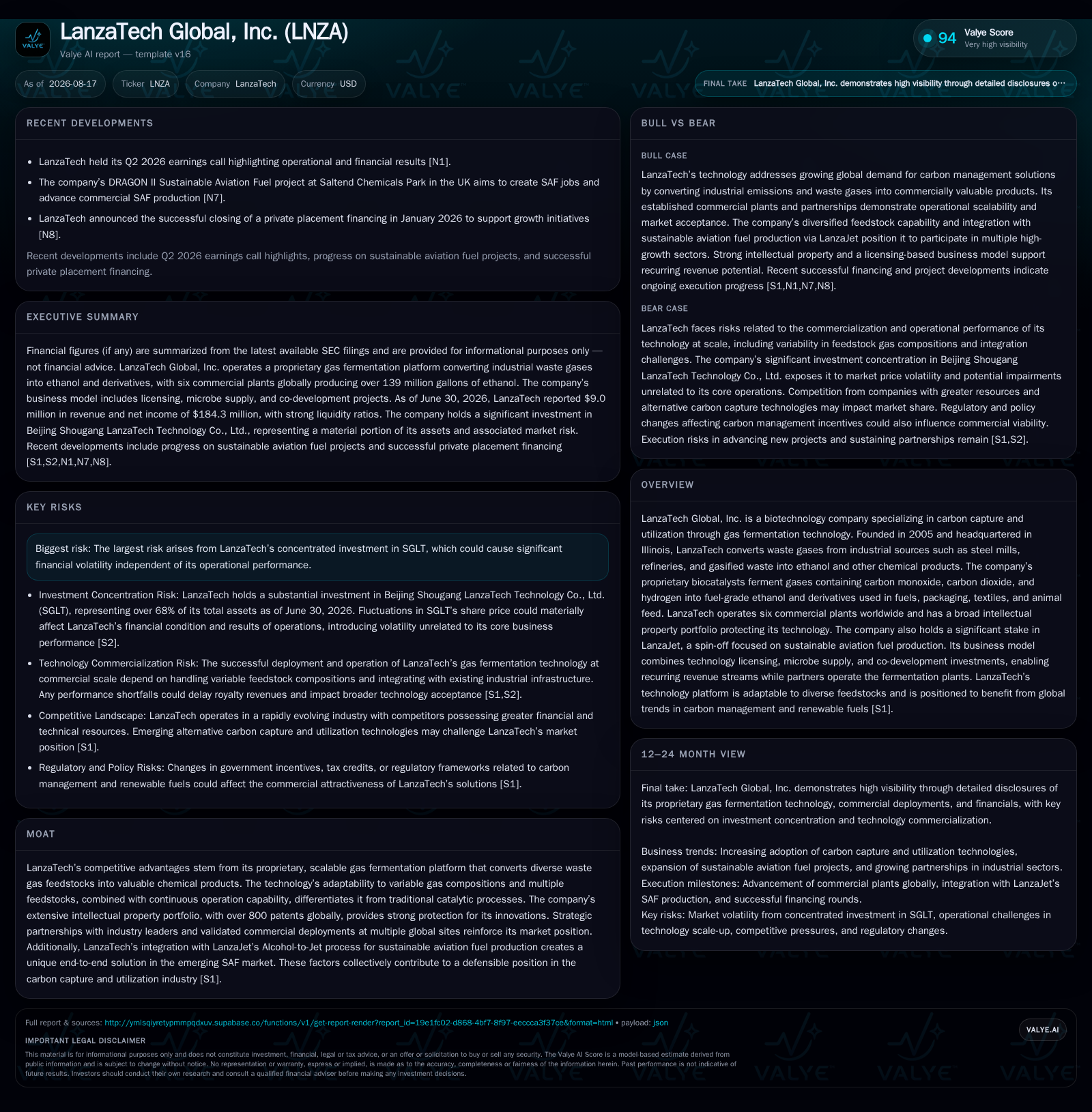
LanzaTech Global, Inc. operates an advanced biotechnology platform that converts industrial waste gases into ethanol and chemical derivatives via proprietary gas fermentation, with six commercial plants worldwide. The company’s business model emphasizes technology licensing, biocatalyst supply, and co-development partnerships to generate recurring royalty revenue tied to product sales. The recent quarterly update highlights strategic shifts toward commercialization, cost restructuring, and capital efficiency amid ongoing operating losses and a concentrated equity stake in SGLT exposing it to share price volatility. Growth drivers include regulatory pressures for decarbonization, rising demand for sustainable fuels and chemicals, and strategic collaborations, especially through LanzaJet spin-off integration. Liquidity remains a key focus as cash balances exceed $44 million with a conservative current ratio, but continued capital raises are necessary given historic and projected operating deficits.
Recent Operating Update
In its latest quarterly report for Q2 ended June 30, 2026 [S2], LanzaTech Global reinforced its strategic pivot from research-heavy activities toward large-scale commercialization of its proven gas fermentation technology platform. Key developments included a substantial reduction in research and development expenses by roughly 75%, reflecting headcount reductions and project prioritization aimed at improving operating leverage [S10]. This shift accompanies a reported increase in revenue from engineering and other services tied to newly initiated projects, indicating an uptick in customer engagement beyond legacy deals. Despite these operational improvements, the company continues to operate at a net loss consistent with prior quarters.
Concurrently, LanzaTech maintains a sizeable publicly traded equity stake in Beijing Shougang LanzaTech Technology Co., Ltd. ("SGLT"), comprising approximately 8.38% of that entity's issued shares valued at $223 million as of June 30, 2026 [S2]. This holding represents over two-thirds of the company's total assets, underscoring significant concentration risk from SGLT's stock price fluctuations independent of LanzaTech’s direct operational results. The correlation of SGLT's performance with LanzaTech’s royalty revenues from Chinese commercial-scale plants compounds this risk.
Business Model Analysis
LanzaTech generates revenue primarily through licensing its proprietary carbon capture gas fermentation technology to industrial partners who build and operate biorefineries using the licensed process [S1]. Licensees pay royalties based on the volume or value of products manufactured—mainly ethanol and ethanol-derived commodities such as drop-in sustainable aviation fuels (SAF), ethylene for polyethylene packaging, monoethylene glycol (MEG) for textiles and plastics manufacturing, among others. Besides licensing income, LanzaTech supplies proprietary biocatalysts essential for the continuous fermentation process that uniquely adapts to fluctuating waste gas compositions from steel mills, refineries, or gasified waste facilities.
The continuous fermentation operation differentiates it from chemical catalytic conversion by providing operational flexibility aligned with industrial partners’ variable feedstock streams. The company also supplements licensing with co-development partnerships which can involve incremental ownership or operatorship in bioprocessing facilities—enabling tighter control over product output quality and financing structures [S1]. Notably, LanzaTech holds a significant stake in the spin-off LanzaJet focused exclusively on converting alcohols into SAF using its Alcohol-to-Jet (ATJ) platform. This vertical integration extends LanzaTech’s value chain participation from upstream carbon capture to downstream biofuel production.
Industry Structure & Competitive Positioning
Operating within the niche yet rapidly scaling carbon capture and utilization biotechnology sector, LanzaTech competes against providers of synthetic biology platforms for industrial enzymes (e.g., Novozymes), carbon capture solutions (e.g., Carbon Clean Solutions), biofuel producers like Gevo or Renewable Energy Group, and synthetic fuel technology companies such as Velocys. However, no single peer currently matches LanzaTech's integrated approach combining gas fermentation microbial technology with commercial global plant deployment.
Its moat is fortified by an extensive intellectual property portfolio—over 800 patents worldwide—that protects proprietary biocatalysts and process innovations [S1]. Additionally, sustained partnerships with major industrial emitters provide feedstock access critical to scaling operations. The versatility across feedstock types (carbon monoxide-rich blast furnace gases to municipal solid waste-derived syngas) offers competitive resilience compared to more narrowly focused catalytic technologies.
Growth Drivers
Several structural tailwinds support LanzaTech’s growth trajectory: increasing regulatory mandates worldwide aim to reduce carbon emissions encourage adoption of clean fuel alternatives; major corporations commit to greener supply chains elevating demand for renewable ethanol derivatives; improvements in synthetic biology continuously enhance biocatalyst efficiencies increasing yield; expansion of industrial off-gas availability enlarges potential feedstock pipelines; government subsidies incentivize deployment; rising market acceptance of bio-based chemicals accelerates commercial uptake; lastly, joint ventures like those forming the CirculAir™ program leveraging both LanzaTech’s gas fermentation and LanzaJet’s ATJ pathway create unique end-to-end offerings in sustainable aviation fuels [S1].
Commercially, progress towards locking in new license agreements coupled with advancing early-stage cohort projects from engineering into financing-ready stages signals pathway to enhanced recurring royalty streams [S1]. Operational metrics such as uptime reliability improvements underpin service-level agreements vital for stable licensee production capacities.
Risks & Constraints
A dominant risk lies in financial reliance on the SGLT investment whose share price volatility due to factors external to LanzaTech's direct execution capabilities may materially impact reported assets and investor perception [S2]. The Chinese JV commercial plants operated under SGLT are pivotal revenue contributors; any operational shortcomings could delay royalties or impair reputation.
Technology scale-up risks remain inherent given gas fermentation complexity dealing with varied feedstock gas qualities affecting yields; likewise securing consistent high-quality feedstocks globally involves geopolitical uncertainties. Intellectual property litigation risks are relatively common within biotechnology sectors especially where patent breadth overlaps.
Furthermore, despite recent cost cuts yielding improved capital efficiency margins remain pressured due to high fixed costs associated with commercial plant preparations along with ongoing negative earnings requiring continual fundraising efforts. Regulatory hurdles linked to government funding delays notably within U.S.-driven DOE-supported projects may postpone milestones critical for full-scale operations [S1]. Competition from catalytic conversion firms offering alternative carbon-to-fuel technologies potentially constrains pricing power or market penetration.
What To Watch Next
Market watchers should closely monitor:
- Progression milestones of first cohort projects toward financing closure and plant commissioning slated for early 2027 updates [S1].
- Royalty revenue trends correlated with increased product volume shipments from existing plants indicating improving licensee utilization rates.
- Any shifts in SGLT H-share prices impacting corporate asset valuations beyond operational fundamentals.
- Updates around new licensing agreements or expansions within partnerships signaling ecosystem scaling.
- Cash flow dynamics including timing of additional capital raises or asset monetizations pivotal for sustaining runway.
- Strategic developments involving CirculAir™ collaborations advancing through regulatory approvals or off-take contracts boosting SAF market presence.
Financial Profile Discussion
Recent equity raises including a private placement raising $20 million in January 2026 have partially extended operating runway while cost optimization efforts have reduced R&D expenses substantially contributing to cash conservation [S9][S10]. Sustained royalty revenue growth coupled with improved project execution should gradually improve financial sustainability but timeframe remains uncertain given current commercialization stage.
This analysis reflects data up to August 14–17, 2026 from filings including the latest quarterly report (10-Q), annual report (10-K), recent event filings (8-K), supported by company factual metrics as consolidated by public sources. It aims to provide deep operational context without investment research views or forward-looking projections beyond filings disclosed information.
Disclaimer: This is research-only, informational analysis and not investment advice. It may include AI-generated interpretation and general industry context. Always verify important details using primary sources.

Comments