
Starco Brands Advances Growth Strategy Through Custom Foods Acquisition Despite Liquidity Constraints
Starco Brands recently expanded its consumer packaged goods portfolio by acquiring Custom Foods, financed through a term loan amid ongoing leverage and working capital challenges.
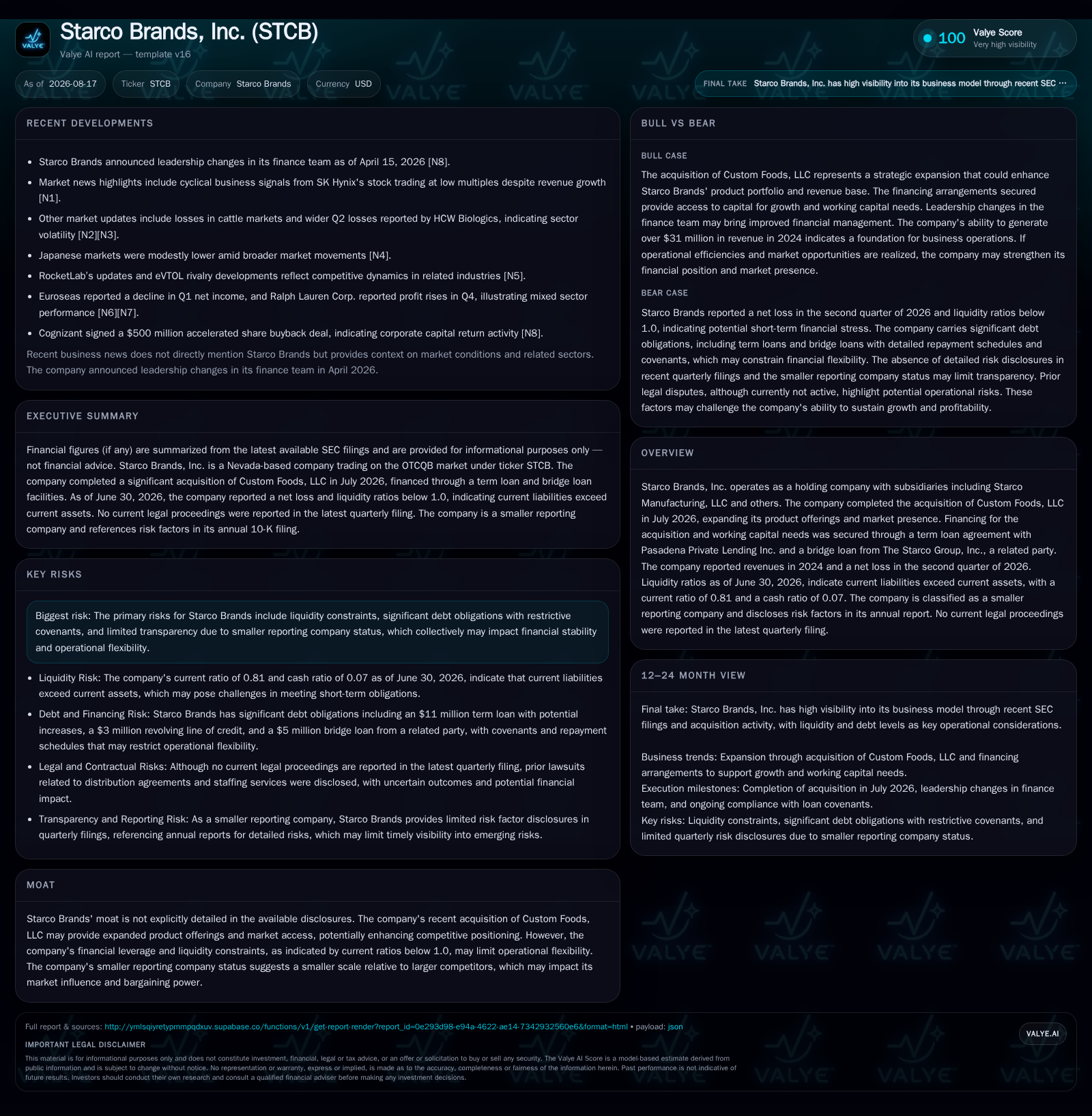
In Q2 2026, Starco Brands, Inc. completed the acquisition of Custom Foods, LLC, marking a strategic step to diversify its product offerings in the consumer packaged goods sector. The acquisition was primarily funded by an $11 million term loan facilitated by Pasadena Private Lending and supplemented by a bridge loan from a related party. However, as of June 30, 2026, the company reported a current ratio below 1.0, signaling working capital pressure and liquidity constraints common among smaller CPG companies undergoing aggressive growth via acquisitions. The firm’s capital structure includes restrictive covenants tied to EBITDA and fixed charge coverage metrics, critical for monitoring financial flexibility going forward.
Recent Operating Update
Starco Brands made a significant strategic move in mid-2026 by acquiring Custom Foods, LLC for an initial $8 million in cash plus potential earnouts up to $2.5 million contingent upon revenue targets in 2027 [S3][S16]. This acquisition aligns with Starco’s approach as a holding company to expand its consumer packaged goods (CPG) brand portfolio through targeted acquisitions that enhance market presence and product diversity. Financing this transaction required an $11 million term loan arranged through Pasadena Private Lending Inc., complemented by prior bridge financing from The Starco Group Inc., a related party controlled by the CEO [S3][S15].
As of June 30, 2026, current assets were approximately $10.9 million while current liabilities stood at $13.4 million—yielding a current ratio of only 0.81—and an even tighter cash ratio near 0.07 due to limited cash reserves versus short-term obligations [F1]. This imbalance suggests constrained working capital that could stress daily operations or compel further reliance on credit facilities if not addressed promptly.
Business Model Overview
Starco Brands operates primarily as a holding company overseeing subsidiaries like Starco Manufacturing, combining manufacturing capabilities with brand management in the CPG industry [S1]. Revenue generation comes through manufacturing consumer products—likely food-related following the Custom Foods acquisition—and distributing them via retail or wholesale channels typical in this sector. The recent acquisition serves both to diversify product offerings and amplify distribution reach.
Revenue is driven by sales volume and pricing across these branded products; however, margins may be impacted short term by costs linked to acquisition integration and elevated financial expenses due to increased leverage. Contractual terms with retailers or distributors affect cash conversion cycles via negotiated payment terms—a critical factor since working capital is currently compressed as indicated by the sub-1 current ratio [F1]. Maintaining efficient supply chain management alongside effective marketing will be pivotal for incrementally improving margins and sustaining continued revenue growth.
Industry Structure and Competitive Position
Within the broader CPG landscape—which includes large multinational peers like Procter & Gamble or Kellogg’s—Starco Brands sits as a smaller reporting company navigating typical industry challenges such as intense competition from established brands and private label producers alike. Its scale is modest relative to global giants but shares industry traits: reliance on diversified brand portfolios, contract manufacturing agreements where applicable, and distribution partnerships spanning retail channels.
Because smaller reporting companies typically face tighter financing options and higher relative leverage than their large-cap counterparts, Starco's ongoing debt load—approximately $3.47 million total with net debt around $2.57 million after accounting for cash—can limit flexibility [F1]. Compared with sector peers focusing on organic growth or larger-scale M&A strategies (e.g., Conagra Brands’ diversification efforts), Starco’s path emphasizes accretive acquisitions supported by external debt financing within covenant constraints.
Growth Drivers
Acquisition-driven portfolio expansion remains central to Starco's growth strategy as demonstrated by its July 2026 purchase of Custom Foods—a move aimed at adding new product lines that can tap evolving consumer preferences around specialty foods or convenience items typical in modern CPG demand trends [S3][S16]. In addition to product breadth gains, leveraging operational synergies across manufacturing subsidiaries may improve supply chain efficiencies over time.
Distribution channel enhancement is another key growth lever; expanding footprint either through direct retailer agreements or wholesale distributor partnerships helps increase market penetration rate essential for revenue scalability. Moreover, financial facilities including term loans and revolving credit lines provide necessary working capital backing for inventory buildup during ramp-up phases.
Product innovation tailored toward health-conscious or niche segments could foster competitive differentiation if executed effectively alongside marketing initiatives that build brand equity beyond commoditized goods.
Risks and Watchpoints
Starco's most visible risks stem from liquidity pressures evident in current ratio metrics below unity and minimal cash reserves [F1], situating it among many mid-sized CPG companies which often juggle operating requirements alongside financial obligations under restrictive covenants.
Integration risks accompany any acquisition; melding operations of Custom Foods into Starco’s ecosystem requires effective change management to realize cost savings without disrupting existing supply chains or customer relationships [S23]. Additionally, competitive pressures from larger entrenched brands can limit pricing power or shelf space access.
Other watchpoints include exposure to commodity price fluctuations impacting input costs—a common volatility driver in food manufacturing—and regulatory compliance with labeling or safety standards which carry reputational risks if not meticulously managed.
What To Watch Next
Key near-term milestones include tracking post-acquisition revenue performance against the earnout targets set for calendar year end 2027—the achievement of which will influence final payout amounts substantially affecting financial outcomes [S16]. Quarterly updates on liquidity ratios vis-à-vis loan covenants will also signal whether capital structure modifications are needed or if additional borrowing requests under accordion provisions are feasible.
Operational indicators such as inventory turnover rates and accounts receivable collections will help assess supply chain health and working capital efficiency—critical under current tight liquidity conditions [F1]. Public disclosures forthcoming within regulatory windows (amendments linked to acquisition financials) should provide enhanced transparency into pro forma performance impacts.
Lastly, any renewal or expansion of distribution agreements beyond legacy contracts could serve as lead indicators of expanding market acceptance for newly integrated product lines stemming from Custom Foods.
Financial Profile Discussion
As per latest reporting as of June 30, 2026, Starco’s liquidity situation reflects strained working capital typical among smaller-scale CPG firms aggressively pursuing inorganic growth [F1][S2]. Cash stands just above $900 thousand against current liabilities exceeding $13 million creating a cash ratio around seven percent—pointing towards operational reliance on receivables collection timing or revolving credit advances for immediate obligations.
Total debt estimated at roughly $3.47 million combined with net debt approximately $2.57 million highlights moderate leverage levels that impose pressure given negative operating income nearing $18.8 million in calendar year end 2025 alongside net losses exceeding $20 million during same period [F1]. The company's financing arrangement also includes substantial fees (e.g., non-refundable closing fees at two percent on initial loan amounts plus similar fees on incremental borrowings) which add to borrowing costs alongside statutory insurance coverage obligations valued above $18 million naming lenders as payees/insureds under collateral agreements—to mitigate lender risk exposures [S15]
Going forward financial agility hinges upon successful realization of synergies from acquisition integration coupled with disciplined working capital management aligning sales growth with cash flow conversion improvements typical among more mature competitive peers.
This report synthesizes publicly available SEC filings and structured financial data without imparting investment advice or research views.
Disclaimer: This is research-only, informational analysis and not investment advice. It may include AI-generated interpretation and general industry context. Always verify important details using primary sources.

Comments