
Lantern Pharma Advances Precision Oncology Pipeline with AI-Driven Clinical Milestones
The latest quarterly filing underscores Lantern Pharma's progress in its AI-integrated oncology pipeline, orphan drug designations, and regulatory engagements shaping its clinical-stage trajectory.
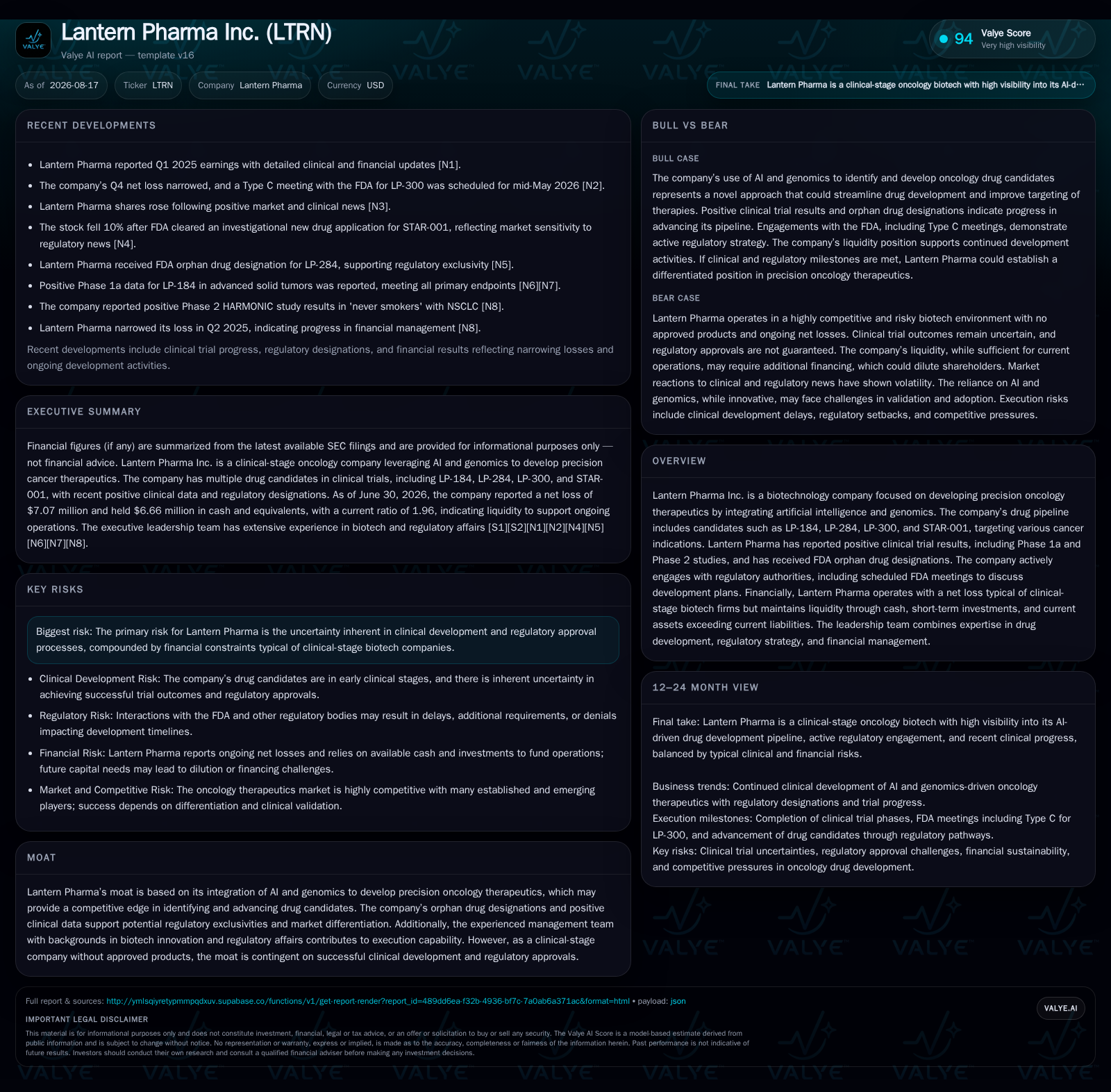
Lantern Pharma’s Q2 2026 disclosures reveal advancement of its precision oncology candidates through ongoing Phase 1 and Phase 2 clinical trials leveraging artificial intelligence and genomics. The company benefits from FDA orphan drug designations that enhance potential market exclusivity but remains exposed to clinical outcome risks that will determine regulatory success. Financially, Lantern maintains near-term liquidity with a current ratio of 1.96 and $6.7 million in cash, consistent with typical burn rates for clinical-stage biotechs investing heavily in R&D. Upcoming catalysts include pivotal trial data readouts and planned FDA interactions critical for validating the AI-driven precision therapy model and sustaining development momentum.
Operating Update: Advancing AI-Enabled Precision Oncology Candidates
Lantern Pharma’s August 14, 2026 quarterly filing highlights active progress across multiple early-stage oncology programs driven by artificial intelligence (AI) combined with genomic data integration. Lead candidates such as LP-184 and LP-284 are advancing through Phase 1a/b and Phase 2 trials targeting challenging cancer indications [S2][S3]. This reflects a deliberate phased clinical strategy common in biotech but notably augmented by Lantern’s proprietary computational platform designed to enhance biomarker identification and prioritize drug candidates more efficiently than conventional approaches.
Trial enrollment appears to be progressing without disclosed impediments—a critical operational metric given the competitive landscape for patient recruitment in oncology studies [S1]. By leveraging AI analytics alongside genomic biomarkers, Lantern seeks to improve the likelihood of successful trial progression relative to peers reliant on traditional candidate selection methods. This integration aims to shorten drug development cycles, a notable challenge industry-wide that companies like Recursion Pharmaceuticals address with different technological emphases
Focusing valuation expectations on measurable clinical KPIs such as phase advancements and biomarker validation grounds assessment in tangible milestones rather than speculative early-stage promise.
Orphan Drug Designations Enhance Regulatory Positioning
Lantern’s portfolio benefits from FDA orphan drug designations granted for select pipeline candidates [S1]. These designations confer potential seven-year market exclusivity post-approval, eligibility for accelerated regulatory pathways, and access to financial incentives including tax credits.
In precision oncology—where therapies often target rare molecular subsets—such designations can provide meaningful commercial advantages by limiting competition and supporting premium pricing strategies. However, these benefits depend critically on forthcoming positive efficacy data; failure to meet clinical endpoints could jeopardize orphan status or diminish exclusivity value.
This regulatory positioning resembles strategies employed by firms like Blueprint Medicines that have effectively leveraged orphan status to establish defensible niche franchises within oncology.
Competitive Landscape: Integrating AI and Genomics in Drug Development
Lantern operates at the convergence of AI-driven discovery and genomics-based precision medicine within oncology—a rapidly evolving yet technically complex segment of biotechnology. While many peers apply machine learning or genomic techniques independently, Lantern’s integrated platform attempts to unify these tools into streamlined candidate identification and development workflows [S1].
This synergistic approach has the potential to accelerate identification of responsive patient populations and refine therapeutic targeting earlier than traditional small molecule pipelines dependent on empirical screening alone. However, successful translation from computational predictions to clinically effective agents remains a significant hurdle faced broadly by AI-enabled biotechs.
Although specific R&D efficiency metrics are not disclosed, monitoring the pace at which Lantern advances candidates through preclinical and early clinical stages relative to classical benchmarks will be important for evaluating the platform’s practical impact amid high capital demands.
Growth Drivers: Clinical Milestones and Regulatory Engagements
Upcoming operational catalysts include interim data releases from Phase 2 trials—particularly for LP-184—and scheduled FDA meetings intended to clarify regulatory pathways [S2][S3]. Positive trial results would validate Lantern’s AI-driven precision oncology hypothesis while potentially expediting approval processes or broadening indications.
While no new partnerships or licensing agreements were detailed in recent filings, such collaborations remain plausible avenues for risk mitigation or resource augmentation. Future milestone payments from partnerships could supplement operational funding given the company’s net loss profile.
Tracking these tangible progress points provides investors with concrete signals beyond baseline R&D expenditure.
Risks: Clinical Development Uncertainty and Financial Sustainability
As a clinical-stage biotech firm pioneering novel AI-guided therapeutics, Lantern faces inherent risks including trial delays or failures due to recruitment challenges or unforeseen safety/efficacy issues—risks amplified by the novelty of its technology platform [S2]
Financially, ongoing net losses reflect heavy investment in research activities without revenue generation. Sustained access to capital markets or strategic partnerships is critical to maintain pipeline momentum. Additionally, integrating complex AI algorithms with biological data entails execution risks; inaccurate predictive models could lead to costly trial failures.
Competition from established pharmaceutical companies developing targeted oncology therapies also poses market entry challenges despite orphan drug protections.
Effective risk management balancing innovation ambitions against pragmatic development pacing remains essential.
Near-Term Watchpoints: Data Readouts and Regulatory Interactions
Key forthcoming milestones include interim efficacy data releases from pivotal Phase 2 studies assessing safety and therapeutic benefit across targeted cancers [S2][S3]. These outcomes will be decisive tests of whether Lantern’s computational approach translates into meaningful patient improvements.
Upcoming FDA interactions aimed at confirming acceptable endpoints or discussing registration-enabling trial designs represent critical junctures that could accelerate approval timelines or identify developmental gaps early.
Monitoring these events will provide essential guidance on the evolving risk/reward profile amid the inherently long biotech development cycle characterized by episodic news-driven sentiment shifts.
Financial Profile Discussion: Solid Liquidity Amid Continued Investment
As of June 30, 2026, Lantern Pharma held approximately $6.7 million in cash and equivalents alongside total current assets near $8.5 million versus current liabilities around $4.3 million—yielding a current ratio of approximately 1.96 [F1]. This indicates sufficient short-term liquidity coverage typical for a clinical-stage biotech managing ongoing R&D expenditures.
The company continues operating at a net loss reflecting substantial investment in advancing its early-phase oncology programs; this financial posture aligns with industry norms where extended pre-commercial development phases require sustained capital infusions absent product revenues.
Given available cash relative to anticipated burn rates implied by disclosed R&D intensity, Lantern’s runway extends into the medium term but will require additional financing or partnership-derived milestone payments aligned with upcoming developmental milestones to sustain operations.
Compared with peer biotech firms at similar clinical stages incorporating advanced technology platforms, this financial positioning is consistent with cautious optimism contingent on successful milestone execution.
This analysis synthesizes available SEC filings as primary sources without projecting forward-looking statements beyond documented evidence. It aims solely at elucidating Lantern Pharma's operating context within the biotech sector framework.
Disclaimer: This is research-only, informational analysis and not investment advice. It may include AI-generated interpretation and general industry context. Always verify important details using primary sources.

Comments