
Neumora Advances CNS Pipeline with Improved Q2 Financials and Leadership Shift
Neumora’s latest quarter highlights significant CNS drug development progress paired with strategic leadership change and operational recalibration.
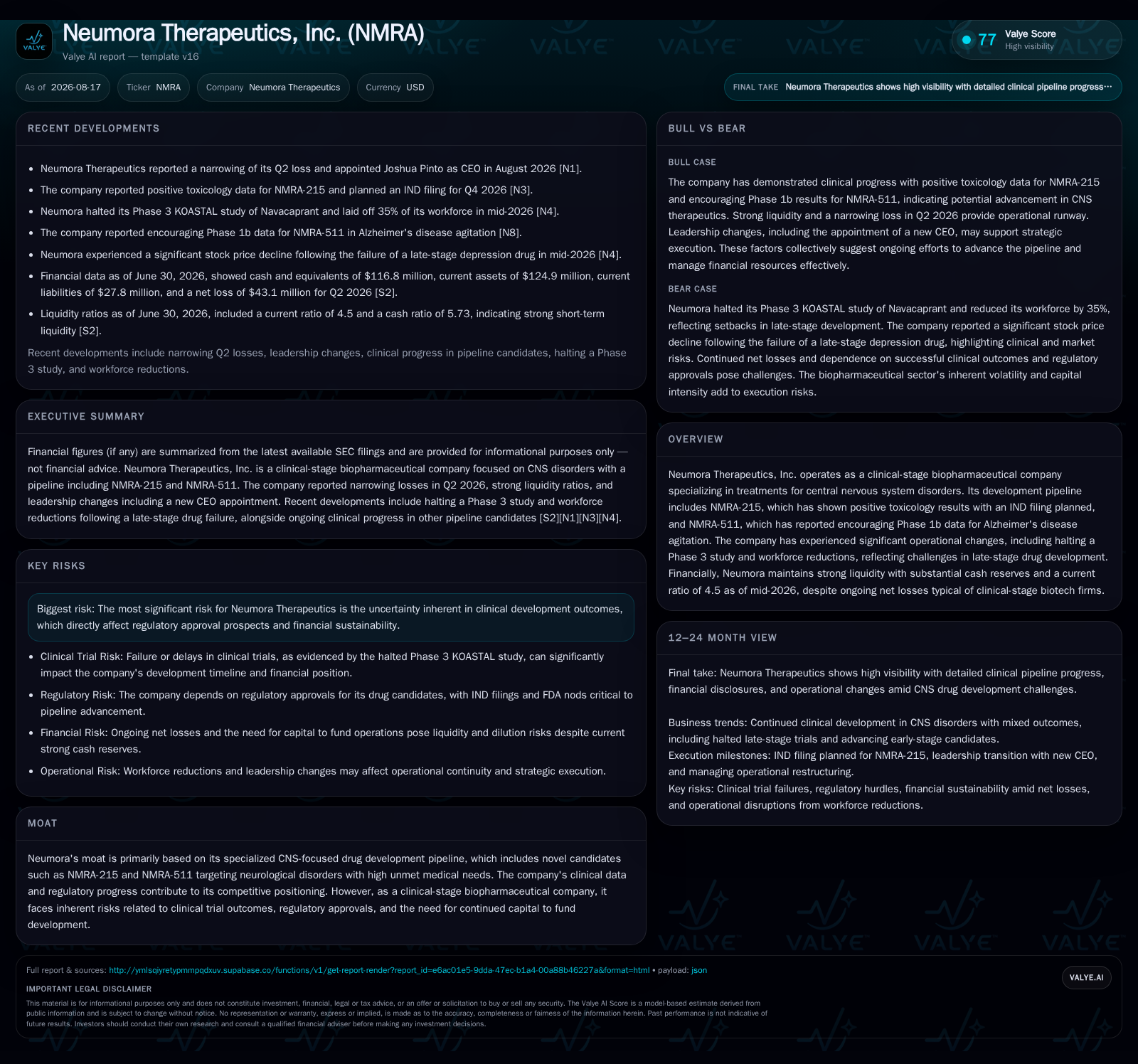
In its Q2 2026 filings, Neumora Therapeutics reported positive toxicology results for NMRA-215 with an anticipated IND filing in Q4 2026 alongside encouraging phase 1b data updates for NMRA-511 targeting Alzheimer's disease agitation. The company ceased its Phase 3 navacaprant program following unsuccessful outcomes and implemented workforce reductions to streamline operations. A leadership transition installed Joshua Pinto as CEO, signaling a focused clinical execution approach amid ongoing challenges typical for clinical-stage CNS biotechs. Neumora maintains a strong liquidity position with $117 million in cash and a current ratio of 4.5, supporting pipeline advancement through at least mid-2027.
Latest Clinical Milestones Shape Near-Term Potential amid Phase Trial Adjustments
Neumora Therapeutics’ Q2 2026 disclosures reflect important clinical progress tempered by late-stage trial setbacks. The company announced positive repeat toxicology study results for its NMRA-215 candidate, a central nervous system-targeted NLRP3 inhibitor designed for neurological indications beyond obesity [S2][S3][N3]. This key preclinical milestone enables an Investigational New Drug (IND) filing planned for Q4 2026, initiating formal clinical development. NMRA-215’s advancement demonstrates pipeline resilience following the halt of navacaprant's Phase 3 development after KOASTAL-2 and KOASTAL-3 studies failed to meet primary endpoints in major depressive disorder patients [S2][S3]. This termination triggered a workforce reduction of approximately 35%, aiming to cut annual costs by roughly $10 million while incurring one-time restructuring charges of about $2 million during the second quarter [S2][S3].
Parallel to these developments, NMRA-511 remains the focal point for Alzheimer’s disease agitation treatment efforts, having delivered encouraging Phase 1b data regarding safety, tolerability, and early signs of efficacy [S1][N1]. Upcoming phase activities include completion of higher-dose cohorts in healthy elderly volunteers expected in late 2026 followed by a Phase 2b dose-ranging study slated to begin by year-end [S25]. These milestones mark critical steps validating NMRA-511’s dosing strategy and informing registration trial designs.
The combined progress on NMRA-215’s preclinical gateway and NMRA-511’s clinical maturation solidify the near-term value inflection points amidst pipeline recalibration caused by navacaprant’s discontinuation.
Pipeline Focus: CNS Disorder Therapeutics Addressing High Unmet Needs with Novel Candidates
Neumora operates predominantly as a clinical-stage biopharmaceutical company developing therapies targeting central nervous system (CNS) disorders characterized by substantial unmet medical needs and sparse effective treatments. Its business model hinges on advancing novel molecules through preclinical validation to early- and mid-clinical studies towards regulatory submissions [S1].
NMRA-511 exemplifies this approach as a selective vasopressin V1a receptor antagonist aimed at mitigating agitation symptoms in Alzheimer’s disease—a notoriously challenging therapeutic area both clinically and regulatory-wise given heterogeneous patient populations and few available pharmacologic options. Its early-phase data affirm safety signals and provide groundwork for dose optimization that could yield differentiation over existing standard-of-care symptomatic treatments [S1][N1].
NMRA-215 extends the CNS portfolio through engagement with the inflammasome pathway (NLRP3 inhibition), implicated in neuroinflammation across multiple CNS conditions. Positive toxicology outcomes position it uniquely as an emerging candidate entering clinical testing imminently [N3]. Such targeting may confer intellectual property advantages and scientific defensibility crucial for navigating crowded pharmaceutical pipelines addressing neurological diseases.
The specialized focus on CNS disorders demands significant investment cycles marked by complex trial designs tailored to subtle efficacy signals and stringent safety monitoring—challenges that often lengthen timelines but also create barriers to entry supporting competitive moats.
Operational Reset: Leadership Change and Workforce Actions Signal Strategic Refocus
The firm enacted notable organizational changes concurrently with its Q2 publication of financial results. Joshua Pinto, Ph.D., previously serving as President, was appointed Chief Executive Officer effective August 14, 2026; former CEO Paul Berns transitioned to Executive Chairperson of the Board [S19][N1]. This leadership reshuffling typically signals intent to sharpen strategic priorities around pipeline advancement and operational efficiency.
In tandem, the June 2026 workforce reduction underscores an effort to re-align operational expenditure with revised pipeline prospects post-navacaprant discontinuation [S2][S3]. Such moves reflect common biopharma practices aiming to mitigate burn rate pressures amid costly phase transitions while preserving core scientific capabilities associated with priority assets.
These adjustments potentially reduce execution risk through clearer accountability structures while prolonging cash runway critical until pivotal readouts or licensing partners materialize.
Industry Context: Clinical-Stage Biotech Dynamics Around Trial Design, Regulatory Hurdles and Funding Patterns
As a clinical-stage biotech focusing on CNS therapeutics, Neumora navigates an environment defined by prolonged development cycles encompassing sequential trial phases: from IND submissions through phased human challenge studies illustrating safety/tolerability before advancing into efficacy-focused pivotal trials [S1]. Success requires meeting milestones such as IND acceptance by regulators, positive early-phase data releases validating biological hypotheses, efficient patient recruitment overcoming enrollment hurdles common in neurological indications, and ultimate regulatory approval predicated on statistically robust outcomes.
Liquid capital sufficiency is paramount given typically sustained net losses during these stages driven by high R&D expenses without product revenue offset [S1][N1]. Neumora's ability to sustain operations depends critically on managing burn rate relative to its cash reserves and securing additional equity or partnership financing as necessary—a scenario mirrored broadly across comparable CNS-focused biotechs balancing innovation complexity against investor capital appetite
Pricing power remains limited pre-commercialization; valuation primarily hinges on prospective milestone achievements reflected in regulatory filings or successful transition between trial stages.
Pathways for Growth: Unlocking Value from Advancing IND Filings and Positive Phase Data Releases
Upcoming catalysts identified by Neumora include the anticipated IND filing for NMRA-215 enabling entry into first-in-human studies targeted by end of 2026 [N3][S25]. The successful transition from toxicology verification to clinical testing remains a valued de-risking step increasing asset attractiveness for potential pharma partnerships or licensing agreements that can infuse non-dilutive capital.
Similarly, NMRA-511's ongoing dose escalation study completion in healthy elderly volunteers will guide subsequent pivotal Phase 2b trials crucial to establish dose-response relationships underpinning registration strategies [S25]. Early positive phase data thus act as signal events enhancing credibility with regulators, collaborators, and investors alike.
Additional pipeline candidates such as NMRA-898 (schizophrenia target) also possess scheduled interim reporting timelines further expanding potential inflection points in coming quarters [S25].
Strategic partnerships unlocked by demonstration of initial proof-of-concept evidence not only provide funding relief but validation contributing to competitive differentiation amid crowded CNS development landscapes.
Risks Ahead: Navigating Trial Outcome Uncertainties, Enrollment Challenges, and Capital Requirements
Neumora's operational environment is fraught with inherent biotech sector risks prominently featuring variability in clinical trial outcomes which can abruptly alter asset valuation trajectories—as evidenced recently by navacaprant's Phase 3 failure [S26][S27][N1]. Delays or difficulties in patient recruitment specific to neurological disease populations could elongate timelines escalating development costs further.
Regulatory review contingencies add uncertainty around approval pacing or labeling claims expansion critical for market adoption. Intellectual property disputes or manufacturing scale-up obstacles pose additional layers of potential disruption.
Financially, continuous negative operating income driven by R&D investment necessitates vigilant cash management combined with external fundraising dependent on capital markets receptivity or partnership deal flow—factors that could constrain strategic options if unmet [S26][S27]
"Signals to Monitor": Upcoming Milestones, Enrollment Updates, and Cash Flow Metrics in Focus
Key performance indicators warranting close observation include successful IND submission timing for NMRA-215 later this year signaling pipeline advancement capacity; progression updates from NMRA-511 dose-ranging cohorts demonstrating tolerability improvements; management commentary targeting patient recruitment efficiency indicative of enrollment pace; quarterly burn rate trends vis-à-vis disclosed liquidity levels providing runway visibility; alongside any new partnership announcements enhancing financial stability.
Disruptions or delays across these dimensions would elevate clinical execution risk premiums whereas timely milestone achievements could materially enhance project valuation prospects.
Financial Profile Discussion: Robust Liquidity Balances Ongoing Net Losses Typical of Clinical R&D Investments
Neumora closed Q2 2026 with approximately $117 million in cash and equivalents against total debt near $58 million yielding a net cash position of about $59 million and a strong current ratio approximating 4.5—parameters reflecting comfortable short-term liquidity supporting ongoing R&D activities into at least late third quarter of 2027 absent material adverse developments [F1]
Operating losses remain substantial consistent with deep early-stage investment cycles common among clinical biotechs, exemplified by reported operating income deficit exceeding $240 million year-to-date through December 31, 2025 [F1]. This negative profitability underscores reliance on financing events or partnerships prior to reaching commercial product launches.
Overall, Neumora's financial positioning currently supports its prioritized pipeline progression strategy emphasizing disciplined spend alongside scientific focus post-operational restructuring.
Disclaimer: This analysis synthesizes publicly available filings and news sources to provide an informational overview of Neumora Therapeutics’ business developments without offering investment advice or research views.
Disclaimer: This is research-only, informational analysis and not investment advice. It may include AI-generated interpretation and general industry context. Always verify important details using primary sources.

Comments