
Creative Realities Navigates Integration and Liquidity Challenges Post-CDM Acquisition
The company’s latest quarter highlights operational momentum tempered by financial sustainability risks amid industry evolution.
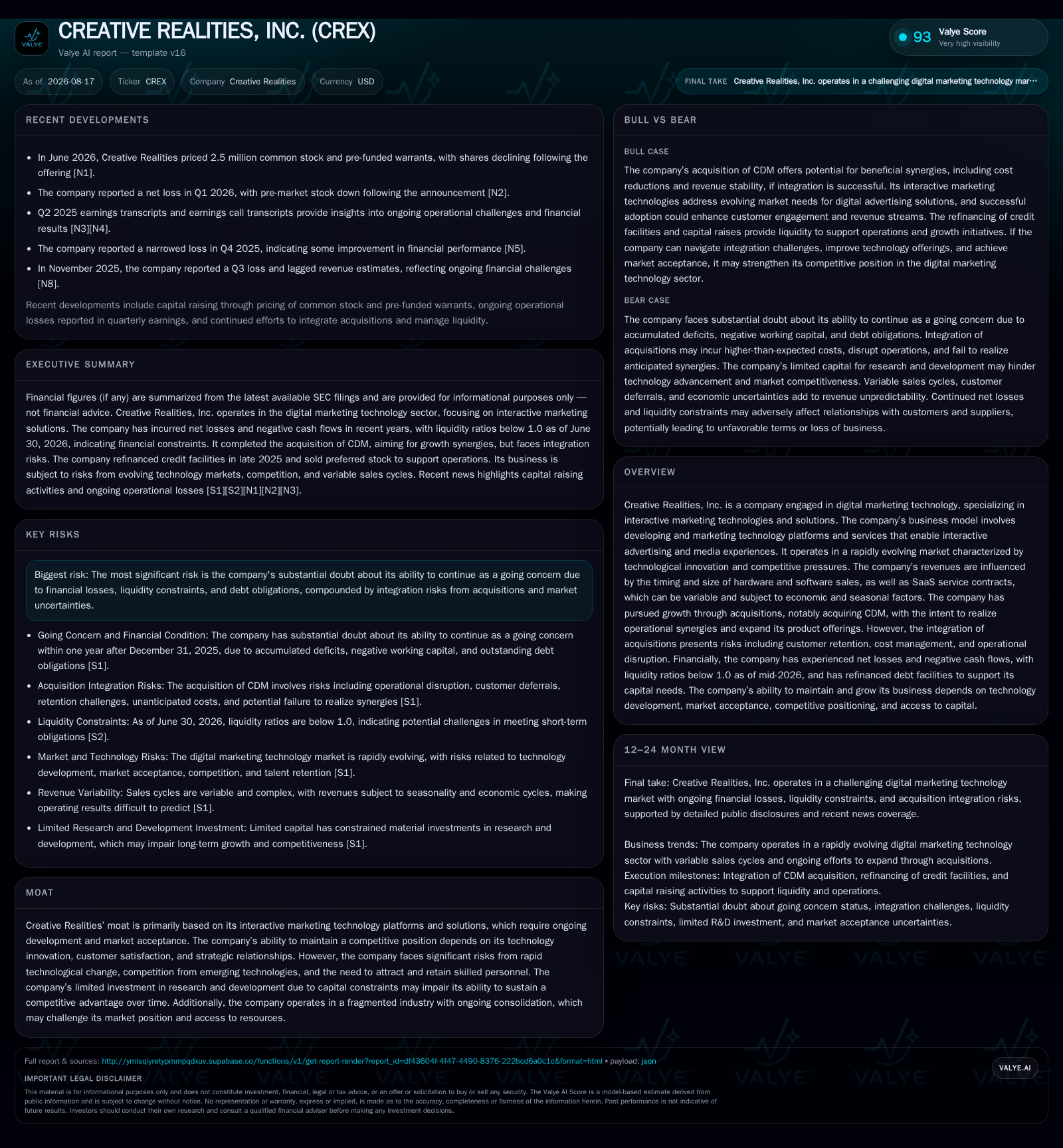
Creative Realities, Inc. released its Q2 2026 results showing revenue stabilization following the acquisition of Cineplex Digital Media (CDM). While operational synergies aim to expand product breadth and market presence in interactive marketing technologies, persistent financial losses and liquidity constraints cast substantial doubt on its going concern status. The balance between hardware sales and SaaS recurring revenue, alongside integration success, will be critical indicators to monitor in this evolving digital advertising sector.
Recent Operating Update
Creative Realities’ Q2 2026 preliminary results indicate revenue between $21 million and $23 million with an adjusted EBITDA margin approximating 10%. This marks steady operational performance following its late-2025 acquisition of Cineplex Digital Media (CDM), which expanded its interactive marketing technology footprint [S16], [S9]. The press release alongside the Q2 10-Q filing signals ongoing integration efforts aimed at leveraging CDM's installed base and product range to enhance Creative Realities' offering. However, full synergy realization is still aspirational amid execution complexity.
Business Model Overview
Creative Realities operates within the digital marketing technology sector by developing interactive advertising platforms combining hardware (digital signage devices) with software solutions including SaaS subscriptions and professional services. Revenue is driven through hardware sales—largely project and seasonally influenced—and recurring software licensing fees tied to platform use and content management capabilities. This mix inherently generates variability; hardware sales can be lumpy due to procurement cycles, while SaaS provides more predictable cash flows contingent on customer retention and platform utilization rates [S1]. The company monetizes through direct sales contracts with brands, retailers, media companies, and agencies seeking multi-device customer engagement.
The integration of CDM broadens Creative Realities’ geographic reach and service scope but introduces operational risks such as retaining acquired customers amid platform consolidation and managing incremental costs without diluting margins. Their growth pivot relies on enhancing AI-driven features within their platforms to create personalized customer experiences that stand out against competitors offering programmatic ad tech or advanced analytics capabilities.
Industry Structure and Competitive Position
Creative Realities occupies a niche as a technology provider offering both digital signage hardware and interactive marketing SaaS solutions — a combination placing it at the intersection of device manufacturing and software development within a fragmented industry landscape. Peers typically specialize heavily either in SaaS-based marketing platforms or hardware production; Creative Realities' blend could provide cross-selling leverage if managed effectively.
The sector undergoes rapid innovation cycles with new entrants leveraging artificial intelligence for targeted advertising and programmatic capabilities that improve ROI measurement. Larger platform providers often benefit from scale economies enabling higher R&D budgets; Creative Realities’ comparatively limited investment due to capital constraints may challenge its competitive edge over time [S1]. Customer retention metrics, although not disclosed here, are pivotal benchmarks in evaluating platform relevance amid aggressive competition.
Growth Drivers
Growth prospects hinge on multi-pronged factors: increasing market adoption of interactive marketing solutions across retail chains and public venues; expansion in digital signage installations which enable experiential branding; growth in recurring SaaS revenues supported by subscription models enhancing lifetime value; AI integration lifting platform personalization thus user engagement; and the potential operational synergies post-CDM acquisition enhancing distribution efficiency.
Cross-device campaign management fueled by data analytics also meets rising demand for measurable advertising spend impact. Consolidation trends may grant Creative Realities opportunities to acquire complementary assets or customers but also elevate pressure to deliver cost savings rapidly. Continuous innovation targeting seamless platform integration with clients’ existing CMS environments will drive adoption rates.
Risks and Constraints
Primary risk centers on substantial doubt regarding the company's ability to continue as a going concern given historical losses, negative cash flow trends, high leverage nearing $47 million versus modest cash reserves near $10.7 million (net debt about $36 million), low current ratio at 0.9 highlighting liquidity tightness without near-term recapitalization [F1], [S24]. This precarious balance constrains R&D investments necessary for technology advancement.
Integration of CDM brings execution risks including potential disruption to service delivery, employee turnover impacting institutional knowledge especially in engineering roles critical for platform innovation, and customer attrition risking revenue erosion [S1], [S9]. The company must also navigate accelerated industry innovation where failure to update features or match AI-driven targeting could result in competitive displacement.
Economic variability affects hardware sales seasonality impacting overall revenue visibility. Further regulatory developments around data privacy in digital advertising might impose compliance costs or limit certain targeting functionalities. Capital raising efforts may face obstacles given tighter credit markets noted earlier [S25]. All these elements collectively pose ongoing operational challenges.
What To Watch Next
Key indicators include monitoring quarterly revenue composition shifts between one-time hardware deployments versus recurring SaaS income—stronger ARR growth would evidence improving sales mix quality. Observation of customer retention rates through churn disclosures would clarify platform stickiness under competitive pressure.
Tracking announcements related to achieving stated operational synergies from CDM acquisition—in both cost control outcomes and cross-selling—is vital for validating expansion strategy efficacy.
Finally, any updates on product roadmap focusing on AI integration depth could signal enhanced differentiation potential crucial for long-term market acceptance.
Financial Profile Discussion
As of June 30, 2026, Creative Realities held approximately $10.7 million in cash against total debt obligations around $47 million, resulting in significant net leverage (~$36 million) [F1]. Current assets stood at approximately $34.9 million trailing current liabilities at roughly $38.6 million yielding a below-par current ratio of 0.9—indicative of short-term liquidity concerns [F1]. This financial setup reinforces ongoing doubts expressed by auditors regarding the company’s ability to operate continuously without securing additional funding or improving profitability substantially [S24].
The company’s refinancing moves in late 2025 incorporated term loans and revolving credit facilities with covenants limiting further leverage escalation but heightening pressure on meeting coverage ratios promptly [S14], [S25]. Future capital raises will likely dilute existing shareholders but appear imperative barring a swift turnaround.
This analysis synthesizes publicly available filings without providing investment research views or price guidance. It aims to contextualize Creative Realities’ operating dynamics within the evolving digital marketing technology sector based on verified company disclosures.
Disclaimer: This is research-only, informational analysis and not investment advice. It may include AI-generated interpretation and general industry context. Always verify important details using primary sources.

Comments