
Live Oak Acquisition Corp. V Advances Through De-SPAC Merger With Operational and Refinancing Challenges
Post-merger SME acquirer Teamshares shows growth from acquisitions but confronts refinancing risks that question sustained expansion.
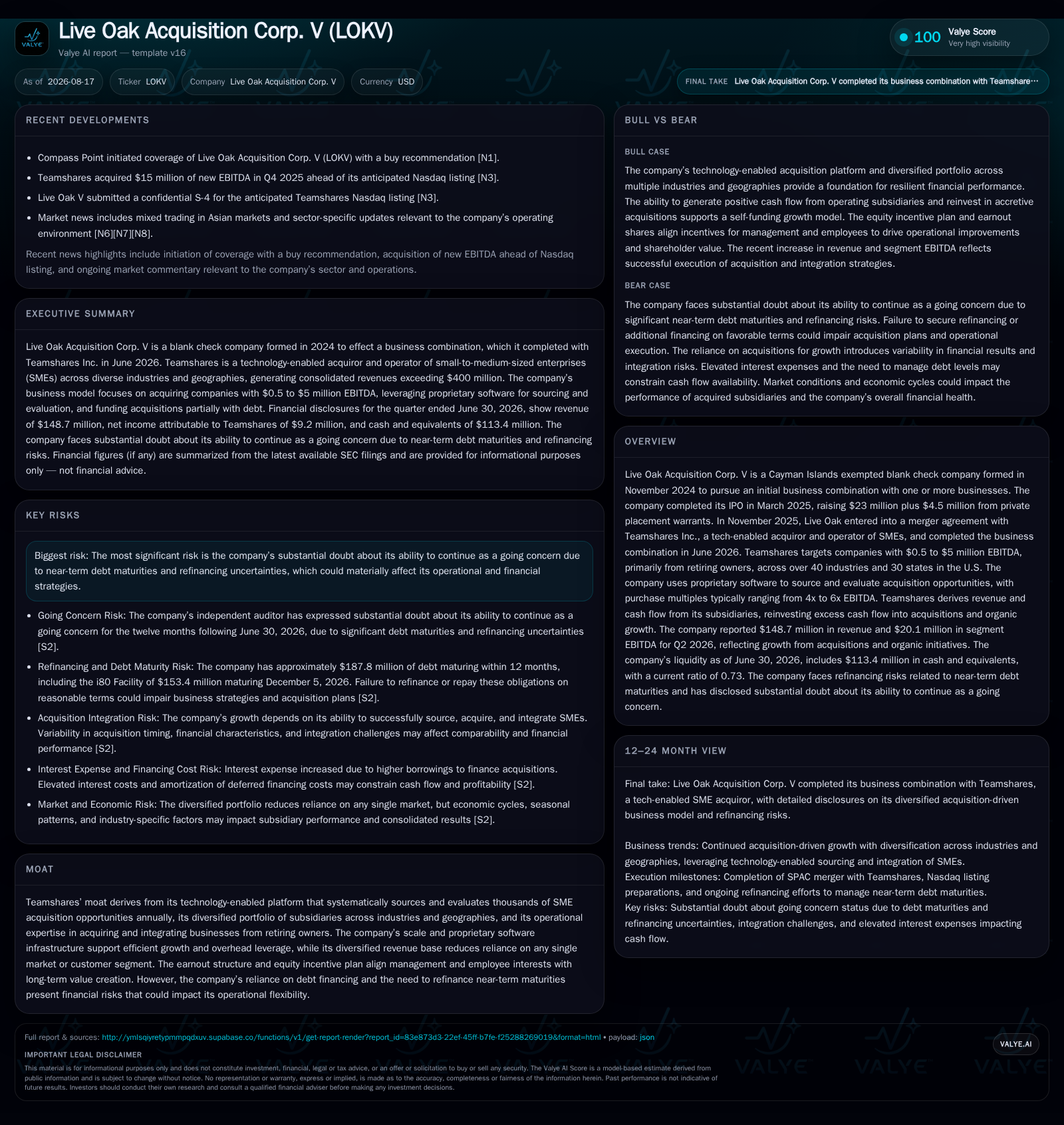
Live Oak Acquisition Corp. V consummated its de-SPAC merger with Teamshares Inc. in June 2026, transitioning from a blank-check vehicle to an operating public company with diversified SME subsidiaries. Teamshares leverages proprietary software to source small-to-medium enterprise acquisitions from retiring owners, focusing on companies with $0.5 million to $5 million EBITDA at purchase multiples of 4x to 6x EBITDA. Recently reported results show revenue growth driven by acquisitions and moderate organic gains, accompanied by margin improvement due to portfolio optimization. However, the company faces substantial going-concern uncertainty amid near-term debt maturities totaling nearly $188 million by end-2026 and challenges refinancing its primary $153 million i80 Facility. Capital availability constraints could impact acquisition cadence and operational agility, placing emphasis on successful refinancing milestones and operational cash flow generation for sustainable growth.
Recent Operating Update: Transition from SPAC to Operating Public Company
Live Oak Acquisition Corp. V completed its initial business combination with Teamshares Inc., a technology-enabled acquirer and operator of small-to-medium enterprises (SMEs), on June 18, 2026, marking its transition from a Cayman Islands exempted blank check company into an operating public entity [S2]. The transaction followed Live Oak’s IPO in March 2025 that raised $23 million plus $4.5 million from private placement warrants [S1]. Post-merger, Teamshares operates subsidiaries primarily acquired from retiring owners with target EBITDA ranging between $0.5 million and $5 million at typical purchase multiples of four to six times EBITDA [S2].
The merger positions Live Oak within the mid-market SME acquisition landscape, where operational expertise and technology-driven sourcing are fundamental competitive advantages. Teamshares’ proprietary software platform evaluates thousands of acquisition opportunities annually across over 40 industries and approximately 30 U.S. states, enabling diversified exposure that reduces reliance on any single market sector or economic cycle [S2]. This scale and diversification underline a strategic moat by mitigating concentration risks often seen in SME platforms.
Business Model: Technology-Enabled SME Acquisitions Driving Revenue via Subsidiary Cash Flows
Teamshares generates revenue indirectly through the operational results of its portfolio companies rather than from direct sales pre-business combination. Post-merger financial performance is consolidated from operating subsidiaries engaged in varied product sales and service offerings predominantly within the U.S. The company’s monetization model hinges on acquiring cash-flow positive SMEs that produce earnings converted into subsidiary-level cash flow streams.
Revenue drivers include both organic growth initiatives within subsidiaries—such as increasing sales volumes—and inorganic growth through further acquisitions funded by a mix of equity and debt capital [S2]. The firm systematically upstreams excess free cash flow from subsidiaries to reinvest in new acquisitions or augment existing businesses, creating a compounding flywheel effect for scale and margin enhancement [S14].
Gross margins have exhibited improvement — rising to approximately 41% for the six months ended June 30, 2026 versus 39% for the comparable period last year — primarily due to acquiring businesses with historically higher gross margins than legacy portfolio components as well as divestiture or cessation of lower-margin subsidiaries [S10]. However, operating income remains negative at the consolidated level because corporate platform costs—including investments in proprietary technology infrastructure—exceed individual subsidiary profits at this stage of scaling [S8].
Key operational KPIs include acquisition cadence measured by the number and EBITDA profile of acquired companies, post-acquisition integration success facilitating overhead leverage gains via shared services automation, retention rates of key subsidiary leadership personnel post-ownership transitions, gross margin trends across the overall portfolio mix, and consolidated segment EBITDA progression normalized for acquisition timing effects [S19]
Industry Context: SPAC Lifecycle Completed; Operationally Active Mid-Market SME Platform Emerges
Within the broader SPAC ecosystem, Live Oak represents a classical flow wherein capital was raised via an IPO to fund a business combination timed within an approximately two-year window mandated by governance documents. Unlike many SPACs lingering in shell status until late-stage combination announcements or facing liquidation risk due to unmet deadlines, Live Oak consummated its de-SPAC transaction promptly in mid-2026 after executing its initial business combination agreement in November 2025 with amendments extending negotiation periods as needed [S1][S2]
Teamshares fits within the mid-market roll-up archetype propelled by technology-enabled deal sourcing—a growing theme contrasting traditional private equity approaches reliant more heavily on manual origination pipelines or concentrated industry focus. Peer groups include other small-cap enterprise aggregators albeit many remain private equity-backed rather than public after SPAC transitions.
The capability to identify thousands of potential SME targets annually sets Teamshares apart structurally versus smaller acquirers constrained by limited deal flow visibility or more geographically concentrated operations. This scale reduces dependence on sporadic deal availability while allowing selective focus on firms that tightly match criteria: owner retirement-driven deals offering stable cash flows at reasonable purchase multiples [S2]. This approach aligns with longer-term strategic imperatives to build resilient recurring revenue bases underpinned by diversified sources rather than patchwork portfolios vulnerable to idiosyncratic shocks.
Growth Drivers: Acquisition Pipeline Strength and Platform Scale Versus Refinancing Needs
The principal growth engine is inorganic expansion — selectively acquiring SMEs at attractive multiples supplemented by integrating them swiftly into Teamshares’ tech-enabled platform to capture efficiencies and incremental cash flow synergies [S14][S19]. The pipeline is robust given the proliferation of retiring owner entrepreneurs seeking exit opportunities absent strategic buyers or larger PE appetite at these enterprise sizes.
Organic growth complements this via marketing enhancements at subsidiary levels targeted toward specific industry verticals or customer segments expanding revenue volume beyond baseline acquired book-of-business metrics.
Financial capacity shapes achievable growth rates materially [S8][S15]. Teamshares’ ability to fund future acquisitions relies heavily on accessing debt capital markets efficiently as well as opportunistically issuing equity or equity-linked securities aligned with shareholder value outcomes during public market windows
Other growth enablers include leveraging proven management incentives such as earnout shares aligning subsidiary leadership retention and performance with incorporation success metrics; sustained investment in backend technology platforms reducing per-unit operating costs; ongoing capital recycling through divestment of subscale or underperforming operations; and geographical/industry diversification mitigating cyclical downturns within any one sector.
Risks and Watchpoints: Going Concern Doubts Amid Significant Near-Term Debt Maturities
Despite operational progress post de-SPAC merger, Teamshares faces significant financial headwinds centered around refinancing pressure underscored by auditor-expressed substantial doubt regarding its ability to continue as a going concern over the next twelve months following June 30, 2026 filing dates [S2]. Key near-term maturities total approximately $188 million due primarily by December 2026—including roughly $153 million outstanding on the i80 Facility—with no remaining borrowing capacity under it currently available [F1][S6][S15].
This debt load represents nearly 2.5x cash on hand ($113 million) and contributes to a working capital deficit reflected in a current ratio below unity (0.73), signaling short-term liquidity pressures potentially constraining operational flexibility including timely acquisition closings or necessary capital investments [F1]
Management continues active discussions with lenders but has only obtained non-binding term sheets without binding commitments so far. Failure to successfully refinance or secure alternative funding sources could force reduced acquisition discipline—potentially delaying or downsizing deal activity—or trigger distress-driven restructurings adversely affecting shareholder value creation plans [S9][S15].
Additional risks arise related to potential dilution if subsequent equity raises become necessary under unfavorable market conditions; integration risks inherent in fast-paced SME roll-ups including cultural mismatches or leadership attrition; fluctuations in acquisition target valuations impacting purchase price multiples; and macroeconomic volatility potentially dampening customer demand across portfolio industries impacting subsidiary revenues unexpectedly.
What To Watch Next: Refinancing Milestones and Acquisition Activity Metrics
Critical upcoming indicators will include definitive documentation execution for proposed warehouse credit facilities aimed at stabilizing near-term acquisition funding capabilities as announced August 2026 [S6][S9]. Progress toward refinancing or extending the maturing i80 Facility is pivotal given its large principal balance due before year-end.
Operationally, monitoring acquisition volume alongside associated EBITDA contribution increments will clarify whether increased capital access translates effectively into portfolio profitability gains consistent with stated platform leverage objectives. Incremental quarterly gross margins approaching or exceeding recent runs of ~41%-47% among acquired businesses will validate continued portfolio quality improvement efforts.
Retention statistics for newly integrated subsidiary leadership teams alongside changes in corporate overhead relative to scaled revenues/purchase multiples will provide insight into unfolding integration efficiencies critical for long-cycle value creation models typical in multi-step aggregation strategies like Teamshares’. Additionally, any significant variance in redemption rates among original Live Oak public shareholders tied to initial share tender offers could influence available equity capital reserves upon future business combination extensions if required.
Financial Profile Discussion
As of June 30, 2026, Live Oak/Teamshares held approximately $113 million in cash and equivalents alongside $12 million restricted cash earmarked for debt service reserves and self-insurance programs—a meaningful liquidity buffer but moderate when weighed against total debt obligations nearing $286 million including short- and long-term tranches resulting in net debt around $173 million [F1][S8]. The current ratio stands at approximately 0.73 reflecting working capital pressures given higher current liabilities ($289 million) relative to current assets ($211 million) [F1].
Interest expenses increased year-over-year driven largely by higher average borrowings related to acquisitions bearing interest rates averaging about 14.7% on legacy credit facilities including i80—the highest-cost component expected targeted for reduction upon successful refinancing initiatives which management anticipates could lower interest costs commensurate with improved credit profile supported by equity proceeds from the SPAC merger transaction [S17][S8].
Net cash used in operating activities improved by $22.5 million for the six months ended June 30, 2026 compared to the same period in 2025, reflecting higher earnings contributions from recently acquired subsidiaries and favorable working capital movements; however, operating cash flows remain negative due principally to elevated corporate investment levels aimed at scaling platform capabilities rather than indicating mature free cash flow generation typical at later roll-up phases [S2]
In summary, while underlying operational metrics indicate progressing commercial momentum and portfolio quality enhancement post-merger alignment with Live Oak's initial intent as a blank-check vehicle transitioning toward an active platform operator model; substantial financial uncertainties centered upon refinancing execution timelines create material risk factors critical for sustaining growth trajectories beyond near-term horizons.
This analysis is based solely on publicly available SEC filings dated up through August 14, 2026 ([S1]-[S27]) combined with known industry structure relevant to Special Purpose Acquisition Companies completing de-SPAC transactions focusing on mid-market SME platforms. No investment advice is offered.
Disclaimer: This is research-only, informational analysis and not investment advice. It may include AI-generated interpretation and general industry context. Always verify important details using primary sources.

Comments