
First Carolina Financial Services Capitalizes on Strong Liquidity and Emerging Growth Opportunities
Fresh quarterly disclosures reveal a well-capitalized regional bank newly public, undertaking executive realignments to accelerate growth amid competitive and regulatory pressures.
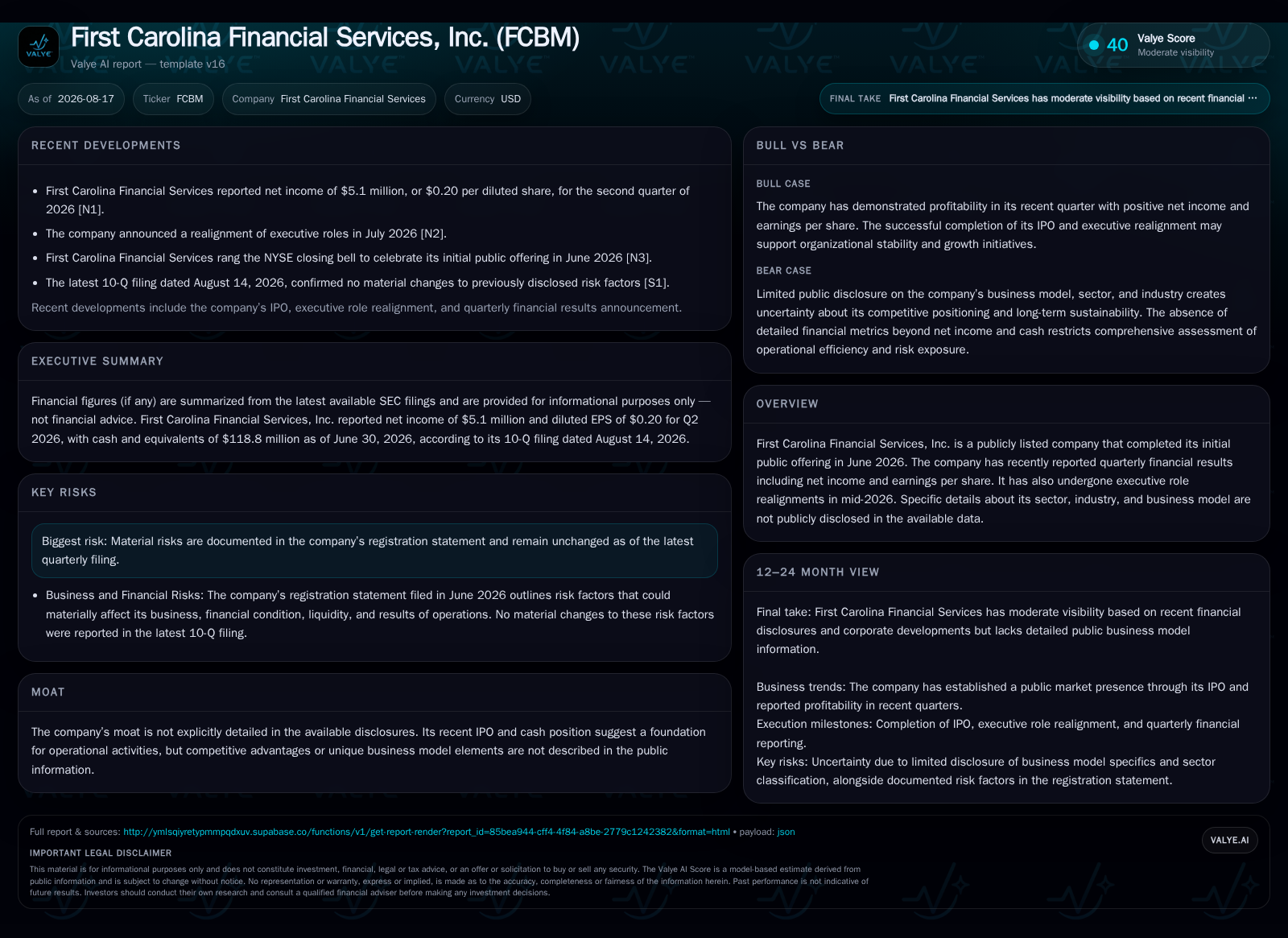
First Carolina Financial Services, having completed its IPO in June 2026, reported a solid second quarter with $5.1 million net income supported by a strong cash position surpassing debt levels. Recent executive role shifts hint at strategic refinement as the bank seeks to scale loan and deposit growth in a challenging regional banking landscape. Key risks remain consistent with initial registration filings, particularly credit quality and interest rate volatility. Monitoring loan portfolio expansion, deposit base evolution, and margin trends will be critical to gauge the company’s trajectory in this early post-IPO phase.
Post-IPO Operational Snapshot Underpinned by Strong Liquidity Position
First Carolina Financial Services stepped into the public markets with its June 2026 IPO raising approximately $68.75 million gross proceeds, setting a robust liquidity foundation crucial for regional banking operations [S8]. The subsequent second-quarter results announced in July report net income of $5.1 million or $0.20 per diluted share, marking an early demonstration of profitable operations in a typically capital-intensive financial intermediation business [N1], [F1]. On the balance sheet front, the company holds $118.8 million in cash and equivalents against $50 million of debt as of June 30, 2026 – a net cash position providing tangible flexibility to support loan originations without immediate pressure to raise funding externally or disrupt leverage targets [F1]. This capital structure sits well within the expected range for emerging regional banks seeking growth post-IPO.
Liquidity strength is paramount given the role regional banks play as intermediaries between retail/commercial depositors and borrowers, where maintaining a stable deposit base funds loan portfolio expansion that generates net interest income. The bank’s ability to deploy fresh capital towards higher-yielding loans while managing funding costs will materially affect near-term earnings trajectories.
Early Executive Realignments Signal Strategic Priorities Shift
In mid-July 2026, First Carolina Financial publicly announced executive leadership realignments signaling a pragmatic shift or acceleration in strategic focus post-IPO [N2], [S3]. Though specifics are limited, such changes typically reflect responses to operational scaling challenges or market opportunities like digital product adoption or refined customer segmentation within regional banking. Given industry norms, management reshuffles may aim at enhancing lending efficiency, bolstering deposit acquisition strategies, or strengthening risk management frameworks.
This concerted focus could also prepare the bank for competitive pressures from fintech entrants and larger peers optimizing omnichannel customer service. Tracking future disclosures on these leadership changes’ operational impacts will shed light on execution capabilities crucial for transitioning from start-up phase capital deployment toward sustainable financial services growth.
Deconstructing Revenue Engines: Loan Growth, Deposits, and Margin Pressure
While First Carolina Financial does not yet disclose detailed segment KPIs such as net interest margin (NIM), loan growth rates, or deposit rate dynamics explicitly in this early stage [S2], the underlying revenue mechanics align with typical regional banking models. Revenue primarily arises from interest received on loans less interest paid on deposits (net interest income), supplemented by fee income linked to account services or wealth management offerings when scaled.
Profitability depends heavily on sustaining an efficient spread between earning asset yields and cost of funds along with controlling credit losses through vigilant underwriting. Stable or improving NIM amidst recent volatile interest rate environments would suggest good asset-liability management and pricing power over deposits; conversely, deposit competition can elevate funding costs squeezing margins.
Growth in loan portfolios funded by expanding deposit bases is essential feedback for validating business model scalability. Without disclosed granular data yet available beyond total net income metrics [F1], investors should monitor future updates on loan balances and deposit trends as leading indicators.
"Embedded Risks": Credit Quality and Regulatory Vigilance in Early Stage Operations
Risk disclosures remain consistent with those presented in the June 2026 registration statement without material amendments during Q2 2026 reporting periods [S7]. As a nascent public financial entity amplifying lending activities, credit risk poses a perennial threat given potential borrower defaults especially if economic headwinds intensify locally or nationally. Although specific provisioning levels are not detailed yet publicly, maintenance of adequate allowance for loan losses remains critical to cushion earnings volatility.
Regulatory capital requirements also demand attention given the dual need to support growth while ensuring capital adequacy ratios meet thresholds set by banking regulators – particularly relevant since IPO proceeds constitute part of tier 1 capital base augmentation. Interest rate risk arising from fluctuating rates can impact net interest margin unpredictably affecting earnings consistency.
Ongoing adherence to regulatory mandates around liquidity coverage ratios further underscores importance of managing short-term funding adequacy vis-à-vis asset maturities. Prudence across these risk domains is essential given limited operating history as a public company.
"Positioning Against Regional Peers": Competitive Context within the Mid-Tier Banking Landscape
Without explicit peer comparisons from the company itself, it is apt to frame First Carolina Financial within the qualitative landscape alongside established regional banks like Regions Financial Corporation or Fifth Third Bancorp that operate at greater scale with diverse branch networks and broader fee income sources. These incumbents benefit from entrenched customer bases and infrastructure that drive operating efficiencies.
For newer entrants like First Carolina Financial, competitive challenges encompass achieving scale economies amidst elevated marketing expenses to grow deposit franchises while investing in digital platforms increasingly demanded by customers. Deposit pricing discipline becomes pivotal given alternative savings vehicles offered by non-bank fintech providers potentially eroding traditional retail deposits.
Moreover, tightening regulatory scrutiny requires balancing innovation investments with compliance cost structures. Without disclosed moats or industry-differentiating factors at this juncture, competition will likely focus on local relationship banking enhanced by technology adoption honoring evolving consumer behavior.
"Growth Drivers" Grounded in Economic Expansion And Product Diversification Potential
Growth prospects hinge critically on economic vitality across the regions served by First Carolina Financial as typical regional banking demand correlates strongly with commercial activity and residential lending environments. The company’s strong post-IPO liquidity supports loan portfolio expansion initiatives which are fundamental revenue generators if underpinned by disciplined underwriting standards that preserve asset quality.
Concurrent emphasis on broadening customer deposit bases can lower funding costs supporting margin improvement while accumulating transactional fee income streams from diversified financial product offerings provides incremental revenue beyond core lending spreads.
The recent executive realignment potentially signals intent to accelerate digital transformation efforts that have become key enablers in extending outreach beyond brick-and-mortar channels – an increasingly vital tool to capture younger demographics and improve retention metrics within retail segments [N2]
Market conditions favoring rising rates could enhance net interest margins temporarily; however this benefit depends on lag effects between re-pricing deposits versus loans alongside active balance sheet management.
"Risks Ahead": Interest Rate Volatility and Emerging Credit Uncertainty Challenges
Among primary risks outlined consistently are credit cycle fluctuations that directly impact provision for credit losses which if underestimated could materially impair reported earnings [S7]. Volatility in interest rates introduces uncertainty into margin forecasting as rapid hikes might increase cost of funds faster than corresponding loan yield adjustments especially if fixed-rate assets dominate.
Furthermore, regulatory capital requirements impose constraints limiting aggressive growth if risk-weighted assets outpace allowable buffers necessitating either capital raises dilutive to equity holders or slower asset buildout – challenging optimal profit maximization plans typical for emerging regional banks.
Competition intensity from both traditional banks and emerging fintech entities creates additional pressure points affecting pricing power over both deposits and loans requiring agile responses in product design and distribution capabilities.
"Signal Watch": Key Metrics And Milestones To Validate Early Trajectory
Looking ahead into upcoming quarters, several quantifiable markers will provide clarity on whether First Carolina Financial’s early promising results crystallize into durable momentum. Close tracking of sequential quarterly loan growth rates could signal effective deployment of existing liquidity towards earning assets while deposit growth figures will indicate success in stabilizing low-cost funding bases.
Return on assets (ROA) and return on equity (ROE) evolution serve as integrated profitability barometers reflecting operating leverage amid scaling phases; upward trends here would validate the strategic path following leadership adjustments documented earlier [N2], [S2].
Additionally monitoring non-performing loan ratios or any shifts in provisions for credit losses would shine light on asset quality trajectory informing balance sheet health assumptions foundational for sustained investor confidence.
Transparency around fee income diversification metrics tied to cross-selling efforts would complement analysis but remains forthcoming at this nascent stage.
Overall, meaningful progress along these KPIs will collectively confirm whether the company transitions successfully from an IPO-related capital infusion phase into an autonomous regional financial institution capturing sustainable franchise economics.
Disclaimer: This is research-only, informational analysis and not investment advice. It may include AI-generated interpretation and general industry context. Always verify important details using primary sources.

Comments