
Dragonfly Energy Leverages Dry-Electrode Tech and OEM Partnerships Amid Financial Constraints
Dragonfly Energy’s proprietary manufacturing and strategic market focus underpin growth despite capital-intensive challenges.
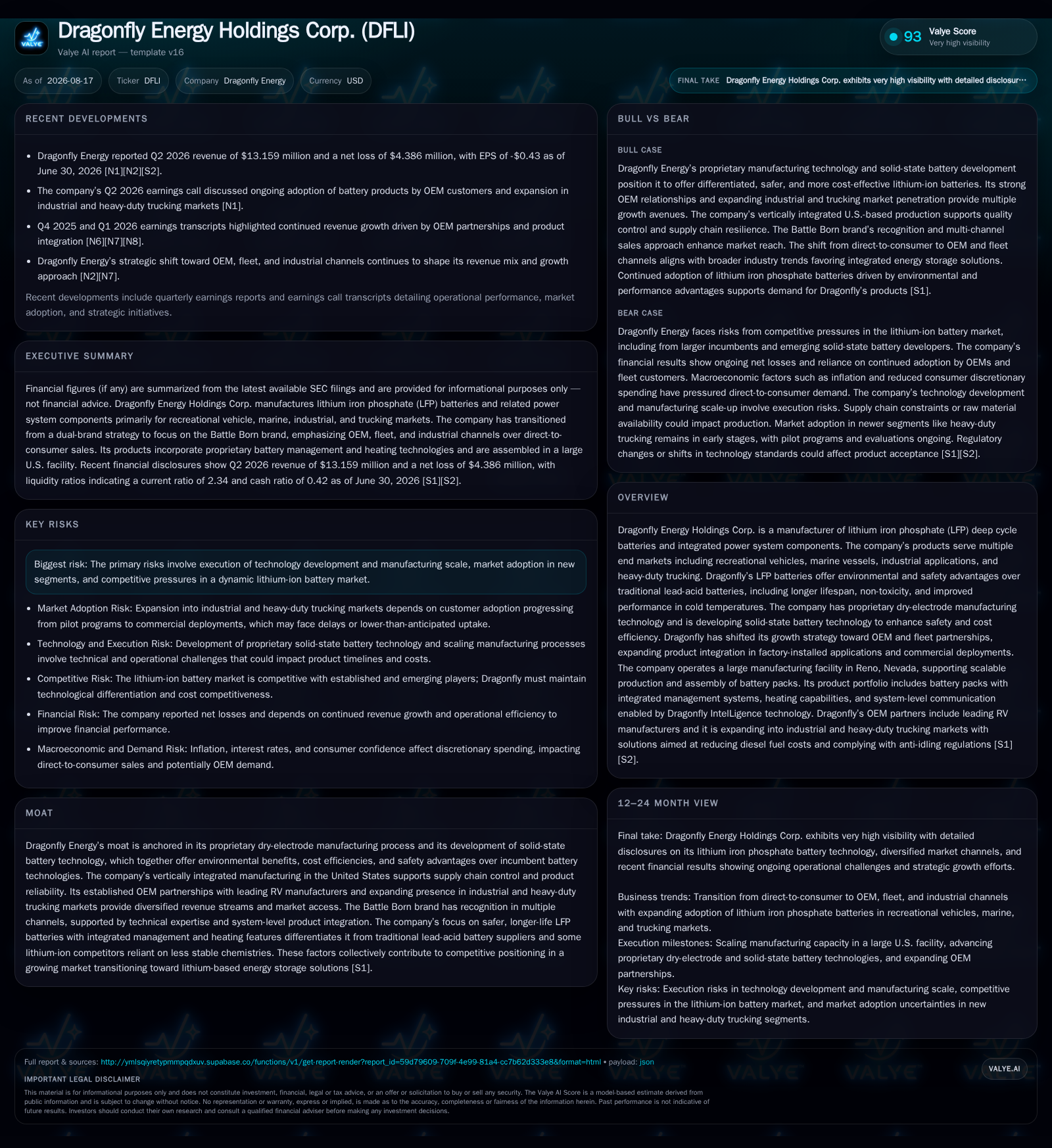
Dragonfly Energy Holdings Corp. continues to emphasize its lithium iron phosphate (LFP) battery production powered by its patented dry-electrode technology, targeting OEMs and fleet deployments in recreational vehicles, marine, industrial, and heavy-duty trucking markets. The latest quarterly update shows no material changes in risk factors but highlights ongoing operational cost reductions and strategic shifts toward commercial channels from direct-to-consumer marketing. The company remains capital constrained with modest liquidity and manageable debt, reflecting typical execution risks associated with scaling advanced battery manufacturing and solid-state technology development. Key growth drivers include expanding OEM content and penetration into emerging industrial applications, while risks center on technology scale-up, supplier concentration, and competitive intensity.
Recent Operating Update
Dragonfly Energy Holdings Corp.'s latest quarterly filing (10-Q dated August 14, 2026) confirms the continuation of prior risk factors without any material changes [S2]. This signals management confidence that previously disclosed execution challenges—especially around manufacturing scale-up and supply chain dependencies—remain the primary concerns rather than new unforeseen issues. Concurrently, a strategic cost realignment program initiated earlier this year has begun delivering tangible savings estimated at $8.9 million annually through a combination of targeted workforce reductions, executive salary cuts (approximately 20%), discretionary spending decreases particularly in direct-to-consumer marketing, and consolidation of leased facilities yielding approximately $4 million in expense mitigation [S8][S9]. This reinforces management’s pivot to prioritizing financial discipline while investing selectively in commercial channel expansion.
Additionally, an August 6, 2026 earnings announcement highlighted preliminary Q2 financials alongside management commentary underscoring steady progress in OEM penetration within recreational vehicles (RVs), marine vessels, industrial equipment, and heavy-duty trucking sectors [S3][N1]. The earnings call transcript further emphasized that revenue expansion is expected from increasing system content per unit as well as from broader commercialization of integrated power system components
Business Model Analysis
Dragonfly Energy specializes in the manufacture and assembly of lithium iron phosphate (LFP) deep cycle batteries complemented by integrated system-level components such as battery management systems (BMS), heating elements for cold-temperature performance, and proprietary communication platforms branded Dragonfly IntelLigence® [S1]. The core product offering comprises LFP battery packs optimized for end-markets where safety, long cycle life, and environmental considerations are critical—namely RVs, marine vessels, industrial applications, and emerging heavy-duty truck electrification.
A key differentiator stems from Dragonfly’s proprietary dry-electrode manufacturing process—a patented cell production method that substitutes conventional wet-coating slurry processes with solvent-free dry powder deposition. Third-party assessment validates this approach reduces energy consumption during manufacturing by approximately 71%, shrinks factory footprint by about 22%, and lowers carbon emissions versus industry norms due to eliminating toxic solvents like N-Methyl-2-pyrrolidone (NMP) [S18]. This positions Dragonfly to leverage vertical integration opportunities by progressing from an LFP cell pack assembler to a cell manufacturer capable of producing diverse chemistries more cost-effectively.
Revenue flows primarily through OEM partnerships where Dragonfly custom-engineers battery systems specified for factory installation in new vehicles or vessels [S1]. These contractual relationships often embed value beyond mere pack sales: they include integrated BMS technologies and complementary power electronics which increase per-unit system content—a key driver for revenue growth. The company also serves distributor networks, fleets adopting electrification technologies for operational efficiencies or regulatory compliance benefits, and maintains direct-to-consumer aftermarket sales under its Battle Born® brand
Industry Structure and Competitive Positioning
Within the lithium-ion battery manufacturing sector focused on energy storage systems for transportation and industrial markets, Dragonfly competes against incumbent lead-acid suppliers transitioning customers towards LFP chemistry due to superior safety profiles and lifecycle economics. Moreover, other lithium-ion specialists supplying nickel-cobalt chemistries push higher energy density batteries but with tradeoffs in thermal stability and raw material sourcing concerns.
Peer groups include established large-scale battery makers like CATL focused on high-volume automotive cells as well as startups such as QuantumScape pursuing advanced solid-state technologies aiming to leapfrog current limitations. Against these peers, Dragonfly’s moat is anchored in its combination of dry-electrode manufacturing innovation—promising lower capital intensity and improved sustainability—and a targeted go-to-market strategy emphasizing tightly integrated OEM systems targeting niche end-users requiring rugged durability and safety.
The company’s ongoing R&D investments towards solid-state lithium-ion batteries signal an aspiration to capture emerging market demand for safer cell chemistries with enhanced cost structures; however technological development risks remain acute given the industry-wide challenges in scaling such next-generation cells commercially [S1][S14]. Supply chain risk is accentuated by reliance on limited suppliers for LFP cells and BMS components which could disrupt production if not mitigated through vertical integration or alternative sourcing.
Growth Drivers
Fundamental demand drivers for Dragonfly include accelerating electrification trends within recreational vehicle manufacturing driven by consumer preference shifts coupled with regulatory support favoring low-emission solutions. Similarly, marine vessel operators increasingly seek non-toxic batteries with extended cycle life suitable for off-grid applications. On the industrial side—and notably heavy-duty trucks—fleet operators are transitioning to electric powertrains motivated by total cost-of-ownership advantages over diesel alternatives.
Incremental revenue growth hinges on expanding penetration within existing OEM contracts by embedding higher-value system components like integrated heating for cold climates or enhanced communications enabling fleet telematics use cases. Furthermore, converting pilot programs in industrial users into scaled commercial deployments showcases validation momentum crucial for long-term adoption [S1]. Complementary aftermarket sales through the Battle Born brand also represent a growing channel enabling replacement upgrades or retrofits benefiting from established customer trust.
Risks and Watchpoints
Execution remains pivotal: scaling labor-efficient automated manufacturing lines based on dry-electrode processes while maintaining requisite quality standards is a complex undertaking fraught with potential delays or cost overruns. The concentrated supply base exposes vulnerability to component shortages or supplier failures impacting fulfillment timelines or margins [S14]. Solid-state battery development carries inherent technical uncertainty; delays or underperformance relative to expectations would postpone realizing anticipated safety/cost advantages.
Customer concentration risk exists due to dependence on select OEM partners; failure to deepen integration or loss of key contracts could materially affect revenue streams. Legal exposure includes a pending class-action alleging terminal connection defects on certain Battle Born branded LiFePO4 batteries; while management contests the claims’ merit currently no indemnity has been recognized indicating unresolved contingent liability [S1]. Competitive dynamics intensify as incumbents enhance their LFP offerings while breakthrough technologies threaten obsolescence unless Dragonfly successfully executes proprietary innovations.
Capital constraints also create pressure: debt servicing requires prudent liquidity management amid continued losses and negative cash flow trends historically recorded [F1]
What To Watch Next
Key near-term milestones will include production ramp metrics measuring yield improvements in dry electrode cell lines once operational capacity expands out of Reno facilities; book-to-bill ratios reflecting incremental OEM orders including both RV/marine content increases and fresh industrial fleet wins; commercialization progress of solid-state cells including pilot deployments or qualified test results; legal developments in the class-action lawsuit; quarterly cash flow trends indicating operating leverage progression; plus any changes in capital raising successes.
Tracking customer adoption rates across target end-markets will serve as leading indicators whether Dragonfly’s technology differentiation translates into durable market share gains amidst competitive encroachment.
Financial Profile Discussion
As of June 30, 2026, Dragonfly reported cash and equivalents of approximately $6.3 million alongside total debt near $11.1 million resulting in net debt roughly $4.8 million; its current ratio stands at a comfortable 2.34 indicating reasonable short-term liquidity coverage [F1]. This reflects recent efforts to conserve cash through cost reductions including workforce pruning (20% reduction in payroll expenses) and consolidated facility costs estimated at $4 million annually [S8][S9]. Despite these measures profitably remains elusive with trailing net losses weighing heavily on cash flow generation capabilities.
Raising incremental capital remains necessary both for supporting volume ramp-up investments related to proprietary dry electrode line scale-out as well as funding continuing research into solid-state battery commercialization [S12]. Equity dilution risk persists if additional capital raises occur under non-favorable market conditions given historical volatility in share price levels.
Overall financial positioning typifies capital-intensive cleantech manufacturers balancing promising innovation against ongoing negative operating income scenarios until scale efficiencies mature fully.
This analysis synthesizes information available through August 17, 2026 from SEC filings including the most recent quarter reports along with verified earnings releases without offering investment advice.
Disclaimer: This is research-only, informational analysis and not investment advice. It may include AI-generated interpretation and general industry context. Always verify important details using primary sources.

Comments