
Atlantic International Q2 2026: Debt Settlement and Refinancing Efforts Amid Liquidity Strains
Atlantic International resolved litigation tied to debt defaults and is pursuing senior debt refinancing to address substantial leverage and liquidity challenges.
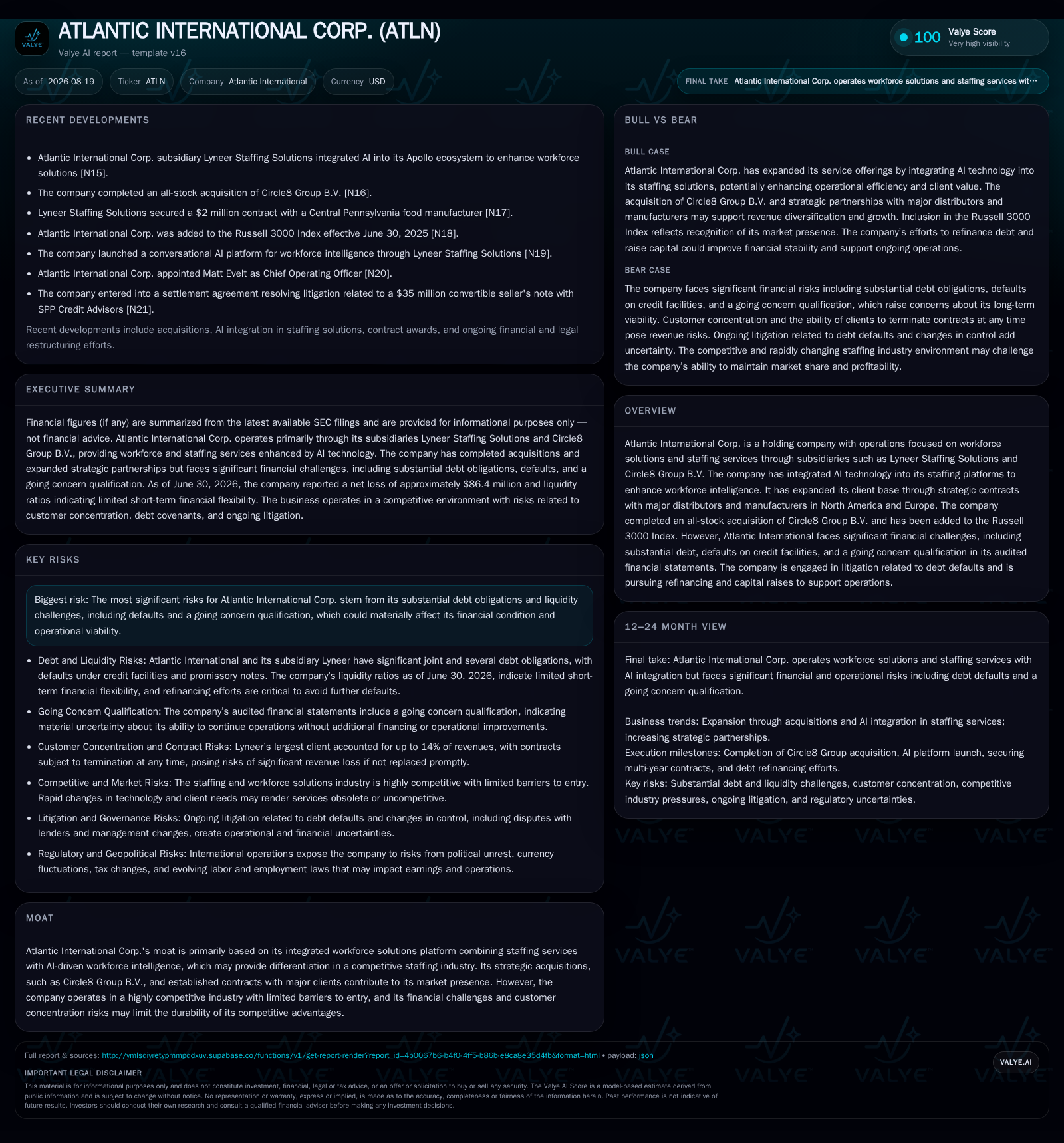
In Q2 2026, Atlantic International Corp. completed a settlement extinguishing a $35 million convertible promissory note and resolved litigation related to loan defaults, a critical step amid significant financial distress. The company faces liquidity constraints, evidenced by a net debt of approximately $548 million and a current ratio of 0.39 as of June 30, 2026. Atlantic's subsidiary Lyneer Staffing is actively working to refinance its senior debt facility, targeting completion within 45 days from August 7, 2026, a pivotal event for stabilizing the company's financial position and mitigating going concern risks.
Q2 2026 Financial and Legal Developments
Atlantic International Corp. reported significant financial and legal developments in 2026 that reflect ongoing financial distress during efforts to stabilize its capital structure [S3]. A key milestone was the completion of a settlement agreement that extinguished a $35 million convertible promissory note. This settlement resolved litigation arising from defaults under the company’s bridge and term loan credit agreements, removing a significant source of legal uncertainty and potential immediate liability.
Furthermore, current assets of $330.8 million compared to current liabilities of $842.6 million yield a current ratio of 0.39, indicating a pronounced working capital deficit and liquidity stress [F1]. These metrics underscore the company’s constrained ability to meet short-term obligations without additional financing or operational improvements.
In response to these challenges, Atlantic International’s principal subsidiary, Lyneer Staffing Solutions, is actively pursuing refinancing of its senior debt facility with North Mill Capital LLC (operating as SLR Business Credit) [S3]. The refinancing effort aims to complete within 45 days from August 7, 2026. Upon successful refinancing, Lyneer is obligated to make a $5 million payment to satisfy the SLR Bridge Loan in full, cover outstanding legal fees, and reduce the principal balance of indebtedness to SPP. This refinancing is a critical near-term event that will directly influence the company’s ability to manage debt maturities and avoid further defaults or restructuring.
Atlantic International’s audited financial statements include a going concern qualification, reflecting risks associated with its substantial debt obligations, prior defaults, and liquidity constraints [S1][S2]. This qualification highlights the uncertainty surrounding the company’s ability to continue operations without successful refinancing or significant capital restructuring.
Business Model and Operational Context
Atlantic International operates primarily through its subsidiaries Lyneer Staffing Solutions and Circle8 Group B.V., delivering workforce solutions and staffing services across North America and Europe. Lyneer focuses on comprehensive staffing services in industrial sectors such as food production, manufacturing, and logistics in the U.S., while Circle8 provides specialized IT and technology staffing across Europe [S1]. Circle8’s platform integrates AI-driven talent sourcing and workforce intelligence to support technology professionals in software development, data analytics, cybersecurity, and related fields.
The company generates revenue by charging fees for staffing services, including billable hours for temporary placements and fixed contracts for recruitment and consulting. Growth is pursued through acquisitions and expanding client contracts, leveraging a broad geographic footprint and specialized capabilities. However, the business model is capital-intensive and working capital–intensive due to payroll obligations and timing differences between client receivables and payments to placed workers.
Margins and cash conversion are influenced by competitive pricing pressures, client retention, utilization rates, and the working capital cycle length [S1]. Key performance indicators in this sector include revenue growth rate, gross margin percentage, client retention rate, working capital cycle length, and debt-to-equity ratio.
Operators in this industry often contend with working capital intensity due to payroll timing and client payment cycles, making liquidity management critical. Large diversified staffing firms emphasize scale and client diversity to mitigate risks, while specialized providers focus on high-growth sectors such as IT to capture higher margins. Technological adoption, including AI-driven platforms, is increasingly important for operational efficiency and competitive differentiation.
Atlantic International’s financial distress and leverage place it at heightened risk compared to peers with more conservative capital structures. The company’s ability to refinance debt and manage working capital will be central to navigating industry cyclicality and competitive pressures.
Analytical Conclusions and Near-Term Outlook
The settlement extinguishing the $35 million convertible promissory note and resolving related litigation is a vital step in reducing immediate legal and financial uncertainties for Atlantic International [S3][F1]
The ongoing refinancing effort by Lyneer Staffing to restructure the senior debt facility is a pivotal near-term development [S3]. Completion of this refinancing within 45 days from August 7, 2026, is essential for satisfying bridge loans, legal fees, and reducing principal balances. Additionally, operational metrics such as client retention and billable hours, if disclosed, will provide insight into the company’s revenue stability and cash flow generation.
In summary, Atlantic International’s financial condition as of mid-2026 reveals a company navigating severe financial constraints amid efforts to stabilize its capital structure.
Disclaimer: This is research-only, informational analysis and not investment advice. It may include AI-generated interpretation and general industry context. Always verify important details using primary sources.

Comments