
SurgePays Q2 2026: Subscriber Transition and Liquidity Constraints Shape Operating Performance
SurgePays' Q2 2026 results reveal a shift in subscriber base amid subsidy changes and highlight significant liquidity challenges.
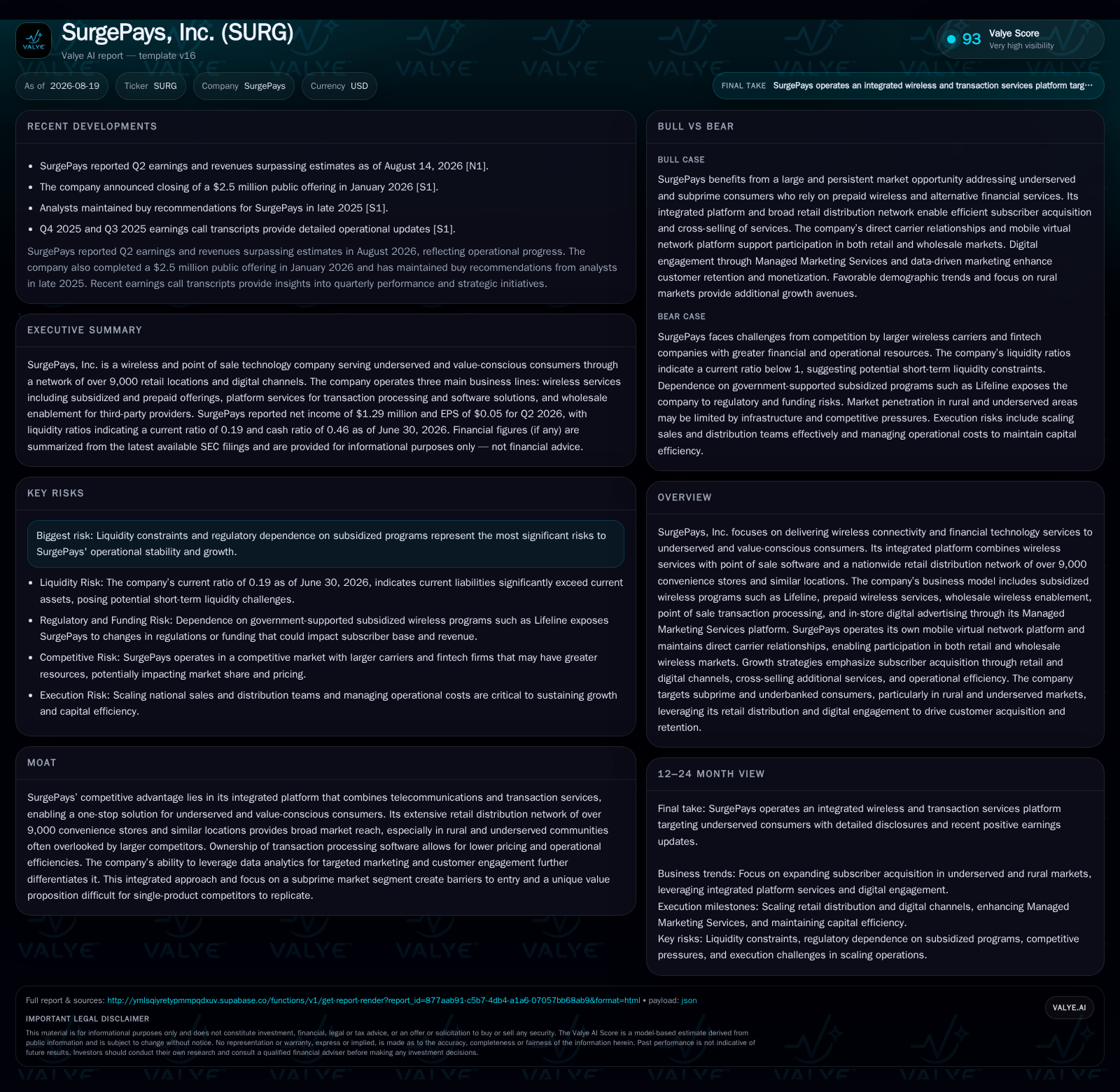
In Q2 2026, SurgePays experienced a structural transition in its wireless subscriber base, offsetting the loss of Affordable Connectivity Program funding with growth in Lifeline program subscribers. The company’s integrated wireless and fintech platform continues to support customer acquisition through a broad retail network. However, the balance sheet shows a current ratio of 0.19 and net debt near $13 million, indicating substantial liquidity constraints that pose risks to operational stability and future growth.
Q2 2026 Operating Update and Subscriber Transition
SurgePays, Inc. reported Q2 2026 operating results that reflect a significant transition in its subscriber base driven by changes in government subsidy programs [S1][S2]. Since mid-2024, the company lost funding from the Affordable Connectivity Program (ACP), which had previously supported a large portion of its Mobile Virtual Network Operator (MVNO) revenues.
This transition represents a structural shift in the company’s revenue base. The ACP funding cessation caused a 69% decline in MVNO segment revenue by 2025, from $43.45 million in 2024 to $13.45 million in 2025, reflecting the loss of subsidy-supported revenue streams [S1]. Despite this, SurgePays retained an existing subscriber base of approximately 250,000 and absorbed wholesale costs averaging $7 to $10 per subscriber per month to keep these subscribers active during the transition [S1]. The Lifeline program provides recurring subsidized revenue but at lower margins and with higher wholesale cost absorption initially, creating margin pressure in the wireless segment.
SurgePays’ integrated platform, which combines wireless services, point of sale software, and a nationwide retail network of over 9,000 independently owned convenience stores, supports subscriber acquisition and cross-selling opportunities. This platform targets underserved and value-conscious consumers, particularly in rural markets where competition is limited and pricing is often higher [S1]. As of June 30, 2026, SurgePays held cash and cash equivalents of $1.95 million against total debt of $14.86 million, resulting in net debt of approximately $12.9 million [F1]. Current assets stood at $4.86 million, while current liabilities totaled $26.16 million, yielding a current ratio of 0.19 [F1].
These liquidity pressures pose risks to SurgePays’ operational stability and its capacity to invest in growth initiatives without securing external financing or refinancing existing debt [F1][S2]. The constrained cash position relative to debt and liabilities suggests tight cash flow conditions, which could affect ongoing subscriber acquisition efforts and platform development.
Business Model and Competitive Positioning
SurgePays operates an integrated wireless and fintech platform focused on underserved and value-conscious consumers. Its business model generates revenue through multiple channels: recurring wireless service fees (both subsidized and non-subsidized), transaction fees from point of sale and prepaid wireless top-ups, wholesale wireless enablement fees, and advertising revenue from managed marketing services [S1]. The company’s competitive positioning is strengthened by its combination of telecom and fintech services delivered through a broad retail distribution network exceeding 9,000 locations. This omni-channel approach facilitates customer acquisition and retention, particularly in rural and underserved markets that represent approximately 18% of the U.S. population [S1]. However, SurgePays’ dependence on government subsidy programs such as Lifeline introduces structural revenue risk, as regulatory changes can materially affect funding availability and cost structures.
Margins and cash conversion in this sector are influenced by subsidy program funding levels, wholesale wireless cost absorption, and operational efficiencies from owning transaction processing software. SurgePays’ absorption of wholesale costs during the ACP to Lifeline transition reflects the challenges in maintaining margin stability amid subsidy shifts.
Recent Strategic Developments: Redline Wireless Joint Venture
In August 2026, SurgePays announced the formation of Redline Wireless Group, LLC, a joint venture with a major wireless master distributor [S3]. SurgePays contributed in-kind assets, including rights to use its LinkUp Mobile prepaid wireless brand, access to its MVNO platform, and billing and customer service infrastructure, while retaining its direct carrier relationships and wholesale MVNO agreements at the corporate level [S3].
Redline Wireless is governed by a six-member board equally appointed by both partners, with SurgePays’ CEO serving as chair and holding a casting vote in case of deadlock [S3]. This joint venture aims to leverage wholesale and retail wireless markets by combining the strengths of both partners, potentially expanding SurgePays’ wholesale enablement capabilities and retail reach.
Risks and Outlook
SurgePays faces significant risks related to its liquidity position and regulatory dependence on subsidized wireless programs [F1][S2]
Additionally, the company’s revenue stability is structurally tied to government subsidy programs such as Lifeline and formerly ACP. Changes in these programs’ funding or eligibility criteria could materially impact subscriber acquisition, revenue, and margins. Monitoring quarterly subscriber growth and retention in Lifeline and non-subsidized segments, as well as any regulatory developments affecting subsidies, will be critical to assessing SurgePays’ future performance.
The recently formed Redline Wireless joint venture represents a strategic effort to enhance wholesale and retail operations, but its financial impact and contribution to liquidity remain to be seen [S3]. In summary, SurgePays’ Q2 2026 results illustrate a company adapting to subsidy program shifts by growing its Lifeline subscriber base and leveraging an integrated wireless and fintech platform. However, substantial liquidity constraints present ongoing financial risks that will require careful management and possible capital raising to sustain operational stability and growth.
Disclaimer: This is research-only, informational analysis and not investment advice. It may include AI-generated interpretation and general industry context. Always verify important details using primary sources.

Comments