
LIXTE Advances LB-100 Clinical Programs Amid Strategic Integration of Proton Therapy
Clinical-stage progress with LB-100 protein phosphatase inhibitor and proton therapy stake frame LIXTE’s dual cancer therapeutics approach.
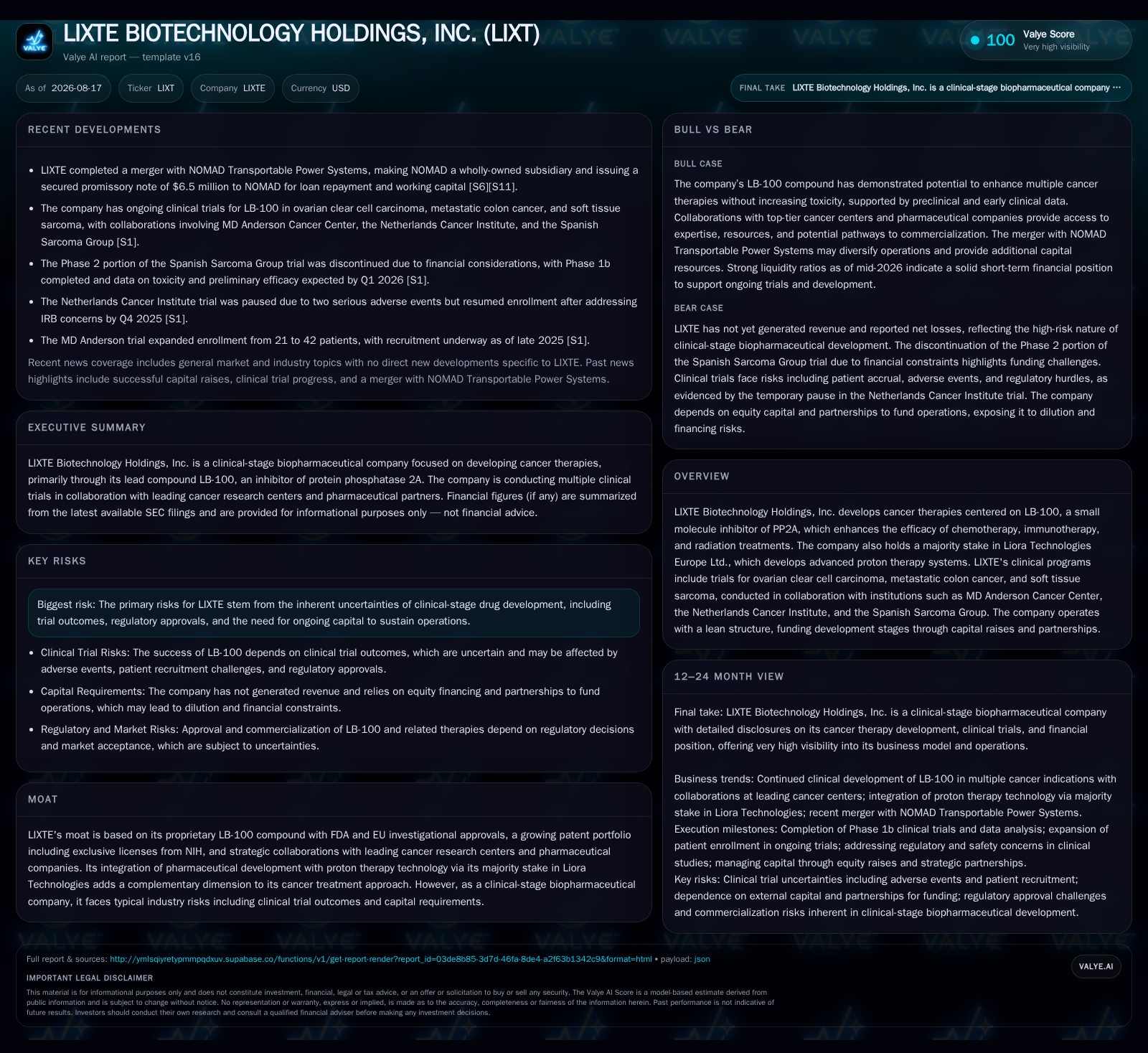
LIXTE Biotechnology Holdings is advancing its proprietary small molecule, LB-100, through multiple phase 1b/2 oncology trials targeting ovarian clear cell carcinoma, metastatic microsatellite stable colorectal cancer, and soft tissue sarcoma. The company also consolidates exposure to proton therapy technology via a majority stake in Liora Technologies Europe. Recent filings confirm continued clinical activity, patent expansion, and a capital-efficient operating model focused on milestone-driven development. Despite inherent clinical-stage biotech risks, LIXTE’s integration of pharmaceutical and radiation technology platforms offers a distinctive strategy within the oncology treatment ecosystem.
Recent Operating Update
LIXTE Biotechnology Holdings’ latest quarterly filing dated August 14, 2026 [S2] confirms steady progress in advancing LB-100 across multiple active clinical trials while maintaining financial discipline characteristic of a lean biotech operation. There have been no material changes to previously disclosed risk factors since the March 31, 2026 annual report [S1,S7], indicating operational consistency during typical sector uncertainties.
The company continues collaborative clinical programs with leading oncology research centers such as MD Anderson Cancer Center and the Netherlands Cancer Institute. Notable ongoing studies include Phase 1b trials combining LB-100 with atezolizumab for metastatic microsatellite stable colorectal cancer and dostarlimab for ovarian clear cell carcinoma. Additionally, a Phase 1b dose escalation study pairing LB-100 with doxorubicin in advanced soft tissue sarcoma is underway at GEIS [S1]. Patient enrollment milestones have been achieved steadily across these trials, supporting a measured advancement through dose determination phases. A planned randomized Phase 2 trial in soft tissue sarcoma remains pending completion of the Phase 1b dose-finding study [S1].
Corporate developments disclosed on July 2, 2026 [S6,S13,S19,S21,S27] include merger-related restructuring such as amendments to authorized shares and board composition changes designed to enhance governance flexibility. These changes align with ongoing capital raising efforts critical for sustaining late-stage clinical programs. Importantly, these corporate actions did not materially alter the core focus on LB-100 development or Liora Technologies’ proton therapy initiatives.
Business Model
LIXTE operates as a clinical-stage biotechnology company specializing in oncology therapeutics centered on LB-100—a small molecule inhibitor of protein phosphatase 2A (PP2A). By inhibiting PP2A, LB-100 increases stress signaling pathways within tumor cells, leveraging an activation lethality paradigm that diverges from traditional cytotoxic or targeted therapies [S1]. The compound is positioned primarily as an adjunctive agent aimed at potentiating chemotherapy drugs (e.g., doxorubicin), immune checkpoint inhibitors (e.g., atezolizumab), or radiation treatments.
Currently lacking commercialized products or revenue streams, LIXTE funds operations predominantly through equity capital raises supplemented by milestone payments embedded in collaboration agreements with academic partners [S1]. Outsourcing clinical trial execution to established institutions like NKI and GEIS reduces overhead costs and allows focused investment in compound advancement and intellectual property protection
Complementing its pharmaceutical pipeline, LIXTE holds a majority interest in Liora Technologies Europe Ltd., which develops the LiGHT System—a next-generation image-guided proton therapy platform. Proton therapy offers precise radiation delivery that minimizes damage to healthy tissues. This cross-platform approach integrates pharmacologic enhancement via LB-100 with advanced radiation modalities, potentially creating synergistic therapeutic benefits [S1].
Industry Structure and Competitive Position
Within oncology-focused biotechnology, companies typically invest heavily in R&D progressing compounds through phased clinical trials under regulatory oversight. Peers include firms developing small molecule inhibitors or immuno-oncology agents advancing through Phase 1/2 studies.
LIXTE’s competitive advantage stems from its proprietary LB-100 compound protected by an expanding patent portfolio including exclusive NIH licenses. The activation lethality mechanism represents an innovative treatment concept distinct from common checkpoint inhibitors or DNA-damaging chemotherapies widely pursued by competitors [S1].
Strategic partnerships with academic centers enable efficient trial execution without replicating costly infrastructure internally—providing a cost-effective model relative to peers bearing higher fixed expenses. Additionally, integrating Liora’s proton therapy technology situates LIXTE uniquely at the intersection of pharmaceutical drug development and advanced radiation oncology devices.
Growth Drivers
Key growth catalysts include successful clinical progression demonstrating safety profiles, recommended phase dosing (RP2D), and preliminary efficacy signals such as improved overall survival (OS) or progression-free survival (PFS):
- Completion of dose escalation phases establishing safe and effective combination regimens.
- Initiation of randomized Phase 2 efficacy trials following promising early-phase results.
- Continued patient enrollment supporting robust clinical data generation.
- Regulatory milestones maintaining investigational new drug (IND) status.
- Patent grants expanding exclusivity around PP2A-targeted therapies.
- Strategic collaborations providing milestone payments or licensing income enhancing funding profiles.
- Rising adoption of combination therapies amplifying LB-100’s therapeutic appeal.
- Synergies between pharmaceutical advances and proton therapy innovations broadening potential market applications.
Risks and Watchpoints
Typical risks for a clinical-stage biotech apply:
- Potential delays or failures in clinical trials could materially impact valuation and timelines.
- Regulatory uncertainty remains significant given evolving standards and competing therapies.
- High dependence on continuous equity financing exposes the company to capital market volatility.
- Intellectual property challenges could dilute competitive advantages if patents are contested or expire.
- Reliance on external research partners entails operational risks beyond direct control.
- Manufacturing scale-up risks will emerge approaching commercialization stages.
- Market adoption post-regulatory approval carries reimbursement uncertainties.
- Legal claims related to development activities present possible liabilities.
- Rapid scientific advances require ongoing innovation investment to maintain relevance.
Monitoring enrollment pace and milestone achievements will be critical indicators of execution risk alongside cash runway considerations.
What to Watch Next
Investors should track:
- Updates on patient recruitment progress at MD Anderson, NKI, and GEIS trial sites.
- Announcements regarding dose escalation completion and RP2D confirmation for combination regimens.
- Progression into randomized Phase 2 efficacy studies marking key value inflection points.
- New patent awards or licensing arrangements extending IP protection for PP2A inhibitors.
- Strategic partnerships that may provide additional funding or co-development opportunities.
- Milestone payments reported in financial disclosures correlating with clinical successes.
- Advances integrating Liora Technologies’ proton therapy systems within broader oncologic treatment frameworks.
Financial Profile Discussion
While lacking product revenue due to its clinical-stage status, LIXTE’s financial health supports ongoing R&D activities. As of June 30, 2026 [F1], current assets stood at approximately $19.3 million against current liabilities near $1.5 million, resulting in a strong current ratio of about 12.87x—signaling ample short-term liquidity suitable for sustaining operations through upcoming clinical milestones. Cash equivalents were last reported at $3.4 million as of March 31, 2024 [F1], but recent merger transactions likely supplemented available funds.
Overall, LIXTE's financial position appears sufficient for near-term plans but warrants close monitoring as trial progress dictates future funding needs.
This analysis reflects information available as of August 17, 2026. It does not constitute investment advice.
Disclaimer: This is research-only, informational analysis and not investment advice. It may include AI-generated interpretation and general industry context. Always verify important details using primary sources.

Comments