
Professional Diversity Network Confronts Liquidity and Nasdaq Compliance Amid AI-Driven Recruitment Growth
A mixed operational update highlights strategic AI integration and expanding recruitment services while financial liquidity and regulatory challenges loom.
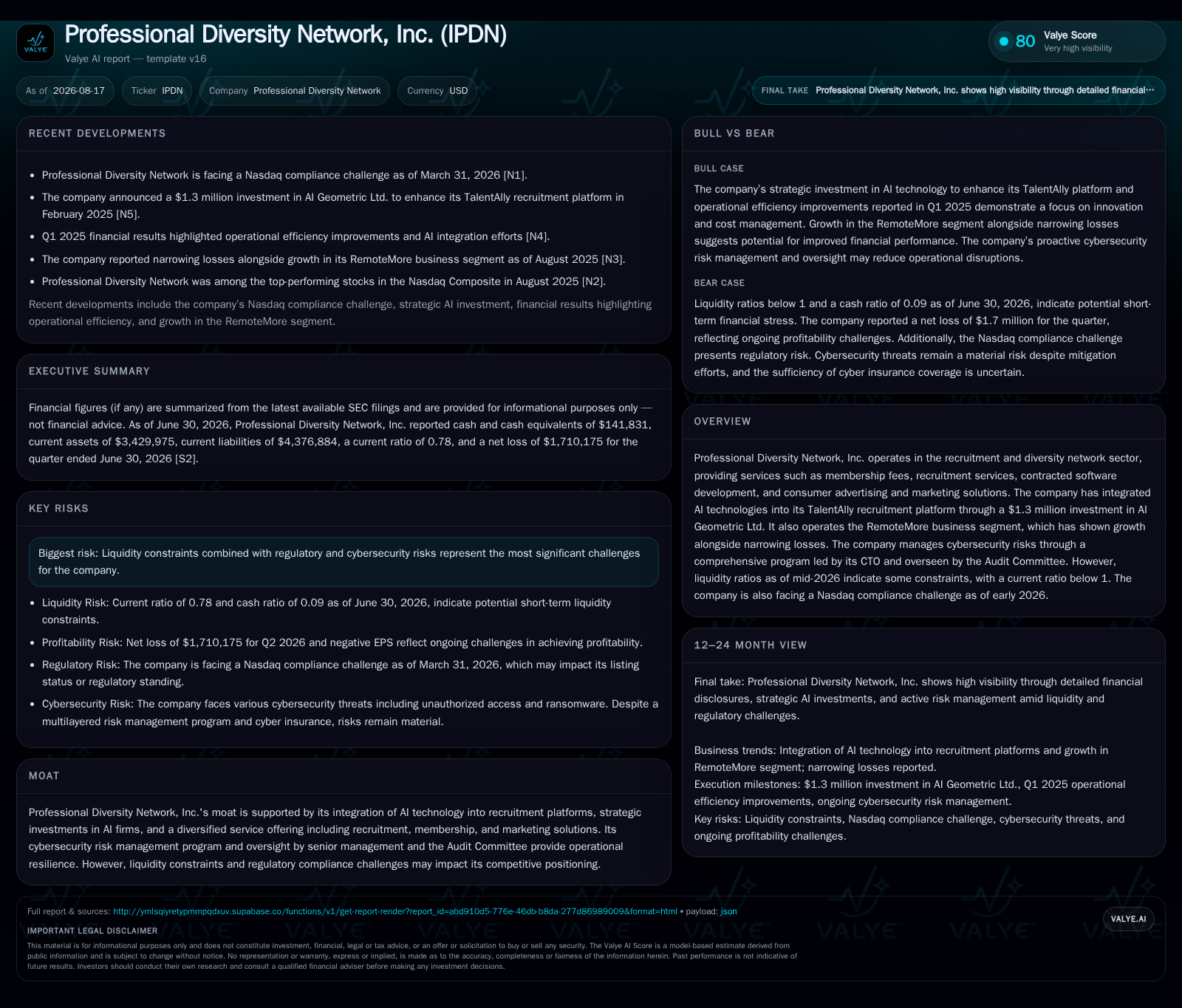
Professional Diversity Network, Inc. (IPDN) advanced its AI capabilities through a $1.3 million investment in AI Geometric Ltd., integrating these technologies into its TalentAlly recruitment platform to enhance candidate matching. Its RemoteMore business segment exhibits revenue growth with reduced losses, signaling operational progress. However, liquidity constraints persist, with a current ratio below 1 as of mid-2026, alongside ongoing Nasdaq compliance issues that could impact capital market access. The firm's diversified revenue streams span membership fees, recruitment services, contracted software development, and advertising solutions with growing emphasis on AI-powered offerings and cybersecurity risk management.
Recent Operating Update Highlights
In its latest quarterly filing dated August 14, 2026 [S2], Professional Diversity Network (IPDN) reported continuing progress in expanding its service offering portfolio while facing persistent liquidity constraints. A crucial development is the $1.3 million strategic investment in AI Geometric Ltd., an AI technology firm whose capabilities have been integrated into IPDN's TalentAlly platform—a core offering that serves registered users seeking recruitment services [S1]. This infusion of artificial intelligence is intended to enhance the platform’s matching algorithm accuracy and overall user experience by leveraging data-driven insights to streamline candidate-employer connections.
Additionally, the RemoteMore business segment demonstrated sequential revenue growth alongside narrowing operating losses [S2], signaling operational leverage beginning to materialize in this ancillary service line that complements core recruitment and membership-based revenues.
As of June 30, 2026, IPDN held approximately $142K in cash and equivalents against current liabilities exceeding $4.3 million — resulting in a current ratio of roughly 0.78 [F1]. This under-1 liquidity ratio suggests short-term funding pressures that could constrain ongoing operations or investments if unaddressed.
Compounding these cash flow issues is an active engagement with Nasdaq on listing compliance matters since early 2026 [S3], which introduces regulatory uncertainty impacting investor confidence and potentially restricting capital market access for fresh funding.
Business Model Overview
Professional Diversity Network operates at the intersection of online recruitment services and professional diversity networking — a niche increasingly prioritized during corporate diversity & inclusion agendas. Its multi-pronged revenue model comprises four primary streams: membership fees collected from professionals accessing diversity-focused communities; recruitment services fees earned by facilitating employer-candidate placements via platforms like TalentAlly; contracted software development income derived from custom software projects for clients; and consumer advertising/marketing solutions targeting professional audiences within its network [S1]
Revenue fundamentally scales through growth in registered users—defined as individuals who have voluntarily joined affiliated affinity groups by submitting demographic or contact information—which enlarges the audience available for recruitment matchmaking and marketing monetization. These users access TalentAlly sites free of charge initially but become part of advanced service usage or membership tiers that generate recurring fees.
Margins are sensitive to platform engagement levels (frequency/duration), successful match rates driving recruitment service volume, contract win rates for software development engagements, and advertising client uptake. Investment in AI-powered matching aims to enhance these underlying dynamics by improving match quality (thereby increasing placement volume) and platform stickiness (bolstering user retention). Ancillary contracted software work diversifies revenue away from pure recruiting but may entail variable gross margin depending on project scope.
Industry Structure and Competitive Positioning
IPDN operates within Online Recruitment and Diversity Networking Services—a sector characterized by platforms connecting employers with diverse talent pools through digital means enhanced by data analytics and increasingly AI technologies. Standing alongside giants such as LinkedIn (general professional networking with robust recruitment functionality), broader job boards like Indeed or Glassdoor, as well as specialty diversity job boards (e.g., DiversityJobs), IPDN seeks differentiation through focused affinity group communities paired with integrated AI capabilities.
Complementary peers include SaaS HR tech providers offering recruitment workflow automation or advanced matching algorithms but often lack deep affinity group engagement or diversity specialization. Advertising platforms targeting professionals also represent competitive adjacency while augmenting revenue pools.
Given this landscape, IPDN’s moat is constructed around:
- Specialized diversity-focused communities attracting targeted employer interest,
- Integrated AI technology evolving platform relevance,
- Multi-segment monetization blending memberships with services,
- Cybersecurity risk management enhancing platform credibility.
However, scale limitations relative to larger peers constrain bargaining power with advertisers/employers and keep customer acquisition cost (CAC) pressures elevated in growing registered user counts. Retention dynamics also require continual reinforcement via platform feature enhancements.
Growth Drivers Analysis
Key catalysts for Professional Diversity Network's expansion are rooted in structural shifts toward inclusive hiring practices heightened across corporate America coupled with broader trends favoring online professional networking accelerated by remote/hybrid work adoption.
Specifically:
- Rising Corporate Budgets for Diversity Hiring: An uptick in employer spending targeted at equitable workforce representation creates demand for vetted diverse candidate sourcing channels like TalentAlly.
- Registered Users Expansion: Growth in affinity-group registrations fuels the pool size for matching engines; increased memberships directly translate into subscription revenues if conversion from free access accelerates.
- AI-Powered Matching Advances: Progressive integration of AI capabilities reduces friction in finding suitable candidates/employers efficiently—this could shorten sales cycles for recruitment placement contracts enhancing revenue velocity.
- RemoteMore Segment Evolution: Revenue growth accompanied by loss reduction implies operational leverage potential within diversified service verticals beyond pure recruiting/membership fees.
- Contracted Software Development: Providing bespoke solutions to clientele offers both immediate income diversification benefits and potential cross-selling pathways into recruitment or marketing domains.
- Consumer Advertising Uptake: Leveraging audience segmentation within diversity-focused networks enhances advertiser value proposition allowing incrementally higher ARPU (average revenue per user).
The interplay among these drivers shapes fundamental KPIs including membership renewal rates (net retention), monthly active users on TalentAlly (platform engagement), placement volumes (recruitment service throughput), average contract values in software development projects (contracted service margins), and churn rates—all critical to monitor going forward.
Risks and Constraints
Notwithstanding encouraging innovation efforts, several risks temper optimistic outlooks:
- Liquidity Constraints: A current ratio below unity alongside sub-$150K cash poses material operational risk given ongoing fixed costs typical within SaaS platforms plus incremental R&D expenditure connected to AI integration [F1]. Failure to secure incremental financing or improve operating cash flow may necessitate cost rationalizations or sales of assets.
- Nasdaq Compliance Challenges: Public listing compliance issues raise uncertainty around continued market presence affecting stock liquidity which indirectly influences strategic options including capital raises [S3].
- Cybersecurity Threats: Despite a robust multilayered cybersecurity program supervised directly under the CTO with Audit Committee oversight [S1], evolving threats remain inherent risks that could lead to data breaches harming reputation and incurring remediation costs.
- Competitive Pressure: Entrenched players wield stronger network effects plus broader product suites making customer acquisition more costly while innovation pace must be sustained lest platform obsolescence risks emerge.
- User Engagement & Retention Difficulties: Growing registered users must be matched by effective retention strategies to convert free traffic into paying members; high churn undermines predictable revenue growth.
- Technology Execution Risk: Successfully embedding AI functionalities at scale involves complex technical challenges; underperformance here would dampen expected competitive advantages.
- Dependence on Third Parties: Reliance on external service providers for IT infrastructure or software components exposes exposure to operational disruption risks.
What To Watch Next
Key upcoming indicators that will shed light on IPDN’s trajectory include:
- Quarterly updates on registered user gains across TalentAlly platforms—both total count and conversion ratios into paid memberships,
- Membership/subscription renewal rates reflecting net retention trends,
- Recruitment placement volumes indicating sales pipeline health and marketplace traction,
- Progress updates on Nasdaq compliance matters highlighting resolution probability,
- Sequential changes in RemoteMore segment profitability measures demonstrating operational scalability,
- Cash flow improvements or additional financing events alleviating liquidity pressures,
- Any disclosures related to cybersecurity incidents or enhancements evidencing risk mitigation effectiveness,
- Further AI capability rollouts or partnerships expanding technological differentiation,
- Pricing power evolution especially in advertising/marketing solutions reflective of ARPU trends within niche professional audiences.
Continuous monitoring of these metrics will clarify whether IPDN can stabilize financially while executing its strategic imperatives amid competitive complexity within online recruitment infused by diversity objectives.
Financial Profile Discussion
As of June 30, 2026 end-of-quarter data provides crucial context—IPDN holds roughly $142K in cash equivalents against current liabilities pinning the current ratio at about 0.78 [F1]. Total debt approximates $445K as per latest data though timing nuances reduce comparability slightly [F1]. Net debt position stands around $303K—moderate leverage balanced against limited liquid resources constraining maneuverability.
The relatively low liquidity base indicates potential reliance on securing new capital sources such as equity offerings or debt refinancing soon if operating cash flow does not improve meaningfully through better expense control or higher-margin revenue growth initiatives [F1]
In conclusion, while Professional Diversity Network exhibits promising progress integrating AI-enhanced tools into its recruiting ecosystem supported by supportive industry tailwinds around diversity hiring demand, constrained liquidity paired with regulatory compliance questions pose meaningful risk factors requiring vigilant management attention moving forward.
Disclaimer: This is research-only, informational analysis and not investment advice. It may include AI-generated interpretation and general industry context. Always verify important details using primary sources.

Comments