
TuHURA Biosciences Advances IFx-2.0 Through Phase 3 but Faces Critical Liquidity Headwinds
Latest quarterly disclosures spotlight clinical momentum for lead oncology candidate IFx-2.0 alongside pressing cash constraints necessitating urgent financing maneuvers.
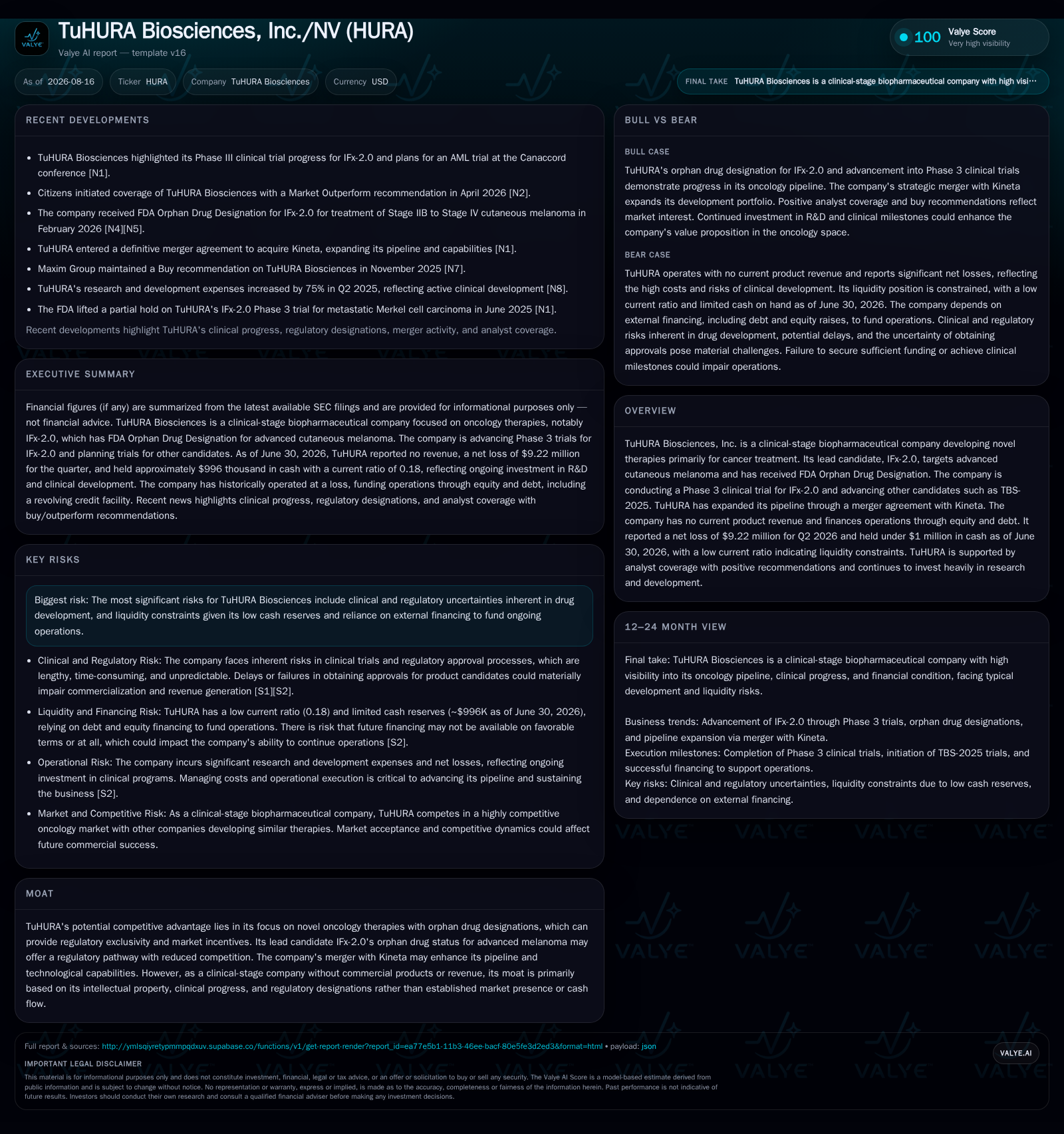
TuHURA Biosciences progresses its lead drug candidate IFx-2.0 through a pivotal Phase 3 trial while leveraging orphan drug designation, which supports regulatory exclusivity. The company’s elevated R&D spending reflects commitment to late-stage development and pipeline expansion via the Kineta merger. However, the Q2 2026 report reveals acute liquidity stress, with cash reserves under $1 million and a current ratio of 0.18, highlighting near-term funding risks. Extended warrant exercise periods and a $3.6 million drawn revolving credit facility offer financing flexibility, though challenges remain in securing sufficient capital to sustain operations before commercialization.
Recent Quarterly Report Reveals Clinical Advances Coupled with Acute Cash Constraints
TuHURA Biosciences’ Q2 2026 filing dated August 14 foregrounds two defining themes: advancement of its lead oncology candidate IFx-2.0 through pivotal Phase 3 studies alongside pressing liquidity limitations that pose operational risks [S2][F1]. The company reported a net loss of $9.22 million for the quarter concurrent with cash and equivalents declining to just below $1 million as of June 30, reflecting a constrained cash runway relative to ongoing expenses typical for a clinical-stage biotech without product revenue [F1]. Moreover, current assets totaling about $1.66 million fall significantly short of current liabilities exceeding $9.25 million, resulting in a low current ratio of 0.18 — indicative of acute working capital stress requiring imminent capital infusions [F1].
To address funding needs, TuHURA extended warrant exercise periods through April 2031 covering over 4.36 million shares held by affiliates at strike prices ranging from $3.69 to $5.70 per share, providing optionality for future equity capital depending on market conditions [S2]
IFx-2.0's Orphan Drug Designation Supports Regulatory Exclusivity Amid Clinical Stage Uncertainty
Central to TuHURA’s therapeutic portfolio is IFx-2.0 targeting advanced cutaneous melanoma — a candidate benefiting from FDA orphan drug designation that grants valuable regulatory exclusivity in niche oncology markets where patient populations are limited and competition is reduced [S1][N1]. This designation enhances the commercial moat by incentivizing expedited review pathways and potential market exclusivity post-approval.
Nonetheless, clinical outcomes remain binary with inherent risk; success or failure in Phase 3 trials will be decisive for valuation and future financing options [N1]. Together these financing instruments illustrate management’s active approach in balancing dilution concerns against costly debt to maintain R&D momentum.
Stock-based compensation expense adds non-cash charges based on Black-Scholes fair value estimates but increases overall operating costs [S2]. Meanwhile, royalty payments tied to IFx-2.0 sales are capped annually yet remain theoretical until commercial launch — reflecting contingent liabilities associated with intellectual property success rather than immediate cash outflows [S5].
The extended warrant exercise agreements provide latitude for future dilution mitigation if share prices exceed strike levels within the extended timeframe through April 2031; however, this mechanism offers limited near-term relief given immediate liquidity pressures.
Kineta Merger Expands Pipeline but Brings Execution Complexity
The recent merger with Kineta introduces additional candidates such as TBS-2025 into TuHURA’s pipeline expansion strategy [S1]. While this diversification broadens therapeutic opportunities beyond IFx-2.0, it also escalates operational complexity requiring effective integration and prioritization amidst resource constraints.
Such consolidation efforts are common in biotech sectors aiming to aggregate promising assets under unified management but carry risks related to aligning clinical development schedules and regulatory strategies under financial pressure.
Elevated R&D Spending Underscores Strategic Commitment Despite Financial Constraints
TuHURA increased research and development expenses to approximately $6.62 million for Q2 2026 compared to prior periods, signaling focused investment in advancing pivotal clinical trials as well as preclinical work related to new pipeline entrants from Kineta [S2][F1]
For clinical-stage biotechs lacking product revenues, sustained R&D expenditure intensity correlates closely with innovation progress but also amplifies recurring funding demands — making efficient capital deployment toward key milestones critical.
Risk Profile: Clinical Binary Outcomes Coupled With Immediate Liquidity Pressures
The company faces dual-layered risks: first, the high attrition probability typical of oncology Phase 3 trials means unfavorable data could abruptly diminish enterprise value; second, severe liquidity constraints evidenced by minimal cash reserves relative to substantial current liabilities exacerbate solvency risk [S2][F1]
This fragile liquidity position (current ratio at 0.18) heightens dependence on successful equity raises or warrant conversions — both sensitive to volatile market conditions affecting investor appetite for speculative biotech investments.
Failure to secure timely funding could disrupt ongoing clinical programs or delay strategic initiatives, compounding valuation erosion absent positive milestone achievements.
Near-Term Catalysts: Enrollment Progress, Regulatory Updates, and Financing Activities To Shape Outlook
Key upcoming catalysts include enrollment milestones in IFx-2.0's Phase 3 program alongside interim data releases that may influence regulatory feedback and potential accelerated approval discussions—a dynamic common among oncology-focused peers where positive signals often unlock partnership or financing opportunities [N1][S2]
Simultaneously, monitoring warrant exercise activity and incremental drawdowns under the Parkview credit facility as well as any new equity offerings will be critical indicators of management’s effectiveness in navigating liquidity pressures.
Investor focus will also center on pipeline progression updates including TBS-2025 trial plans as metrics of broader development execution capability.
Financial Profile Discussion - Short-Term Liquidity Constraints Amid Ongoing High Burn Rates Demand Vigilant Capital Management
As of June 30, 2026, TuHURA holds roughly $996,000 in cash against total debt approximating $3.6 million—resulting in net debt exceeding $2.6 million—and a sharply negative working capital position with current liabilities over five times current assets [F1]
Quarterly net losses near $9.22 million underscore continued high burn without offsetting revenues typical for pre-commercial biotechs focused on oncology indications [S2][F1]. Given these dynamics, the company’s survival hinges critically on executing warrant exercises extending through 2031 or raising additional funds without excessively diluting shareholders while replenishing urgently needed working capital buffers.
This profile typifies many clinical-stage biotechs navigating prolonged development cycles requiring multiple financings before reaching commercialization or licensing inflection points.
Disclaimer: This analysis is based solely on publicly available filings and news disclosures concerning TuHURA Biosciences Inc., intended solely for informational purposes without investment advice or research views.
Disclaimer: This is research-only, informational analysis and not investment advice. It may include AI-generated interpretation and general industry context. Always verify important details using primary sources.

Comments