
Totaligent Q2 2026: Strategic AI Pivot Amid Severe Liquidity Constraints
Totaligent reports critical liquidity shortfall in Q2 2026 while pursuing a strategic shift toward AI integration and diversification.
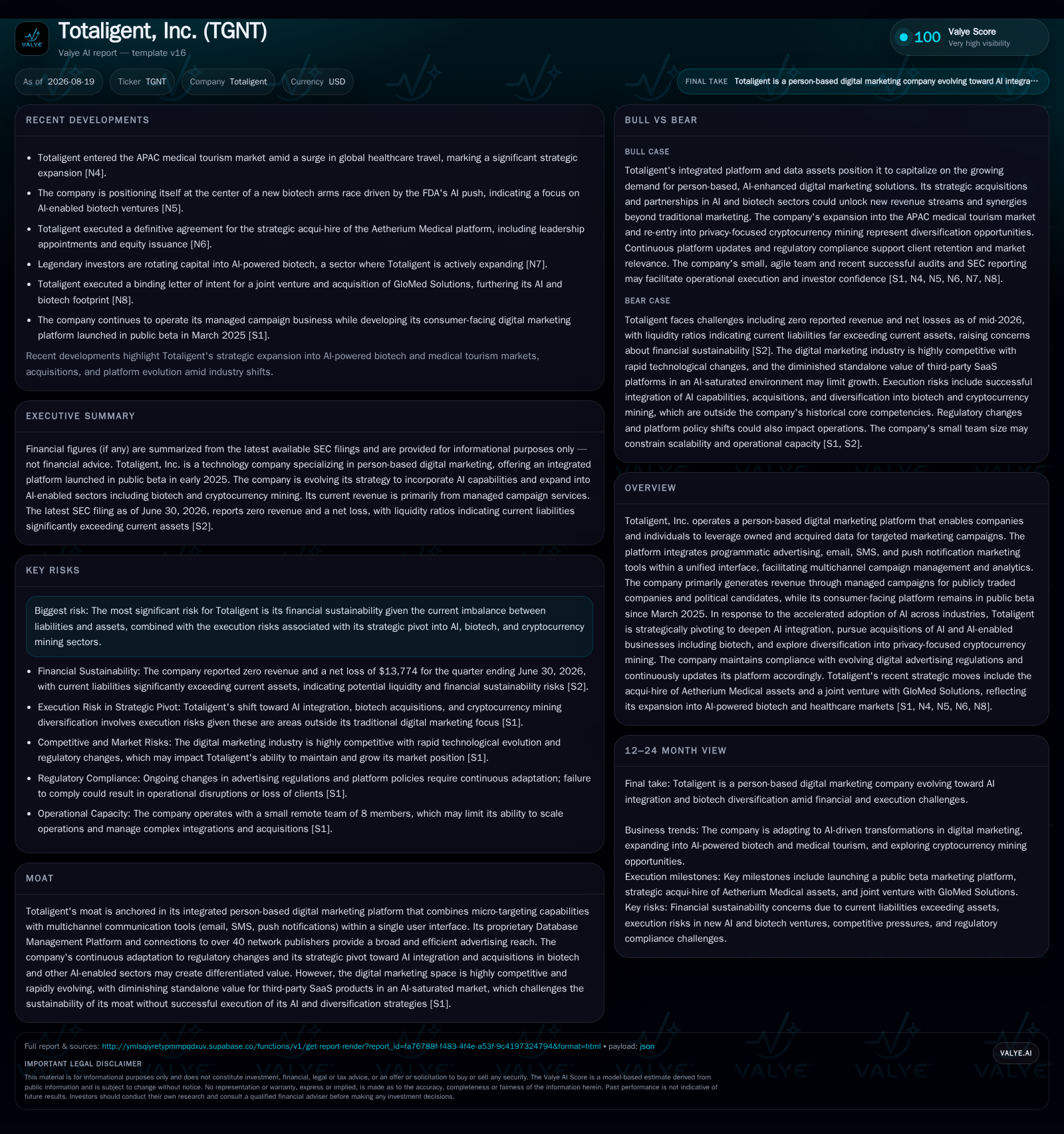
Totaligent, Inc. faces a severe liquidity crisis as of June 30, 2026, with current liabilities exceeding current assets by over $2.2 million, raising substantial going concern risks. Concurrently, the company is executing a strategic pivot to deepen AI integration and pursue acquisitions in AI-enabled sectors including biotech and cryptocurrency mining. This transition reflects the structural challenges posed by rapid AI adoption in digital marketing, which is diminishing the standalone value of traditional SaaS offerings. Totaligent’s core business remains focused on managed digital marketing campaigns for public companies and political candidates, but limited revenue diversification and ongoing financial distress underscore significant near-term operational and capital challenges.
Q2 2026 Financial Position and Liquidity Challenges
Totaligent, Inc. reported a critical liquidity shortfall as of June 30, 2026, with current liabilities totaling $2,200,456 vastly exceeding current assets of only $1,941, resulting in a current ratio effectively at zero [F1]. This severe negative working capital position underscores acute financial distress and raises substantial doubt about the company's ability to continue as a going concern without successful capital raises or operational improvements [S2]. The prior fiscal year ended December 31, 2025, saw a net loss of $600,046, an accumulated deficit of $2,560,631, and a stockholders’ deficit of $2,164,267, further evidencing ongoing financial challenges [S1]. These factors collectively illustrate that Totaligent faces significant near-term capital and liquidity risks that threaten operational continuity absent external financing or a turnaround.
The balance sheet's critical imbalance is compounded by the company's limited cash reserves, which stood at only $4,689 at the end of 2025 [S1]. Without substantial new capital inflows, Totaligent's ability to meet its short-term obligations is severely constrained. Management has acknowledged these risks explicitly, noting that the company’s continued operations depend on securing additional financing through debt or equity issuance [S1]. However, the uncertain market conditions and the company’s financial profile may limit access to capital or impose onerous terms, potentially restricting operational flexibility or diluting existing shareholders.
Strategic Pivot Toward AI Integration and Diversification
during this financial strain, Totaligent is pursuing a strategic pivot to deepen integration of artificial intelligence (AI) within its platform and to diversify its business through targeted acquisitions. The company recognizes that the rapid adoption of AI across industries, including digital marketing, is structurally diminishing the standalone value of third-party SaaS products [S1]. Leveraging its proprietary platform and valuable data assets, Totaligent aims to expand into AI-enabled sectors such as biotech and privacy-focused cryptocurrency mining, seeking to create new revenue streams and enhance platform capabilities [S1][S2].
This strategic evolution reflects an attempt to adapt to the structural shifts in the digital marketing industry driven by AI, positioning Totaligent to capitalize on AI-driven marketing automation, predictive analytics, and personalization technologies. The company’s platform, which integrates programmatic advertising, email, SMS, and push notifications, provides a foundation for embedding AI capabilities that can improve targeting precision and campaign effectiveness [S1]. By pursuing acquisitions of AI companies and AI-enabled businesses, including those outside the traditional digital marketing space, Totaligent is aiming to build a more diversified and resilient business model that can better withstand competitive pressures and technological disruption.
However, this transition occurs amid severe liquidity constraints, complicating execution risks. The company must balance the need for investment in AI integration and acquisitions with the imperative to stabilize its financial position. The success of this pivot will depend on the company’s ability to secure financing, identify suitable acquisition targets, and effectively integrate new technologies and businesses into its platform.
Business Model and Revenue Drivers
Totaligent operates an integrated person-based digital marketing platform that combines programmatic advertising, email, SMS, and push notifications to enable multichannel campaign management [S1]. The platform allows companies and individuals, including publicly traded companies and political candidates, to unlock and utilize first-, second-, and third-party data to efficiently market their products and brands [S1].
Revenue is primarily generated through fees for managed digital marketing campaigns, reflecting a managed services model rather than a broad SaaS subscription base. This approach provides a direct link between campaign volume and revenue but also exposes the company to fluctuations in client demand and campaign activity. The company launched a public beta version of its consumer-facing platform in early 2025, aiming to democratize access to its marketing tools for a wider audience, including small businesses and individual marketers [S1]. This expansion could potentially diversify revenue streams over time, but as of now, the consumer platform remains in beta with limited market penetration.
Despite these efforts, revenue diversification remains limited, exposing Totaligent to risks related to client concentration and fluctuations in campaign volume, which are critical drivers of revenue and cash flow in this sector. The company’s reliance on managed campaigns for publicly traded companies and political candidates concentrates its revenue base and may lead to volatility tied to election cycles and corporate marketing budgets [S1]. This concentration risk underscores the importance of the company’s strategic pivot toward AI-enabled acquisitions and broader market segments to build a more stable and scalable revenue model.
Margins and cash conversion are also under pressure due to the company’s development stage and ongoing operating losses. Operational efficiency and client retention will be key factors influencing future margin improvement.
Industry Context and Competitive Dynamics
The digital marketing technology industry is undergoing a structural transformation driven by accelerated AI adoption, which is reshaping platform economics and competitive dynamics. Traditional standalone SaaS products are losing value as clients demand integrated AI-enabled marketing solutions that combine automation, personalization, and multichannel campaign orchestration. Companies like Totaligent, which operate platforms aggregating first-, second-, and third-party data for targeted marketing, must evolve to maintain relevance and competitive positioning.
Key industry performance indicators include campaign volume and spend, client retention and churn rates, average revenue per user, and AI feature adoption rates. The shift toward AI-driven marketing automation and predictive analytics is creating both challenges and opportunities, pressuring companies to innovate while managing operational and financial risks. Competitors and adjacent players include digital marketing SaaS platforms, programmatic advertising networks, and AI-driven personalization vendors, all vying to capture market share in an increasingly AI-centric environment.
Totaligent’s moat is based on its integrated platform combining multichannel marketing tools and proprietary data assets, but the rapid AI adoption in the industry is structurally diminishing standalone SaaS product value, pressuring the company to evolve [S1]. The company’s strategic focus on AI integration and acquisitions aims to leverage its existing data and platform as a foundation for growth in this evolving landscape.
Risks and Near-Term Watchpoints
Totaligent’s critical liquidity shortfall and negative working capital as of Q2 2026 create substantial going concern risk that requires immediate attention through capital raises or operational turnaround [F1][S1][S2]. The company’s strategic pivot toward AI integration and acquisitions in AI-enabled sectors represents a necessary response to structural industry changes but carries execution risk given the current financial constraints [S1][S2].
The reliance on managed campaign services for a concentrated client base, primarily public companies and political candidates, limits revenue diversification and increases exposure to campaign volume fluctuations [S1]. This concentration risk, combined with the company’s limited operating history and development-stage status, heightens the uncertainty around future revenue stability and growth.
Key near-term watchpoints include:
- The company’s ability to secure additional financing on acceptable terms to address the liquidity shortfall and fund strategic initiatives.
- Progress in AI integration within the platform and the tangible impact on platform capabilities and revenue mix.
- Announcements of acquisitions or strategic investments in AI-enabled or biotech businesses that could diversify and strengthen the company’s portfolio.
- Expansion of the consumer-facing platform beyond its public beta stage, which could broaden the customer base and revenue sources.
- Trends in campaign volume, client retention, and managed service margins, which are critical operational metrics influencing financial performance.
Monitoring these factors will be critical to assessing Totaligent’s operational viability and strategic execution in a rapidly evolving digital marketing landscape. The outcome of its capital raising efforts and success in executing its AI-focused pivot will determine its ability to navigate the structural shifts reshaping the digital marketing technology sector.
Disclaimer: This is research-only, informational analysis and not investment advice. It may include AI-generated interpretation and general industry context. Always verify important details using primary sources.

Comments