
KonaTel Inc. 2026 Q2 Results Highlight FCC Compliance Issues and Financial Stress
KonaTel reported modest Q2 revenue and a net loss alongside regulatory scrutiny of its Lifeline program subsidiary, underscoring financial and operational challenges.
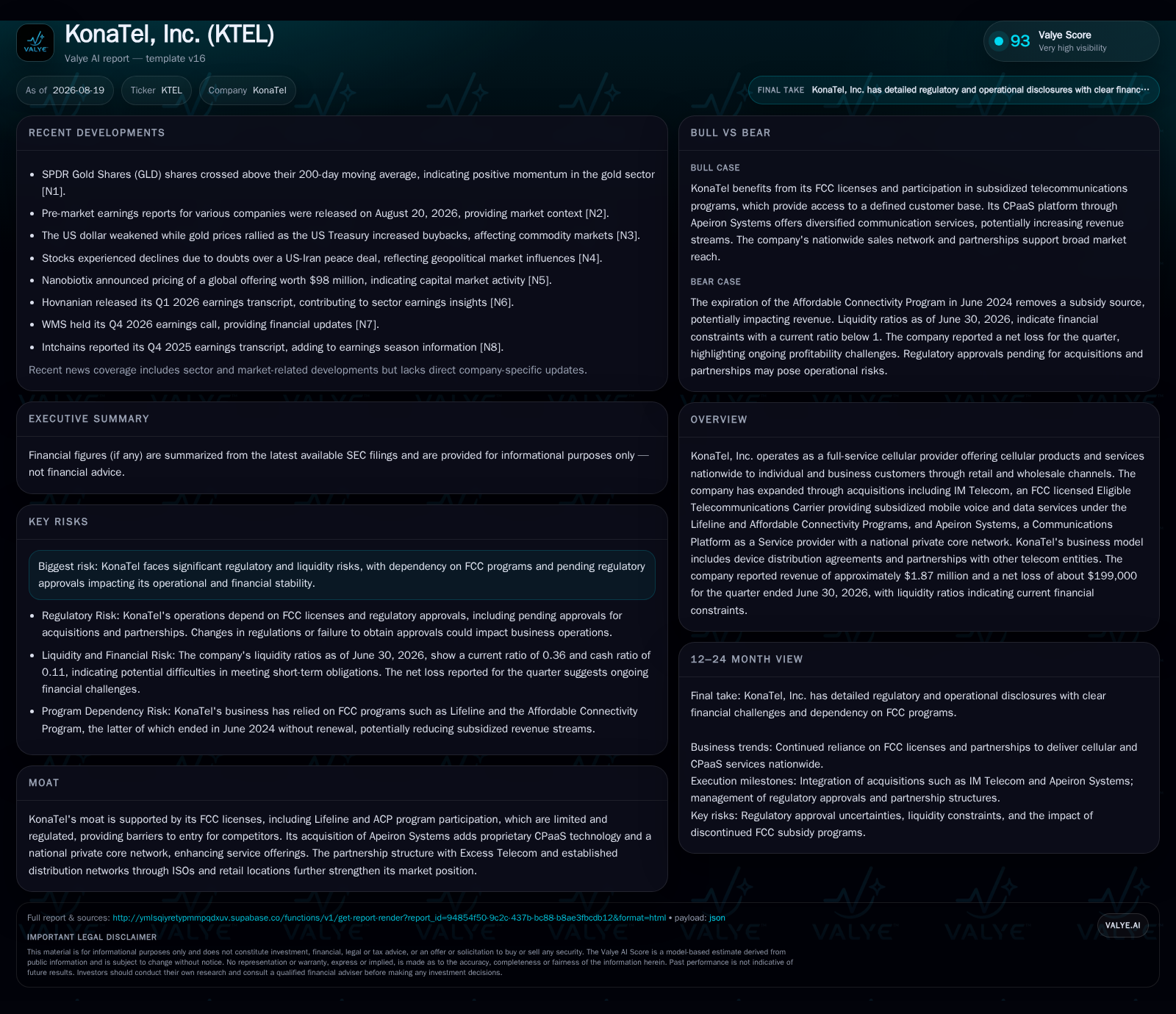
KonaTel, Inc. reported $1.87 million in revenue and a net loss of approximately $199,000 for the quarter ended June 30, 2026, reflecting ongoing competitive pressures and regulatory costs. The company faces significant liquidity constraints, with a current ratio of 0.36 and current liabilities exceeding current assets by over $1.2 million as of quarter-end. Additionally, KonaTel's 51%-owned subsidiary, IM Telecom, received an FCC notice alleging violations of Lifeline program rules, introducing material regulatory risk to a core revenue source. These developments highlight structural challenges in regulatory compliance and financial stability that may impact KonaTel's future operations.
Q2 2026 Financial Performance and Liquidity
KonaTel, Inc. reported revenue of approximately $1.87 million for the quarter ended June 30, 2026, derived from sales of cellular products and services through retail and wholesale channels [S2]. Despite generating revenue, the company recorded a net loss of about $199,000 during the same period, indicative of negative operating margins influenced by competitive market pressures and regulatory compliance expenses [S2]. This modest revenue base reflects ongoing sales from cellular voice and data services, device distribution, and communications platform offerings, but the net loss signals challenges in achieving profitability amid these pressures.
The financial bridge between revenue generation and liquidity constraints highlights the operational difficulties KonaTel faces. While sales continue, the combination of competitive pricing pressures, regulatory compliance costs, and limited cash reserves constrains margin expansion and operational flexibility. This situation underscores the importance of effective working capital management and potential capital raising to sustain the business.
Regulatory Risk from FCC Notice to IM Telecom
On July 27, 2026, IM Telecom, LLC, an Oklahoma limited liability company in which KonaTel holds a 51% ownership interest, received a notice from the Federal Communications Commission (FCC) alleging violations of the Lifeline program rules [S3]. The Lifeline program is a federally subsidized initiative designed to provide affordable telecommunications services to eligible low-income consumers, and participation in this program is a critical revenue driver for IM Telecom and, by extension, KonaTel.
IM Telecom’s Lifeline program license and compliance plan were acquired by KonaTel in 2018 and fully purchased by 2019, making this subsidiary a core component of KonaTel’s business model [S3]. The FCC’s notice alleges certain violations, though the specific nature of these alleged infractions has not been detailed publicly. Nonetheless, the regulatory scrutiny introduces a significant risk, as adverse findings could lead to sanctions, reduced reimbursements, operational restrictions, or even revocation of program eligibility.
Given that Lifeline program reimbursements constitute a material portion of KonaTel’s revenue, any regulatory action that limits IM Telecom’s participation or reimbursement levels would materially impair KonaTel’s financial performance [S3][S1]. This regulatory risk is structural rather than cyclical, as it stems from the company’s dependence on government program participation and compliance with complex regulatory frameworks. The Lifeline program’s integrity requirements and enforcement mechanisms mean that even procedural missteps or documentation issues could have outsized financial consequences.
The FCC’s notice thus represents a critical watchpoint for investors and stakeholders. The resolution and outcome of this regulatory inquiry will directly influence KonaTel’s revenue stability and operational continuity. Furthermore, it highlights the inherent vulnerability of business models reliant on government subsidies and regulatory licenses.
Business Model and Competitive Positioning
KonaTel operates as a cellular service provider offering voice and data products through retail and wholesale channels nationwide [S1][S2]. Its revenue streams include direct sales of cellular products and services to individual and business customers, as well as reimbursements from government programs such as the FCC’s Lifeline and Affordable Connectivity Programs (ACP) [S1]. These programs subsidize telecommunications services for eligible consumers, providing a revenue base that smaller resellers like KonaTel depend upon.
The company’s business model is characterized by its reliance on FCC licenses and participation in federally subsidized programs. These licenses create regulatory barriers to entry, limiting competition from new entrants who lack such approvals. However, this regulatory dependence also exposes KonaTel to compliance risks and potential disruptions from changes in program rules or enforcement actions [S1][S2].
The telecommunications industry is highly competitive, with KonaTel facing competition from larger national carriers such as AT&T, Verizon, and T-Mobile, as well as other resellers [S1]. These competitors benefit from greater scale, brand recognition, and resources, which exert downward pressure on margins and market share for smaller players. KonaTel’s margins are further pressured by the costs associated with regulatory compliance and the need to maintain program eligibility.
Revenue mechanics involve sales of cellular products and services, supplemented by reimbursements from Lifeline and ACP programs through IM Telecom and communications platform services via Apeiron Systems [S1][S2]. While these government programs provide a critical revenue stream, they also introduce volatility and risk due to regulatory oversight and potential changes in reimbursement policies.
Risks and Outlook
KonaTel’s financial and operational outlook is challenged by two intertwined factors: liquidity constraints and regulatory risk. The company’s current ratio of 0.36 and negative working capital position as of June 30, 2026, signal potential difficulties in funding day-to-day operations without external capital or improved cash flow generation [F1][S2]. This financial stress could limit KonaTel’s ability to invest in growth initiatives, respond to competitive pressures, or absorb unexpected costs.
The FCC’s notice to IM Telecom regarding Lifeline program compliance represents a structural regulatory risk. Given that Lifeline program participation underpins a significant portion of KonaTel’s revenue, any adverse regulatory action could materially reduce reimbursements or restrict operations, thereby impacting overall financial performance [S3][S1]. This risk is compounded by the evolving regulatory environment and the FCC’s increasing scrutiny of program compliance.
Key watchpoints for investors and stakeholders include the resolution and outcome of the FCC notice, quarterly liquidity and cash flow trends, changes in revenue derived from Lifeline and ACP programs, and any capital raising or refinancing efforts to alleviate liquidity pressures. Monitoring these factors will be critical to assessing KonaTel’s operational viability and financial stability going forward.
In summary, KonaTel’s Q2 2026 results reveal a modest revenue base of $1.87 million and a net loss of $199,000, alongside significant liquidity constraints [S2][F1]. These developments underscore structural regulatory risks and financial stress that challenge the company’s operational stability and growth prospects. The regulatory scrutiny adds a significant layer of uncertainty, while the liquidity position highlights the need for careful financial management and potential capital infusion to sustain operations. Together, these factors present a complex risk profile that investors must closely monitor in the near term.
Disclaimer: This is research-only, informational analysis and not investment advice. It may include AI-generated interpretation and general industry context. Always verify important details using primary sources.

Comments