
Intelligent Bio Solutions 2026 Fiscal Year: Regulatory Progress and Liquidity Challenges
INBS reported increased net losses and constrained liquidity for fiscal 2026 alongside key regulatory milestones essential for future commercialization.
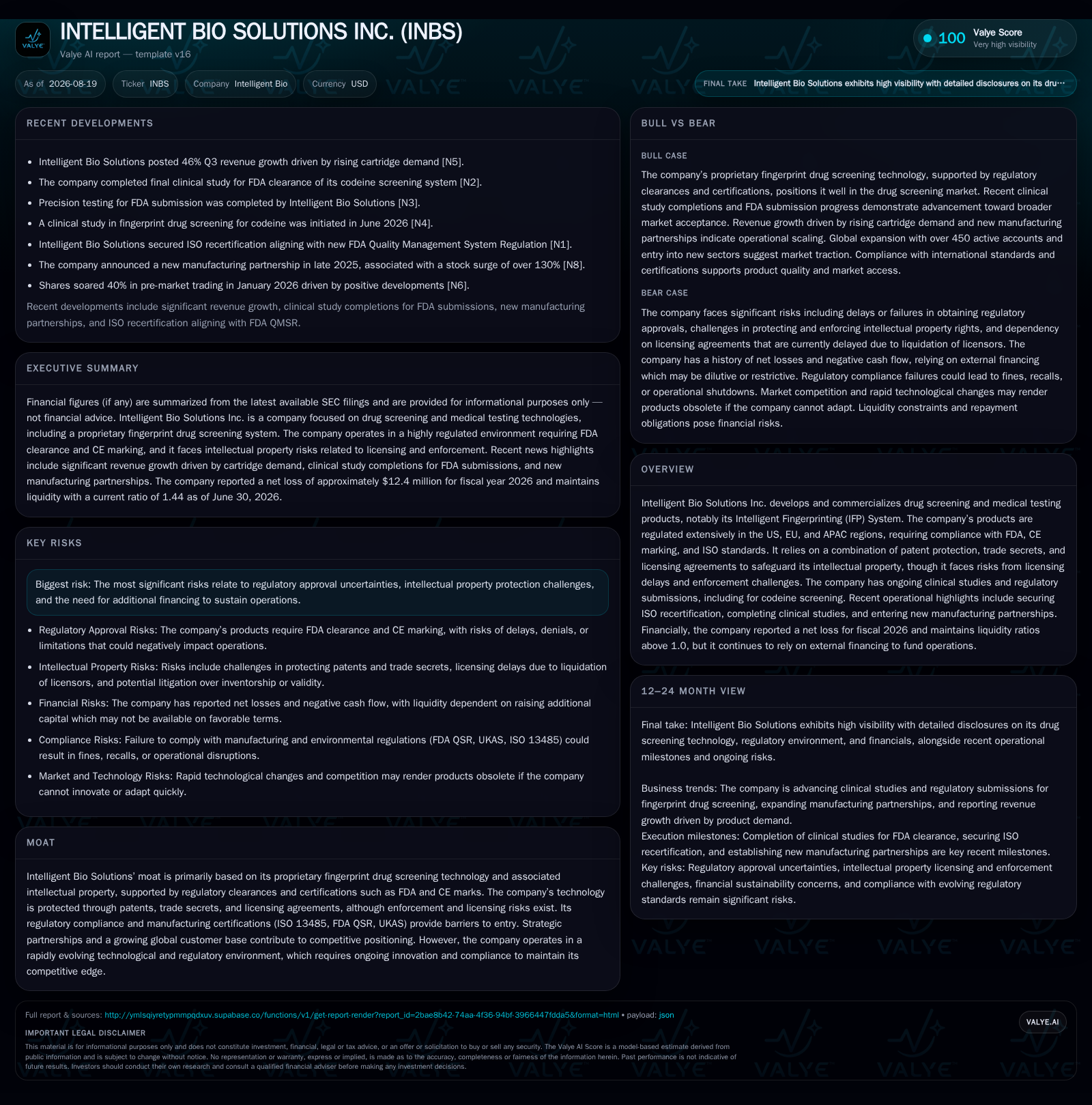
Intelligent Bio Solutions Inc. reported a net loss of $12.43 million for the fiscal year ended June 30, 2026, up from $10.57 million in the prior year, reflecting ongoing operating challenges. The company held $3.99 million in cash and $2.17 million in working capital as of June 30, 2026, with a current ratio of 1.44, raising substantial doubt about its ability to continue as a going concern without additional financing. Despite financial pressures, INBS achieved important regulatory and operational advances, including ISO recertification aligned with new FDA Quality Management System Regulations and completion of clinical studies for FDA clearance of its codeine screening system.
Fiscal Year 2026 Financial Results and Liquidity Status
Intelligent Bio Solutions Inc. reported a net loss of $12,430,975 for the fiscal year ended June 30, 2026, representing an increase from the $10,568,733 loss recorded in fiscal 2025 [S1][S3]. This widening loss underscores ongoing operational challenges as the company continues to invest in product development and regulatory activities without generating positive operating cash flow. As of June 30, 2026, the company held cash and cash equivalents of approximately $3.99 million and reported working capital of $2.17 million, supported by current assets of $7.10 million against current liabilities of $4.93 million, resulting in a current ratio of 1.44 [F1]. Shareholders’ equity stood at $5.29 million, while the accumulated deficit reached $74.96 million as of the same date [S1][F1].
Regulatory and Operational Developments
During calendar year 2026, Intelligent Bio Solutions achieved several critical regulatory and operational milestones that underpin its efforts to commercialize its proprietary drug screening technology [S3][N1]. Notably, the company secured ISO recertification aligned with the new FDA Quality Management System Regulations (QMSR), a key manufacturing certification that supports compliance with evolving regulatory standards.
In parallel, the company completed clinical studies necessary for FDA clearance of its codeine screening system, an important step toward expanding its product portfolio and market reach [S3][N2]. Additionally, INBS finalized precision testing required for FDA submission and established new manufacturing partnerships to support scaling production and distribution of its drug screening products [S3][N3]. These developments are essential for positioning the company to generate future revenue from its Intelligent Fingerprinting (IFP) System and related biosensor technologies.
Intellectual Property and Competitive Positioning
Intelligent Bio Solutions’ business model centers on proprietary fingerprint drug screening technology protected by a combination of patents, trade secrets, and licensing agreements [S1]. The company holds regulatory clearances including FDA and CE marks, which are critical for market acceptance and competitive differentiation. However, the company faces inherent risks related to intellectual property enforcement, potential delays in licensing negotiations—particularly with university licensors—and challenges from competitors potentially developing similar or alternative technologies [S1].
The company’s position relies on maintaining intellectual property protections and navigating regulatory pathways across multiple regions, including the US, EU, and APAC. Manufacturing certifications such as ISO 13485 and compliance with FDA Quality System Regulations support product quality and marketability. However, the complex regulatory environment and intellectual property risks present ongoing challenges to the company’s commercialization efforts.
Risks and Going Concern Considerations
The financial results and liquidity position of Intelligent Bio Solutions as of June 30, 2026, raise substantial doubt about its ability to continue as a going concern without securing additional financing [S1][S3][F1]. The company’s net loss of $12.43 million, combined with limited cash reserves and working capital, indicate that ongoing operating losses are expected to persist in the near term [S1][S3][S8]. Failure to obtain necessary capital could force the company to delay, reduce, or curtail its operations and development activities.
Moreover, the company faces regulatory and execution risks related to product approvals, clinical study outcomes, and manufacturing scale-up. Intellectual property enforcement challenges and licensing negotiations also present material uncertainties. These factors collectively contribute to the risk profile and underscore the importance of monitoring upcoming regulatory milestones, clinical study results, and capital raising efforts.
Business Economics and Outlook
Intelligent Bio Solutions generates revenue primarily through sales of its drug screening products and licensing agreements tied to its proprietary biosensor technology. The company’s margins and cash conversion depend heavily on achieving regulatory approvals, establishing manufacturing partnerships, and successfully commercializing its products. The recent ISO recertification and clinical study completions are positive operational indicators but have yet to translate into sustainable revenue streams.
The company’s customers include medical and drug testing laboratories, healthcare providers, and related entities that require reliable and regulatory-compliant drug screening solutions. The structural dependence on regulatory clearances and intellectual property protection creates a high barrier to entry but also introduces significant execution risk. Cyclical factors such as access to financing and market adoption rates further influence the company’s financial trajectory.
Watchpoints
Key developments to monitor include progress on FDA and other regulatory approvals for new products, outcomes and timelines of clinical studies, and any additional capital raises or financing arrangements. Changes in cash and liquidity position in subsequent filings will be important to assessing the company’s financial health. Updates on intellectual property licensing negotiations and enforcement actions will also be relevant to the company’s ability to protect its technology.
Regulatory and operational progress during 2026, including ISO recertification and clinical study completions, provide important foundations for potential commercialization of its proprietary fingerprint drug screening technology.
Disclaimer: This is research-only, informational analysis and not investment advice. It may include AI-generated interpretation and general industry context. Always verify important details using primary sources.

Comments