
Elauwit Connection Q2 2026: Continued Net Losses and Liquidity Pressure Amid Growth Investments
Elauwit Connection reported increased net losses and a working capital deficit in Q2 2026, reflecting ongoing liquidity challenges despite growth investments.
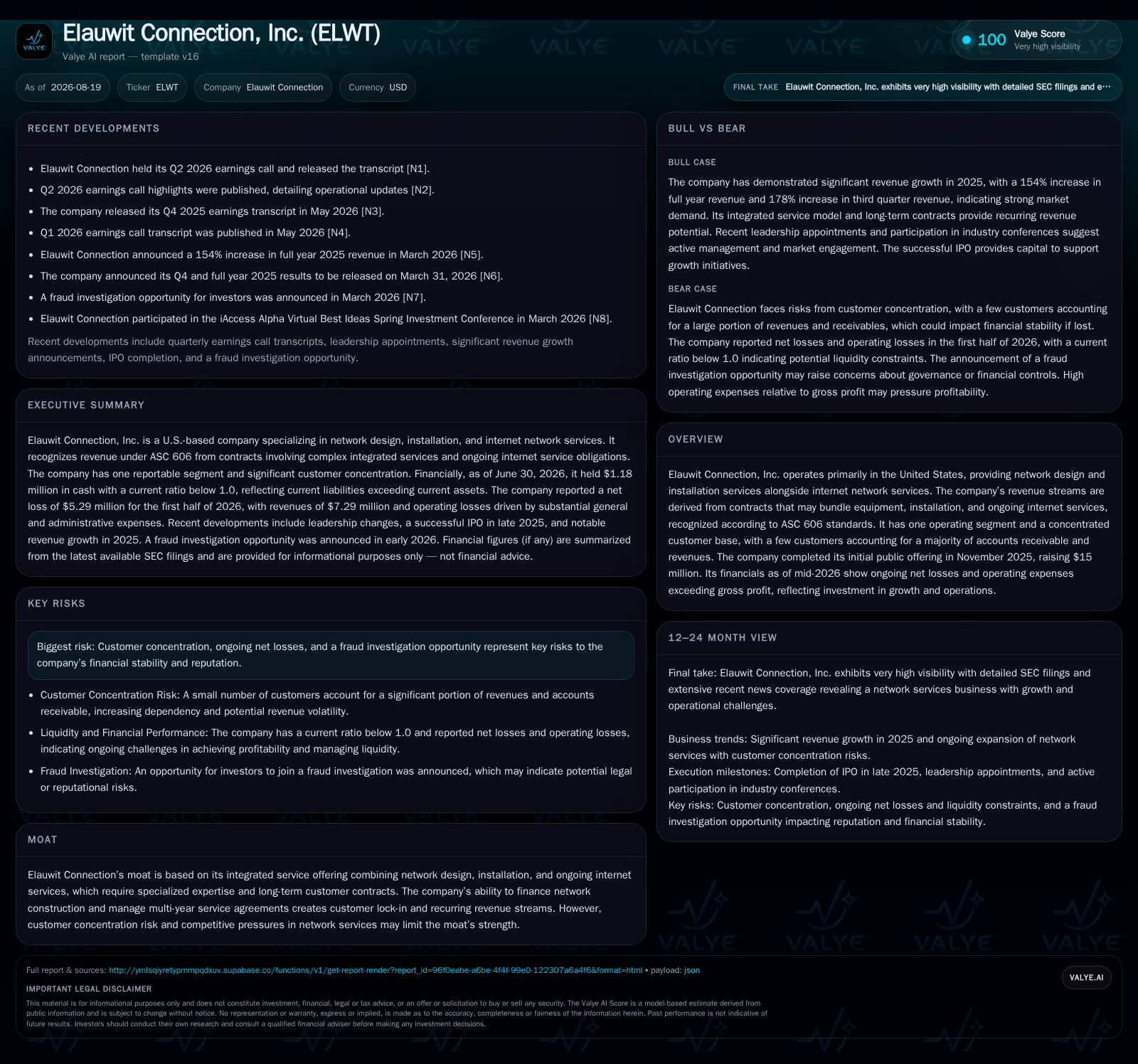
Elauwit Connection, Inc. recorded a net loss of $5.293 million for the six months ended June 30, 2026, up from $1.299 million in the same period of 2025. The company’s current ratio stood at 0.9 as of June 30, 2026, indicating a working capital deficit with current liabilities exceeding current assets. Management’s liquidity assessment considered available borrowings, forecasted cash flows, and discretionary spending reductions. Customer concentration remains a significant risk factor, potentially impacting revenue stability and credit exposure. These results highlight the structural challenge of balancing capital-intensive network infrastructure investments with operating cash flow generation.
Q2 2026 Operating and Financial Performance
Elauwit Connection, Inc. reported a net loss of $5.293 million for the six months ended June 30, 2026, compared to a net loss of $1.299 million for the same period in 2025 [S2]. The company's current ratio as of June 30, 2026, was 0.9, with current assets of $8.218 million and current liabilities of $9.121 million, indicating a working capital deficit [F1].
Operating expenses during this period continued to outpace gross profit, consistent with the company's capital-intensive business model and ongoing investment in network buildout and service expansion [S2]. These expenses include salaries, payroll taxes, travel, management fees, professional fees, insurance, rent, and other operating costs. The sustained excess of operating expenses over gross profit contributes to negative net income and cash flow from operations, underscoring the challenge of balancing upfront expenditures with revenue generation in a business where network deployment and service delivery require substantial upfront capital.
Business Model and Revenue Recognition
Elauwit Connection operates as an integrated telecommunications network services provider, delivering bundled contracts that combine network design, installation, and internet services primarily to enterprise and government customers in the United States [S1]. This bundled approach creates a recurring revenue potential through ongoing internet network services, while also generating upfront revenue from network design and installation projects.
This accounting framework requires the company to allocate transaction prices to each performance obligation and recognize revenue as those obligations are satisfied.
Margins in this business are influenced by the capital-intensive nature of network infrastructure deployment and the ongoing operating expenses required to maintain and expand service offerings. Cash conversion depends heavily on contract terms, timely customer payments, and effective working capital management, all of which are critical in this sector. The company’s recent change in trade accounts receivable loss estimation methodology to an aging schedule method, effective December 31, 2025, reflects a refinement driven by portfolio growth and more granular invoice-level aging data, allowing for a more precise estimate of expected credit losses [S2]. This change may improve the accuracy of credit loss provisions but also highlights the importance of managing credit risk in a customer-concentrated environment.
Liquidity and Going Concern Considerations
Management’s assessment of the company's ability to continue as a going concern for at least one year from the August 19, 2026 filing date incorporated multiple factors [S2]. These included the current liquidity position, which comprised $1.18 million in cash and equivalents as of June 30, 2026 [F1], the availability of additional borrowings under the May 2026 Term Loan, forecasted cash flows anticipating improved operating results, and the capacity to reduce discretionary spending if necessary.
Despite these considerations, the working capital deficit and increasing net losses underscore ongoing liquidity challenges. The structural capital intensity of the business requires careful management of cash flows and financing arrangements to sustain operations and fund network expansion. The company’s ability to access additional borrowings under the May 2026 Term Loan provides a critical liquidity buffer [S2], but reliance on external financing also introduces refinancing and covenant risks that must be monitored closely.
Customer Concentration and Risk Profile
A significant risk factor for Elauwit Connection is customer concentration. A limited number of customers account for the majority of accounts receivable and revenues, elevating the company's exposure to credit risk and revenue volatility [S1]. This concentration means that delays in payments or contract reductions by major customers could materially impact cash flow and financial stability.
This risk is compounded by the capital-intensive nature of the business, where upfront investments precede revenue realization. The concentration of revenue among a few customers increases the company's vulnerability to customer-specific credit and demand risks, which could exacerbate liquidity challenges if major customers delay payments or reduce contract scope. Effective credit risk management and diversification of the customer base are therefore critical to improving revenue stability and reducing financial risk.
Business Economics and Sector Context
In the telecommunications network services industry, companies like Elauwit Connection generate revenue through bundled contracts combining equipment sales, installation, and ongoing internet services. This approach offers recurring revenue streams and customer lock-in but requires substantial upfront capital expenditures, leading to working capital intensity and cash flow timing mismatches.
Key sector performance indicators include contract backlog, recurring revenue percentage, customer concentration ratios, operating expense ratios, and cash flow from operations. These metrics help assess the company's ability to convert investments into sustainable revenue and profits.
Elauwit Connection’s integrated service offering aims to differentiate it by providing end-to-end network solutions, which can create competitive advantages through customer lock-in and bundled service efficiencies. However, competitive pressures in the network services industry and the company’s customer concentration risks limit margin expansion and cash flow stability.
Watchpoints
Investors and analysts should monitor quarterly revenue growth and margin trends to evaluate operating leverage and progress toward profitability. Changes in customer concentration and accounts receivable aging will provide insight into credit risk and revenue stability. Additionally, cash flow from operations and capital expenditure levels will indicate the company's ability to fund growth internally.
Liquidity position and the availability and utilization of term loan borrowings are critical to sustaining operations amid ongoing net losses and working capital deficits. Any developments related to legal or regulatory investigations could also impact costs and reputation, warranting close attention.
The increased net loss and working capital deficit reflect these pressures. The company’s liquidity management, access to financing, and ability to diversify its customer base will be key factors to watch in assessing its financial health and growth prospects.
Disclaimer: This is research-only, informational analysis and not investment advice. It may include AI-generated interpretation and general industry context. Always verify important details using primary sources.

Comments