
NeuroOne Medical Technologies Q3 2026: Operating Losses Persist Amid Limited Revenue and Strong Liquidity
NeuroOne Medical Technologies reported ongoing operating losses and maintained a liquidity buffer as of Q3 2026, underscoring financial and operational challenges in its early commercialization phase.
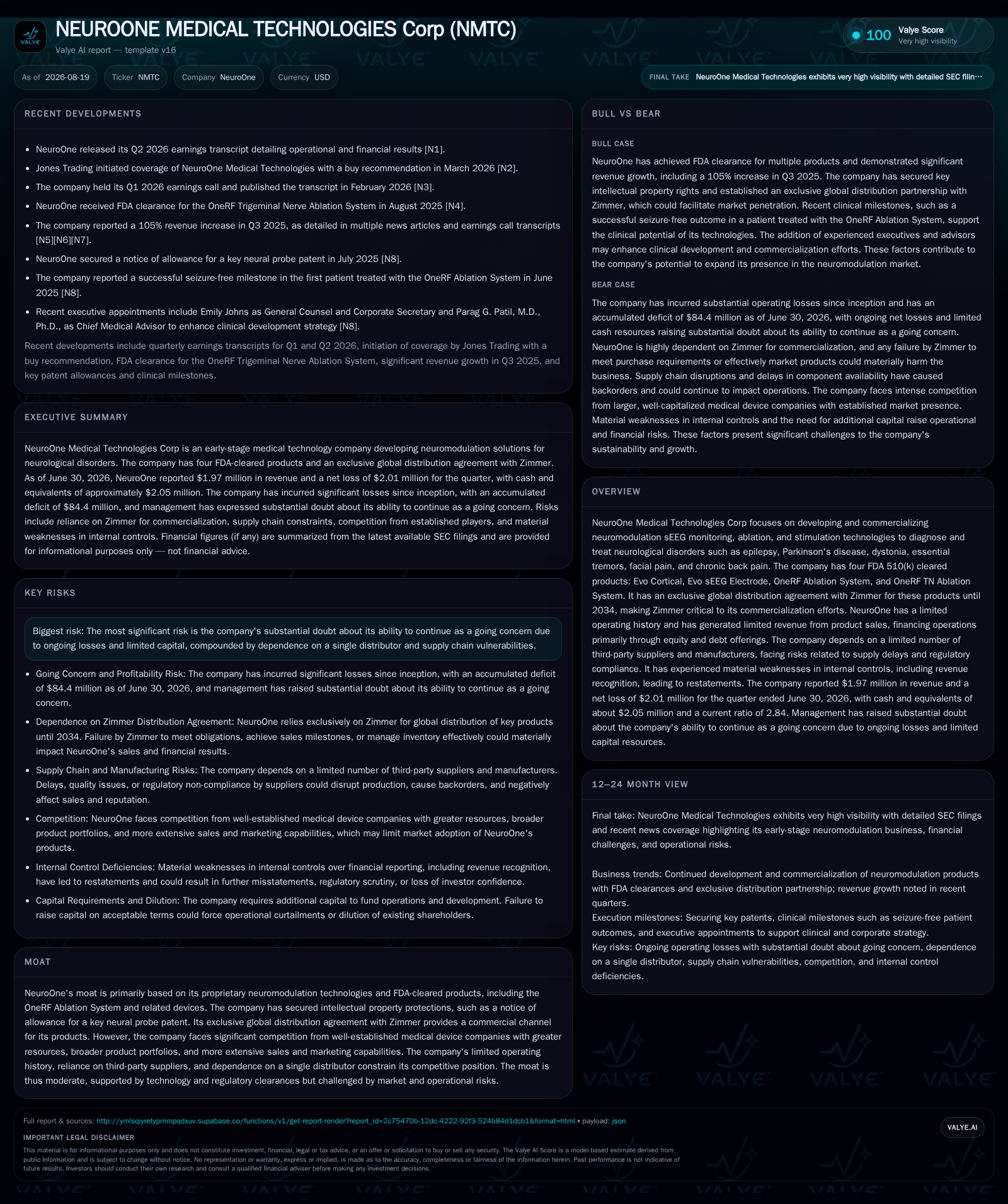
NeuroOne Medical Technologies Corp continues to operate at a loss with an accumulated deficit of $84.4 million as of June 30, 2026, reflecting its early-stage commercialization status. Despite holding cash and current assets exceeding current liabilities, resulting in a current ratio of 2.84, management has reiterated substantial doubt about the company's ability to continue as a going concern. The company’s revenue remains limited and dependent on a single global distributor, Zimmer Biomet, while proprietary neuromodulation technologies underpin a moderate competitive position amid operational risks.
Latest Quarterly Operating and Financial Update
NeuroOne Medical Technologies Corporation reported continued operating losses during the third quarter of fiscal 2026 ended June 30, 2026. The company’s accumulated deficit reached $84.4 million as of that date, underscoring significant operating losses since inception primarily driven by expenses related to research and development, regulatory activities, and commercialization efforts [S2]. Management has explicitly stated substantial doubt about NeuroOne’s ability to continue as a going concern as of June 30, 2026, a concern that has persisted since the prior fiscal year [S2].
These assets exceed current liabilities of $2.04 million, resulting in a current ratio of 2.84, indicating a positive working capital buffer at the quarter-end [F1]. However, this liquidity does not eliminate the going concern risks given the company’s limited operating history and ongoing need for external financing [S2],[F1].
Business Model and Commercialization Context
NeuroOne operates as an early-stage medical technology company focused on neuromodulation products for the diagnosis and treatment of neurological disorders. Its product portfolio includes four FDA 510(k) cleared devices such as the Evo Cortical and OneRF Ablation Systems, which form the foundation of its proprietary technology moat [S1],[S2]. Revenue generation is primarily derived from product sales facilitated through an exclusive global distribution agreement with Zimmer Biomet that extends through 2034 [S2],[S3],[S1].
The company’s commercialization remains limited, reflecting its nascent market penetration and dependence on Zimmer Biomet as the sole distributor. This concentration introduces operational risk, as any disruption in this partnership could materially affect revenue streams. Furthermore, NeuroOne relies on a small number of third-party suppliers and manufacturers, which may pose supply chain and regulatory compliance challenges [S2],[S4].
Competitive Position and Industry Context
NeuroOne’s competitive position is supported by its proprietary neuromodulation technologies and multiple FDA clearances, which contribute to its differentiation relative to peers. However, this position is affected by the company’s limited operating history, dependence on a single distributor, and competition from larger, more established medical device companies with broader portfolios and extensive sales networks [S1],[S2].
The medical device industry’s structural drivers include regulatory hurdles and technology development cycles, which NeuroOne continues to navigate as it advances its product commercialization. While demand for medical devices tends to be stable, capital market conditions and regulatory scrutiny remain relevant cyclical factors impacting NeuroOne’s financing and operational environment.
Financial Analysis and Capital Structure
NeuroOne’s financial profile as of Q3 2026 reflects the typical characteristics of an early-stage medical technology company [S2]. The company’s limited revenue from product sales is consistent with its early commercialization phase, and it continues to incur operating losses due to ongoing investments in R&D, regulatory approvals, and market development.
The balance sheet shows a cash position of approximately $2.05 million and current assets exceeding current liabilities by roughly $3.75 million, yielding a current ratio of 2.84 as of June 30, 2026 [F1]. This positive working capital provides a liquidity buffer but does not fully mitigate the risks associated with continued operating losses and capital requirements. Capital allocation remains focused on advancing product development and commercialization, with no dividends or share repurchases reported [S2],[F1].
Risks and Going Concern Considerations
NeuroOne faces significant financial and operational risks. The company’s ongoing operating losses and substantial accumulated deficit highlight the uncertainty surrounding its path to profitability. Management’s reaffirmation of substantial doubt about the company’s ability to continue as a going concern reflects these risks [S2].
Operational vulnerabilities include reliance on a single global distributor and a limited number of third-party suppliers, which may lead to supply delays or regulatory compliance challenges. Additionally, the company operates in a highly regulated environment subject to FDA oversight and other healthcare regulations, which can impose costly and time-consuming requirements [S2],[S4].
The proprietary neuromodulation technology portfolio and FDA clearances contribute to the company’s differentiation, but dependence on a single distributor and operational challenges persist. Continued investment in R&D and commercialization is expected to drive further operating losses in the near term, with the timing of profitability remaining uncertain.
Disclaimer: This is research-only, informational analysis and not investment advice. It may include AI-generated interpretation and general industry context. Always verify important details using primary sources.

Comments