
Distributor Dynamics and Supply Chain Risks Define Agape ATP’s Health and Renewable Transition
Agape ATP’s August 2026 filing reveals operational challenges tied to supplier concentration and distributor engagement within its MLM health supplements business, alongside emerging renewable energy initiatives.
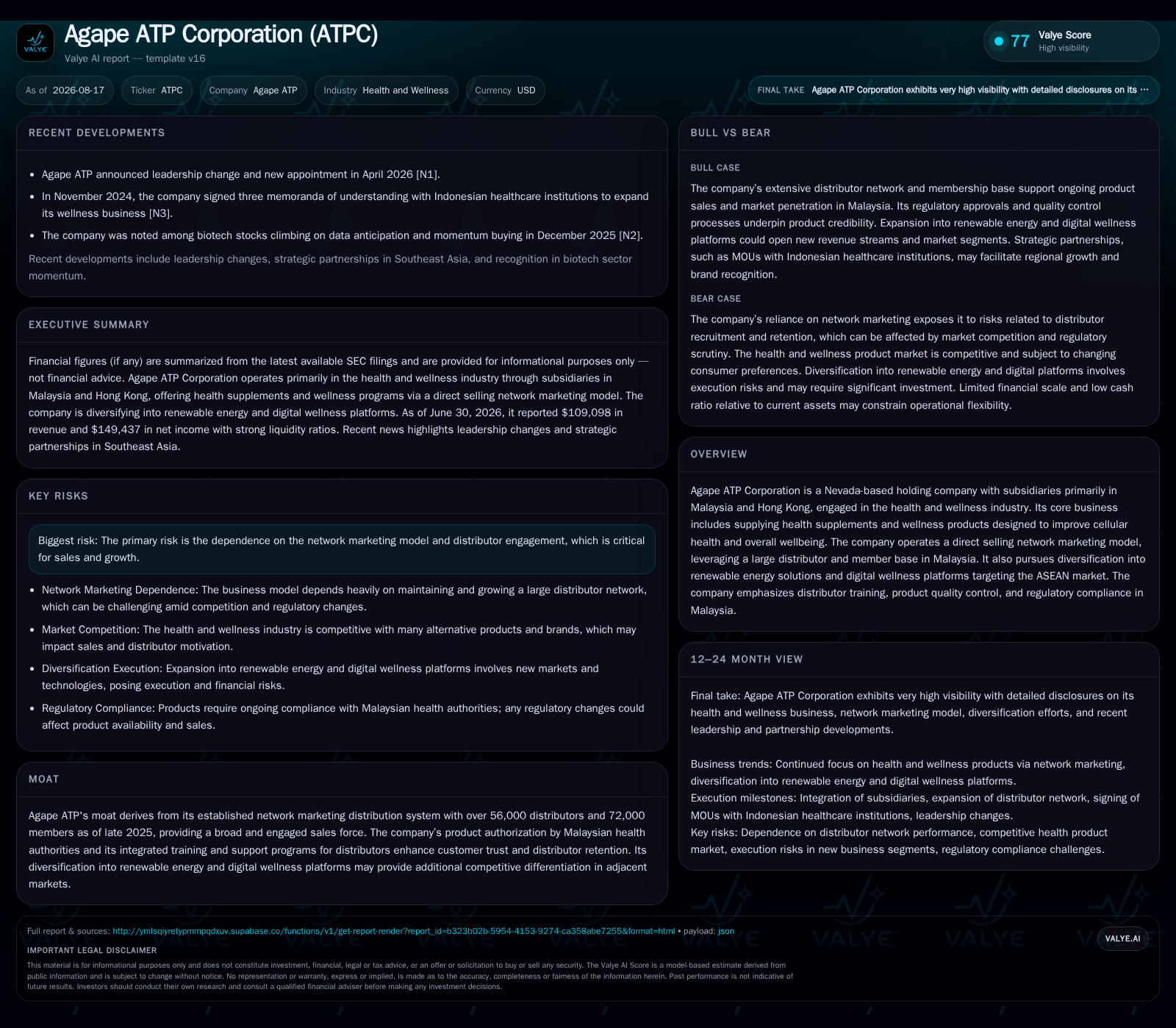
The Q2 2026 update from Agape ATP Corp spotlights continuing operating pressures from heavy reliance on a concentrated supplier pool, which threatens inventory replenishment reliability and margin stability. Meanwhile, the company’s foundational multi-level marketing model centers on a large Malaysian distributor network whose recruitment and training remain critical to sustaining sales growth. Emerging diversification into renewable energy and digital wellness platforms offers potential upside but remains early-stage. Key risks include distributor retention dynamics, supply chain disruptions, and regulatory environment shifts impacting product approvals and consumer trust.
Q2 2026 Operating Update Signals Network Marketing Strains and Strategic Shifts
Agape ATP's latest quarterly filing dated August 14, 2026 highlights notable operational pressures centered around its core health and wellness product supply chains alongside strategic diversification efforts. The company continues to rely heavily on three principal suppliers who together accounted for roughly 87% of its total purchases in 2025: one supplier provided about 55.6%, with the other two contributing approximately 20.3% and 11.1% respectively [S1]. This supplier concentration exposes the firm to risks including supply delays or shortages that could curtail product availability to its extensive distributor network in Malaysia. The filing flags potential disruptions such as labor disputes or natural disasters impacting suppliers' operations [S1]. Such interruptions could cascade downstream resulting in delayed inventory replenishments—a key revenue driver in Agape ATP’s multi-level marketing (MLM) model—and slower cash inflows due to deferred deliveries [S1].
At the same time, the company is pursuing expansion into renewable energy solutions through subsidiaries formed from early-to-mid-2024 onward—an initiative positioned as part of Agape ATP's long-term value creation strategy amid changing global trends [S1]. However, this diversification remains nascent with no material revenue contribution yet reported [S2]. The core MLM operations remain central; thus, managing supplier-related constraints while maintaining distributor engagement is paramount.
How Agape ATP's MLM Model Drives Revenue Through Distributor Expansion and Product Quality
Agape ATP monetizes through direct selling of authorized health supplements and wellness products primarily within Malaysia’s growing consumer market. Its business model follows typical network marketing industry archetypes where an extensive base of independent distributors sells products directly to end consumers while recruiting new members who generate further sales volume [S1]. As of late 2025 data points cited in the filings, Agape ATP boasts more than 56,000 distributors supported by approximately 72,000 members—a substantial network scale that creates a meaningful moat via entrenched distribution channels [S1].
Product authorization by Malaysian health authorities (Food Safety and Quality Division and National Pharmaceutical Regulatory Agency) adds an essential layer of regulatory compliance that builds trust both among distributors and consumers alike [S1]. Samples from every batch undergo random testing at government-registered labs ensuring quality control—a critical factor mitigating churn risk common in MLM health supplement models [S1].
Distributor training programs are vigorously pursued by the company to enhance sales capability and motivate consistent inventory replenishment—a keystone for recurring revenue streams that depend on sustained buying cycles rather than one-off purchases [S1], [S2]. These efforts help counteract natural attrition common in direct selling businesses by promoting member productivity and loyalty.
Supplier Concentration Risks Raise Red Flags for Inventory Replenishment Timing and Margins
The heavy reliance on just a handful of suppliers significantly raises operational risk for Agape ATP. Purchases from these top three suppliers amounted collectively to almost $573,000 in 2025 alone—more than four-fifths of total procurement spend—and notably without long-term contracts or guaranteed supply terms [S1]. The ad hoc nature of purchase orders leaves little room for negotiating favorable pricing or contingencies for volume fluctuations.
If suppliers change their export strategies, reduce production volumes, or raise prices—as acknowledged as possibilities by management—the impact would likely pressure gross margins since Agape ATP might struggle to pass cost increases fully onto its price-sensitive distributor base [S1]. Furthermore, any shipment delays could disrupt distributors’ inventory replenishment cycles reducing sales momentum while tangibly affecting cash flow timings due to slower collections from customers [S1]. This dynamic accentuates working capital strain particularly given the MLM “front-loaded” commission structure whereby upfront commissions are paid before product resales occur downstream.
Competitive Benchmarking Against MLM Peer Practices Highlights Operational Levers
While specific peer financials are not disclosed in filings, broader industry context positions Agape ATP among small-to-mid scale players similar in strategy though smaller than benchmarks like Herbalife Nutrition or Amway. Like these peers, success hinges heavily on recruiting efficiency combined with robust regulatory-compliant product portfolios that maintain consumer confidence.
Agape ATP’s emphasis on formalized distributor training programs parallels industry best practices at Herbalife and Amway which invest considerable resources into ongoing education to enhance distributor productivity and mitigate churn. Such investments typically elevate selling expenses but yield improved average sales per distributor over time if executed well.
Moreover, rigorous product quality controls akin to standards pursued by peers such as USANA Health Sciences contribute positively toward brand reputation—a critical factor given the reputational sensitivities surrounding MLM operations globally. Agape ATP’s thorough batch testing regimen leverages local regulatory credibility as a differentiating asset that can reinforce user retention metrics if consistently upheld.
Growth Prospects: Product Innovation, Regulatory Approvals, and Diversification Potential
Future growth avenues focus on launching additional health supplements securing approval from Malaysian regulators—critical milestones that validate safety claims enabling market acceptance [S1]. New product introductions aligned with evolving consumer trends such as anti-aging or detoxification may expand appeal within existing channels while attracting fresh recruits.
Parallelly, diversification into digital wellness platforms offering advisory content aims at broadening service lines beyond physical products catering to lifestyle wellness trends notably prevalent across ASEAN markets [S1]. Renewable energy projects constituting acquisitions of energy subsidiaries since early 2024 represent longer-term strategic pivots earmarked for sustainable value creation under global decarbonization themes.
While promising conceptually, these expansions currently lack clear evidence of meaningful revenue contributions or scalability metrics; thus their successful monetization remains contingent on execution capabilities alongside core MLM business stabilization.
Key Risks: Distributor Engagement, Supply Chain Vulnerability, Regulatory Sensitivity, Reputational Factors
Agape ATP’s largest inherent risk centers on sustaining an active distributor base crucial for sales generation; diminished recruitment or rising attrition would materially dampen revenue given heavy commission payout structures tied directly to network size [S1], [S2]. Additionally, prolonged supplier disruptions threaten inventory availability critical for replenishment-driven MLM sales cycles exacerbating engagement challenges.
Regulatory scrutiny poses ongoing risk considering the necessity of continual compliance with Malaysian health authorities’ evolving standards plus global skepticism toward MLM schemes requiring transparency to avoid reputational damage affecting consumer sentiment. Any adverse publicity related to product safety or business practices could depress demand sharply in this brand-sensitive space.
Finally economic cycles influencing discretionary spending patterns may truncate customer willingness to purchase non-essential wellness products during downturns—heightening susceptibility compared to staple goods providers.
What to Watch: Distributor Metrics, Regulatory Notices, New Product Launches, Renewable Energy Milestones
Investors and analysts should track quarterly updates on active distributor counts and member engagement rates which serve as vital forward-looking demand proxies reflecting network vitality [S2]. Timely announcements regarding maintenance or issuance of regulatory licenses will signal ongoing compliance capacity supporting portfolio expansion.
Monitoring new product launches approved by Malaysian regulators will indicate innovation trajectory underpinning future topline enhancements. Likewise spotlighting operational progress within renewable energy subsidiaries could reveal materialization of strategic diversification plans aiding longer-term growth beyond core MLM dependencies.
Correspondingly observing inventory turnover ratios will provide indirect insight into supply chain execution effectiveness amidst supplier concentration risks previously documented.
Financial Profile Discussion: Liquidity Cushion Supports Execution but Profitability Remains Challenged
Agape ATP maintains a conservative liquidity posture as evidenced by a current ratio standing robustly at approximately 8.45 at quarter-end June 30, 2026 supported by current assets near $24.8 million USD against liabilities around $2.9 million USD [F1]. Cash reserves tally modestly at about $45K reflecting minimal idle funds but sufficient working capital buffer alleviating immediate solvency concerns amidst revenue volatility [F1].
This analysis synthesizes Agape ATP Corp’s recent disclosures highlighting the intertwined operational dynamics endemic to health supplement MLM businesses compounded by external supply vulnerabilities while recognizing nascent diversification efforts aimed at augmenting future growth potential without yet offsetting foundational profitability challenges. Continual monitoring of distributor engagement metrics alongside supplier performance indicators combined with regulatory developments will be essential barometers informing competitive positioning over coming quarters.
Disclaimer: This report is an analytical assessment based solely upon publicly available information including SEC filings as referenced; it does not constitute investment advice nor does it incorporate confidential company insights.
Disclaimer: This is research-only, informational analysis and not investment advice. It may include AI-generated interpretation and general industry context. Always verify important details using primary sources.

Comments