
1847 Holdings Faces Liquidity and Going Concern Challenges Amid Portfolio Growth Strategy
1847 Holdings LLC pursues fragmented small business acquisitions with operational improvements but faces critical near-term liquidity constraints.
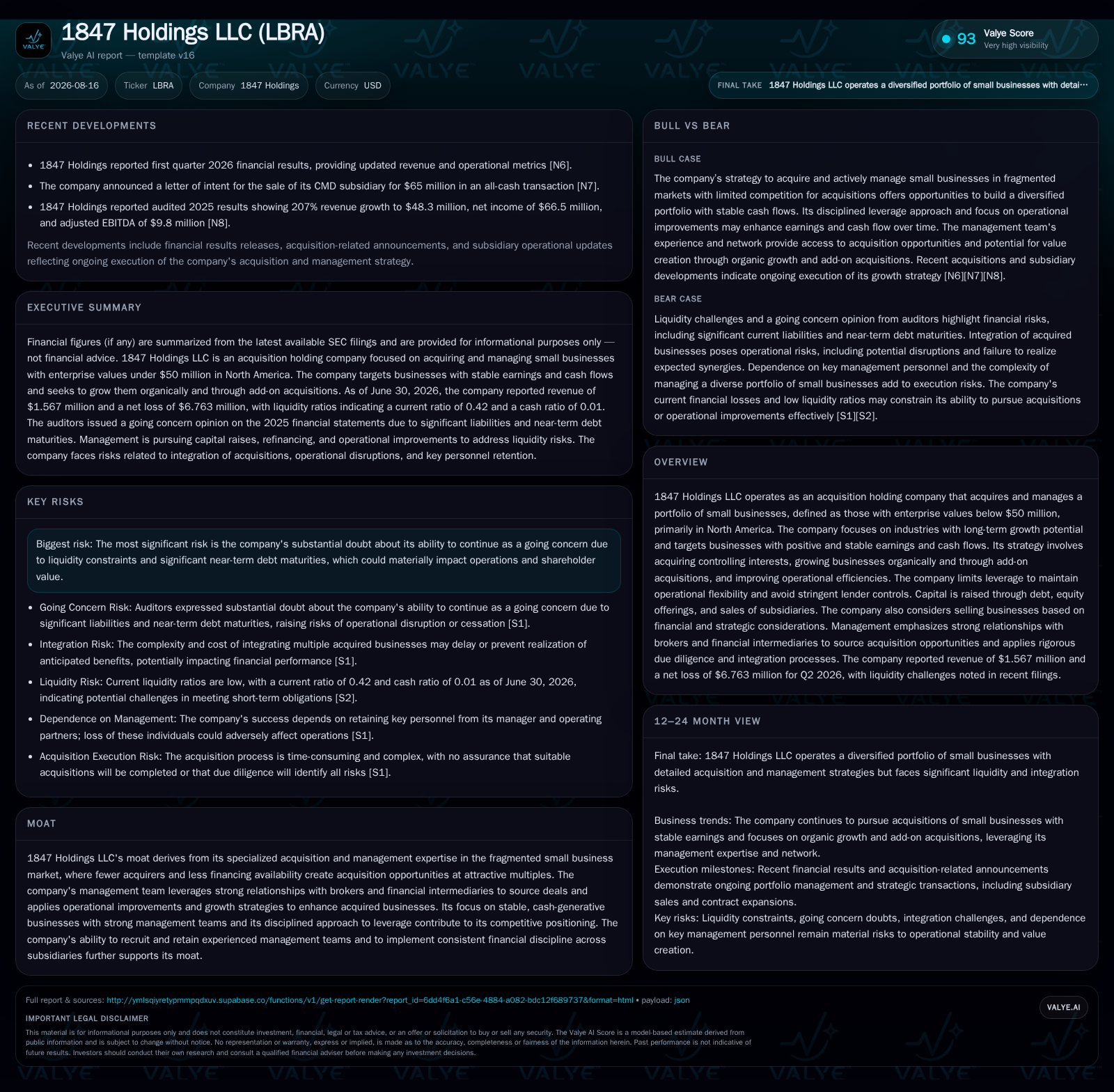
1847 Holdings LLC operates as an acquisition holding company targeting controlling interests in North American small businesses under $50 million enterprise value, focusing on stable cash-generative companies with long-term growth potential. The company’s moat lies in its specialized deal sourcing through broker networks and disciplined portfolio management emphasizing organic growth and add-on acquisitions. However, its financial profile is constrained by significant liquidity challenges and a going concern qualification due to large near-term debt maturities, which overshadow recent operating income and cash generation. Future performance hinges on successful capital raises, refinancing strategies, and effective portfolio operational execution.
Recent Operating Update
The most recent quarter ending June 30, 2026, serves as the primary lens for evaluating 1847 Holdings LLC's near-term operating dynamics. The company filed its latest 10-Q on August 14, 2026 [S2] along with an accompanying 8-K that disclosed the quarterly results and reiterated the liquidity risks facing the firm [S3]. As of this quarter-end, cash and cash equivalents totaled only $442,279 while current liabilities remained exceptionally high at approximately $71.3 million [F1].
Despite these financial pressures, the company maintained positive operating income in the previous full fiscal year of around $4.0 million and generated operating cash flows above $3.3 million [S1]. This indicates the underlying subsidiaries continue generating stable cash flows aligned with management’s strategy to acquire profitable small businesses and enhance their performance organically or via add-ons. However, the scale of liabilities combined with looming debt maturities casts doubt on continued operations absent successful debt refinancing or equity capital raises.
Management acknowledges this going concern qualification explicitly in its annual disclosure [S1], citing uncertainty about meeting obligations over the next twelve months even considering ongoing operational profitability and cash flow generation. The company plans to pursue additional funding through public or private offerings of securities and is exploring strategic alternatives including possible divestitures of subsidiaries to reduce debt burdens.
Business Model Analysis
1847 Holdings functions as an acquisition holding company concentrating on North American small businesses with enterprise values below $50 million [S1]. It differs from pure private equity by operating a portfolio approach aimed at acquiring controlling interests predominantly in businesses exhibiting positive pro forma distributable cash flows for at least three years prior to acquisition—a marker signaling mature operations resistant to immediate obsolescence or major industry volatility.
Revenue generation predominantly occurs at the subsidiary level through traditional product or service sales within their respective industries; 1847 Holdings consolidates these subsidiary earnings while focusing on portfolio-level enhancements such as improving operational efficiencies through financial reporting upgrades, management system improvements, and scaling via add-on acquisitions [S1]. The firm’s monetization involves increasing EBITDA margins across its holdings to deliver steady distributions to common shareholders.
A vital part of its business model is leveraging deep relationships with brokers, investment bankers, commercial lenders, accountants, and attorneys who facilitate acquiring opportunities typically not broadly auctioned due to smaller size or owner-specific considerations like legacy board involvement or employee effects [S1]. This network advantage helps secure deals at lower acquisition multiples compared to larger peers targeting higher-value enterprises.
Furthermore, rather than relying solely on bolt-on acquisitions for growth, the company prioritizes stable earnings profiles coupled with organic operations improvements implemented by upgrading management teams at acquired firms—suggesting a hybrid approach melding private equity-style active management with longer-duration holding company strategies.
Industry Structure & Competitive Position
Within the broader Business Acquisition and Holding Companies sector focused on lower middle-market transactions, 1847 Holdings sits in a fragment characterized by high levels of deal fragmentation and limited financing availability compared to larger buyout targets. This structural circumstance depresses acquisition multiples yet demands significant operational expertise post-transaction if value is to be realized.
Peers can include specialized lower middle-market private equity firms, family offices managing small business portfolios, business development companies targeting similar sizes, or holding groups leveraging broker networks for deal origination. Unlike some peers aiming for rapid scaling or tech-enabled platform builds, 1847 Holdings leans heavily into stable businesses less subject to technological disruption or competitive obsolescence [S1].
The company’s moat derives chiefly from this specialization—the ability to source less competitive deals via strong intermediary ties and then apply consistent operational rigor to improve EBITDA margins across acquired companies at a modest leverage level designed to avoid stringent lender restrictions seen elsewhere. Such discipline allows it to emphasize long-term organic growth alongside selective add-ons, distinguishing it from more aggressive private equity sponsors whose returns depend mostly on multiple arbitrage or high financial engineering.
Growth Drivers
Several factors support potential portfolio expansion:
- The fragmented nature of the targeted market segment ensures a continuous pipeline of acquisition prospects often overlooked by larger buyers due to size or complexity constraints.
- Established relationships with brokers and intermediaries provide privileged access to off-market deals that may be priced more attractively given fewer bidders.
- Opportunities exist for operational uplift within many acquired firms by bolstering management talent and introducing better financial systems—leading to margin expansion.
- Add-on acquisitions supplement organic growth by consolidating local niche players under common ownership thereby benefiting from economies of scale.
- Target industries are selected based on favorable macroeconomic tailwinds ensuring longer-term demand durability even amid economic fluctuations.
Realizing these growth drivers depends heavily on capital availability since acquisitions require upfront investment alongside resources dedicated to integration efforts. Moreover, skilled portfolio management teams must maintain alignment with corporate objectives while driving subsidiary performance improvements.
Risks & Watchpoints
The primary risk afflicts 1847 Holdings’ precarious liquidity position accentuated by substantial near-term debt maturities that raise a genuine going concern issue reported by auditors last fiscal year [S1]. Although management intends capital raises and possible refinance actions, success is uncertain given challenging market conditions for raising funds without dilutive terms or excessive cost.
Integration challenges pose another material risk since acquired businesses operate across varied industries requiring tailored approaches; failure here could dilute estimated benefits leading to diminished cash flows.
Market fragmentation though advantageous for deal sourcing implies inherent valuation uncertainty due to fewer auction processes resulting in irregular pricing norms that could expose the firm to overpaying risks or heightened competition if more players enter this niche segment.
Legal proceedings—such as ongoing litigation related to alleged contract breaches involving securities purchase agreements—introduce potential financial liabilities as well as distraction risk impacting strategic flexibility [S1]
Further risks encompass dependency on strong management teams at each portfolio company; any attrition or underperformance could impair expected financial returns pending replacement efforts or restructuring.
Lastly macroeconomic slowdowns affecting key sectors within the portfolio could pressure revenues temporarily despite structural positioning.
What To Watch Next
Key milestones will include:
- Capital raising updates: Timely announcements regarding equity or debt financings capable of alleviating current liquidity crunches would signal improved survivability.
- Debt maturity refinancings or extensions: Successful negotiations here would reduce immediate default risk allowing focus back on operations.
- Portfolio performance metrics: Indicators such as organic revenue growth rates within subsidiaries plus EBITDA margin trends will reveal whether operational improvement strategies translate into tangible financial uplift.
- Add-on acquisition volume: New deals completed at accretive multiples would demonstrate sustained access to attractively priced platform expansions.
- Legal case developments: Resolution outcomes affecting contingent liabilities could materially impact balance sheet strength or distract management focus.
- Management team stability: Retention announcements for critical subsidiary leaders would support continuity assumptions integral for executing growth initiatives.
Financial Profile Discussion
As of June 30, 2026 [F1], 1847 Holdings displays constrained financial health markers consistent with going concern commentary:
- Cash & equivalents are $442,279 against current liabilities exceeding $71 million.
- Current assets totaled about $29.9 million but pale relative to short-term obligations signaling stressed working capital conditions potentially impeding normal operations without external support.
Investors should monitor incremental developments around liquidity initiatives alongside execution effectiveness over subsidiary performance metrics informing medium-to-long term value realization pathways.
Disclaimer: This article is provided strictly for informational purposes reflecting publicly available data as of August 2026 and does not constitute investment advice or research views.
Disclaimer: This is research-only, informational analysis and not investment advice. It may include AI-generated interpretation and general industry context. Always verify important details using primary sources.

Comments