
Kimball Electronics Q3 2026: Quarterly Revenue Decline and Q4 Loss Highlight Near-Term Challenges
Kimball Electronics experienced sequential revenue declines in Q3 2026 and reported a Q4 loss, reflecting near-term cyclical pressures amid a stable liquidity position at fiscal year-end.
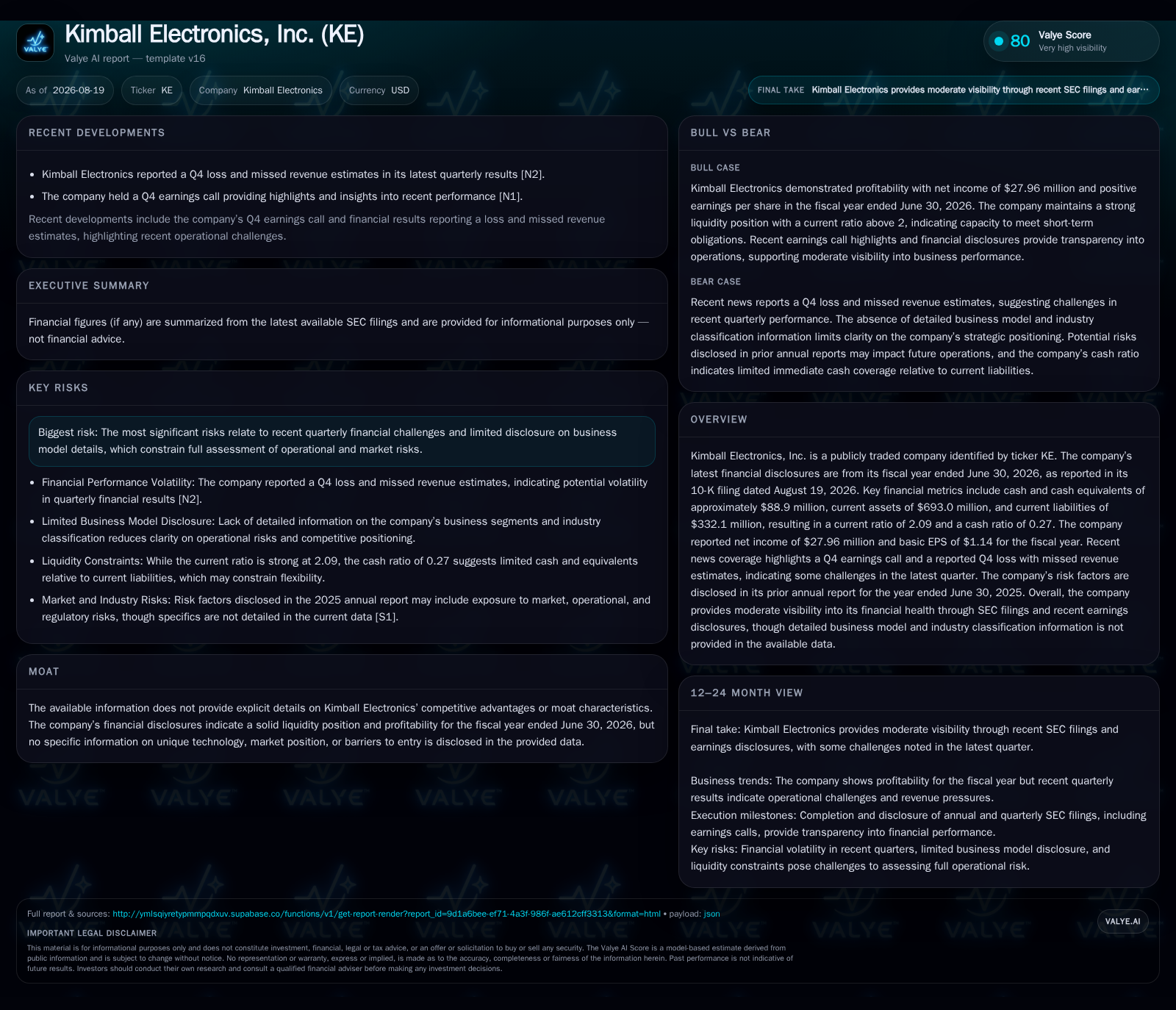
Kimball Electronics, an electronic contract manufacturer, reported a sequential revenue decline in Q3 2026 followed by a Q4 2026 net loss with missed revenue estimates. These quarterly results contrast with the company’s fiscal 2026 full-year profitability and highlight near-term operational challenges likely driven by cyclical demand softness. Despite these setbacks, the company maintained a solid liquidity profile and manageable leverage as of June 30, 2026. Monitoring upcoming revenue, margin trends, and order backlog will be critical to assess recovery prospects.
Near-Term Operating Performance and Revenue Trends
Kimball Electronics, Inc., a contract manufacturer specializing in electronic components and assemblies, reported a sequential decline in revenue during the third quarter of fiscal 2026, as disclosed in its 10-Q filing dated May 6, 2026 [S2]. This downward trend continued into the fourth quarter, where the company reported a net loss and missed revenue estimates according to the 8-K filing and earnings release dated August 12, 2026 [S3]. These quarterly results mark a departure from the company’s prior performance within fiscal 2026, indicating near-term operational and market challenges.
Electronic contract manufacturers (ECM) like Kimball typically experience fluctuations tied to OEM product cycles and broader market conditions. The Q4 2026 loss implies margin compression or increased cost pressures during the quarter, contrasting with the company’s earlier profitability within fiscal 2026 [S2][S3]. This sequential revenue decline and earnings miss suggest that Kimball is currently facing cyclical softness in demand, likely influenced by OEM customers adjusting production in response to end-market conditions. The company held $88.9 million in cash and cash equivalents against total debt of $116.2 million, resulting in net debt of approximately $27.3 million [F1]. This moderate leverage position is complemented by a current ratio of 2.09, derived from current assets of $693.0 million and current liabilities of $332.1 million, indicating a strong short-term liquidity buffer [F1].
This financial position provides Kimball Electronics with operational resilience amid the cyclical challenges reflected in the recent quarters. The current ratio above 2.0 suggests that Kimball has sufficient current assets to cover its short-term liabilities comfortably, which is critical in a capital-intensive manufacturing environment where working capital management is essential [F1]
Moreover, the relatively low net debt compared to cash holdings indicates prudent financial management, enabling the company to maintain flexibility in capital allocation and potentially invest in operational improvements or strategic initiatives when market conditions stabilize. This liquidity and leverage profile is a key factor in mitigating risks associated with cyclical downturns in the ECM industry.
Business Model and Industry Positioning
Kimball Electronics operates as an electronic contract manufacturer providing turnkey manufacturing services to original equipment manufacturers (OEMs). Its offerings include printed circuit board assembly (PCBA), box build assembly, and supply chain management services [S1]. Revenue generation is primarily through contract manufacturing agreements, which may be project-based or long-term, with OEM customers outsourcing their electronic manufacturing needs.
In this capital-intensive and complex sector, key operational drivers include capacity utilization, manufacturing yield, fixed cost absorption, and supply chain efficiency. Margins are sensitive to these factors, as well as to the ability to manage bill of materials costs and operational throughput. Competitive positioning depends on quality certifications, operational efficiency, and supply chain agility, though no explicit proprietary advantage is documented for Kimball Electronics.
The ECM industry’s cyclical nature means that near-term revenue softness can reflect demand fluctuations. Kimball’s recent quarterly revenue decline and loss are consistent with this pattern. The company’s business model ties its financial performance to the production cycles and capital expenditure plans of its OEM customers, which can be volatile and influenced by broader economic conditions.
Key performance indicators for the industry include capacity utilization rate, order backlog, manufacturing yield, gross margin per unit, and working capital intensity. These metrics directly impact Kimball’s ability to convert revenue into profit and cash flow. For example, lower capacity utilization during demand downturns can lead to higher per-unit fixed costs and margin compression, as seen in the recent quarters.
Analytical Summary and Outlook Considerations
The evidence from Kimball Electronics’ recent quarterly filings and earnings releases indicates near-term cyclical demand softness and operational margin pressure [S2][S3]
As of June 30, 2026, Kimball Electronics reported a current ratio of 2.09 and net debt of approximately $27.3 million [F1]. These balance sheet metrics provide a snapshot of liquidity and leverage at fiscal year-end but do not alone indicate the company’s capacity to manage working capital needs or operational pressures beyond that date.
However, the margin compression and revenue misses warrant close monitoring. Key metrics to watch in upcoming quarters include order backlog, capacity utilization rates, and working capital efficiency. These indicators will provide insight into whether demand is stabilizing or if softness will persist. Additionally, cash flow conversion and operational improvements will be critical to sustaining profitability during periods of revenue pressure.
A grounded watchpoint is the potential for prolonged cyclical softness to impact Kimball’s margins and cash flow if OEM demand remains weak or if supply chain disruptions increase costs.
In summary, Kimball Electronics’ recent quarterly results reflect the ECM industry’s typical cyclical dynamics rather than a fundamental business deterioration. The company’s stable balance sheet and historical profitability support operational resilience, but ongoing revenue and margin trends will be critical to assess the near-term outlook.
Disclaimer: This is research-only, informational analysis and not investment advice. It may include AI-generated interpretation and general industry context. Always verify important details using primary sources.

Comments