
BKV Corp Q2 2026: Operational Strength Drives Upstream Growth and CCUS Commercial Launches
BKV Corp's Q2 2026 results show increased production and power generation alongside the commercial start of two carbon capture projects, reflecting strategic progress amid commodity volatility.
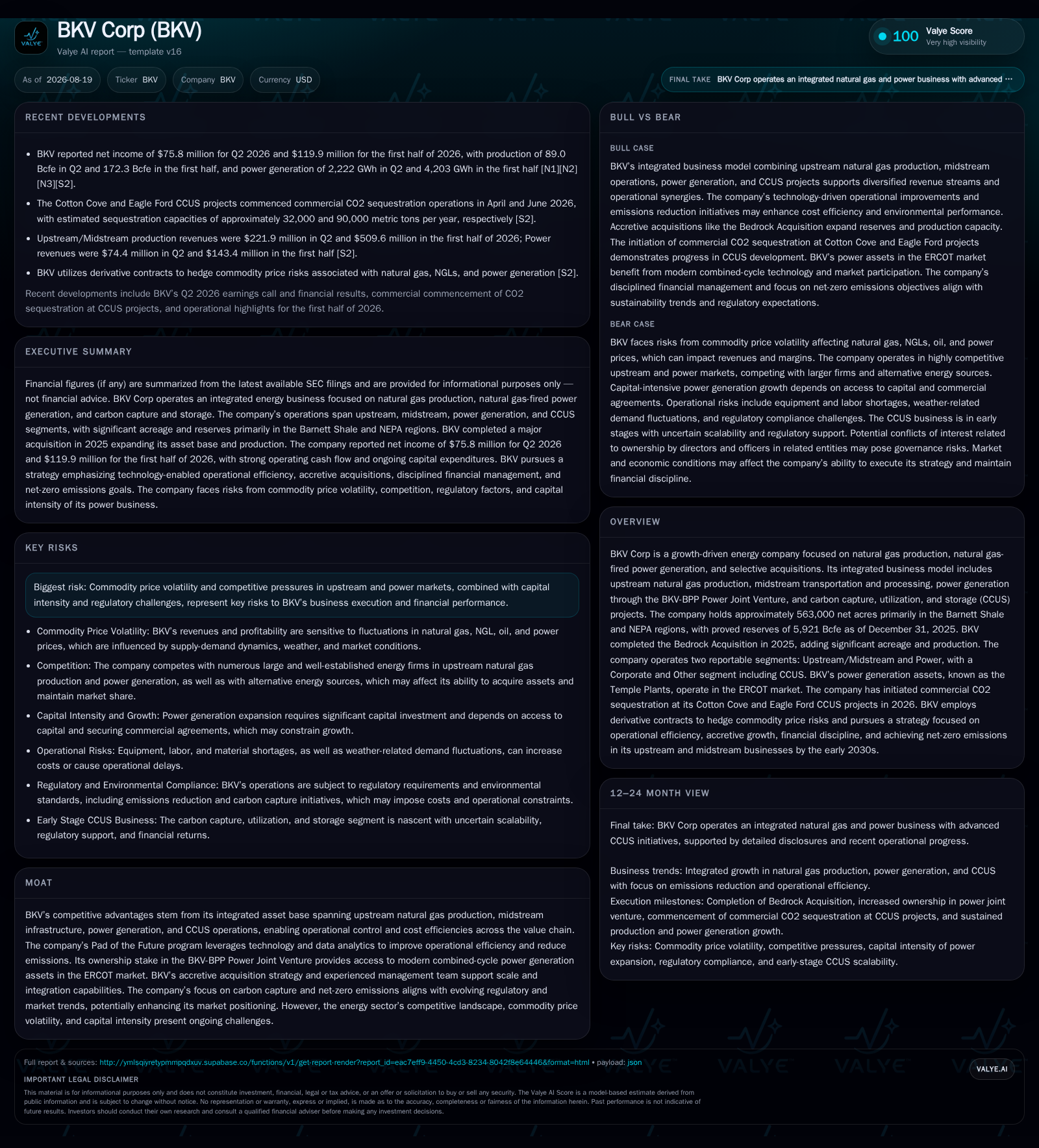
In Q2 2026, BKV Corp reported higher natural gas, NGL, and oil production and increased power generation from its Temple Plants compared to prior periods. The company commenced commercial operations at two carbon capture and sequestration projects with combined annual capacity exceeding 120,000 metric tons of CO2. Despite these operational gains, net income declined year-over-year due to commodity price fluctuations and cost pressures. BKV's integrated energy model and new CCUS ventures position it for diversified revenue streams, while commodity market volatility remains a key factor influencing cash flow.
Q2 2026 Operational and Financial Performance
BKV Corporation reported a solid operational performance in the second quarter of 2026, highlighted by increased production volumes and stable power generation metrics. The company produced 89.0 billion cubic feet equivalent (Bcfe) of natural gas, natural gas liquids (NGLs), and oil, averaging 978.3 million cubic feet equivalent per day (MMcfe/d), marking an increase from prior periods and supporting upstream revenue growth [S2][S3]. This production scale contributed to upstream and midstream revenues of $221.9 million for the quarter, complemented by power segment revenues of $74.4 million, reflecting the company's integrated energy operations [S2].
Power generation from BKV's Temple Plants reached 2,222 gigawatt-hours (GWh) in Q2 2026, with a capacity factor of 69.6%, indicating consistent utilization of its combined-cycle power assets [S2][S3]. This stable generation underpins the company's ability to supply wholesale power customers and contributes to diversified revenue streams.
Despite operational gains, net income attributable to BKV declined in Q2 2026 compared to the prior year period, reflecting the impact of commodity price volatility and operational cost factors inherent in the energy sector [S3]. Operating cash flow, a critical measure of financial health in capital-intensive energy businesses, totaled $109.7 million for the quarter, supported by realized commodity prices and production volumes but subject to fluctuations driven by market dynamics [S3].
Carbon Capture Commercialization and Strategic Implications
A significant development in Q2 2026 was the commercial commencement of two carbon capture, utilization, and sequestration (CCUS) projects: the Cotton Cove and Eagle Ford facilities [S2][S3]. These projects collectively have an annual sequestration capacity exceeding 120,000 metric tons of CO2, representing a structural expansion of BKV's business model into carbon capture services.
The Cotton Cove project began operations on April 2, 2026, receiving CO2 waste from BKV's adjacent gas processing plant, while the Eagle Ford project started on June 10, 2026, capturing CO2 from a nearby midstream energy company’s processing facility [S2][S3]. This new operational capability introduces a revenue stream beyond traditional commodity sales, aligning BKV with regulatory trends emphasizing emissions reduction and carbon management.
BKV commenced commercial operations at two CCUS projects in Q2 2026, with combined annual sequestration capacity exceeding 120,000 metric tons of CO2. The operational performance and scaling of these projects will be important to monitor as indicators of their contribution to BKV's financial results and business development.
Balance Sheet and Liquidity Analysis
As of June 30, 2026, BKV reported cash and cash equivalents of $152.2 million against total debt of approximately $1.25 billion, resulting in net debt near $1.10 billion and a net leverage ratio of 1.78x [S3][F1]. This leverage level is consistent with the capital-intensive nature of integrated upstream, midstream, power generation, and CCUS operations.
Current assets stood at $457.8 million with current liabilities of $398.7 million, yielding a current ratio of 1.15, which indicates modest short-term liquidity [F1]. The company accrued capital expenditures of $72.4 million in Q2 2026, reflecting ongoing investments across its upstream, power, and carbon capture assets [S3].
BKV is actively engaged in commercial discussions to secure a long-term power purchase agreement (PPA) for a portion of its Temple combined-cycle facilities. Such an agreement would enhance revenue visibility and optimize generation economics by locking in contracted cash flows, which is particularly valuable given the volatility in commodity and power markets [S3]
Business Model and Industry Positioning
BKV operates an integrated energy business model encompassing natural gas, NGL, and oil production, midstream operations, natural gas-fired power generation, and carbon capture and sequestration services [S1][S2][S3]. Customers include wholesale power purchasers and midstream counterparties who buy these commodities and services.
Revenue generation depends heavily on realized commodity prices, production volumes, power plant utilization rates, and operating expenses [S2]. The company's margins and cash flow are sensitive to commodity price swings and capital expenditure requirements, common characteristics in the energy sector.
BKV's integrated asset base offers operational control and potential cost efficiencies, while its recent expansion into CCUS aligns with structural industry shifts driven by regulatory and environmental considerations. However, the company remains exposed to cyclical commodity price volatility and the capital-intensive nature of its growth initiatives.
Outlook and Watchpoints
Key areas to monitor include the progress and finalization of long-term power purchase agreements for the Temple Plants, which would improve revenue stability. Commodity price trends will continue to influence realized prices and cash flow volatility, underscoring the importance of BKV's hedging and operational flexibility.
The operational performance and capacity utilization of the Cotton Cove and Eagle Ford CCUS projects will be critical to assessing their contribution to revenue diversification and regulatory compliance. Additionally, capital expenditure levels and funding sources for growth projects will impact the company's leverage and liquidity profile in upcoming quarters.
Overall, BKV's Q2 2026 results demonstrate operational consistency and strategic advancement, with the commercial launch of CCUS projects marking a notable expansion of its business model. While commodity price volatility remains a near-term challenge, the integrated energy and carbon capture platform positions BKV to adapt to evolving market and regulatory environments.
Disclaimer: This is research-only, informational analysis and not investment advice. It may include AI-generated interpretation and general industry context. Always verify important details using primary sources.

Comments