
BTCS Inc. Q2 2026: Ethereum-Focused Blockchain Operations Drive Revenue Growth Amid Stable Liquidity
BTCS Inc. reported Q2 2026 results showing growth in Ethereum validator and block building operations, supported by a stable liquidity position.
In Q2 2026, BTCS Inc. expanded its revenue-generating activities centered on Ethereum blockchain infrastructure, notably through Validator Node Operations and Block Building. The company’s integrated business model also includes decentralized finance deployments, which complement its core operations. BTCS maintained a current ratio of 2.06 as of June 30, 2026, reflecting sufficient working capital to meet short-term obligations amid ongoing market volatility and regulatory risks. These results underscore BTCS’s operational focus on Ethereum network participation and DeFi activities, while highlighting the importance of monitoring digital asset price fluctuations and regulatory developments.
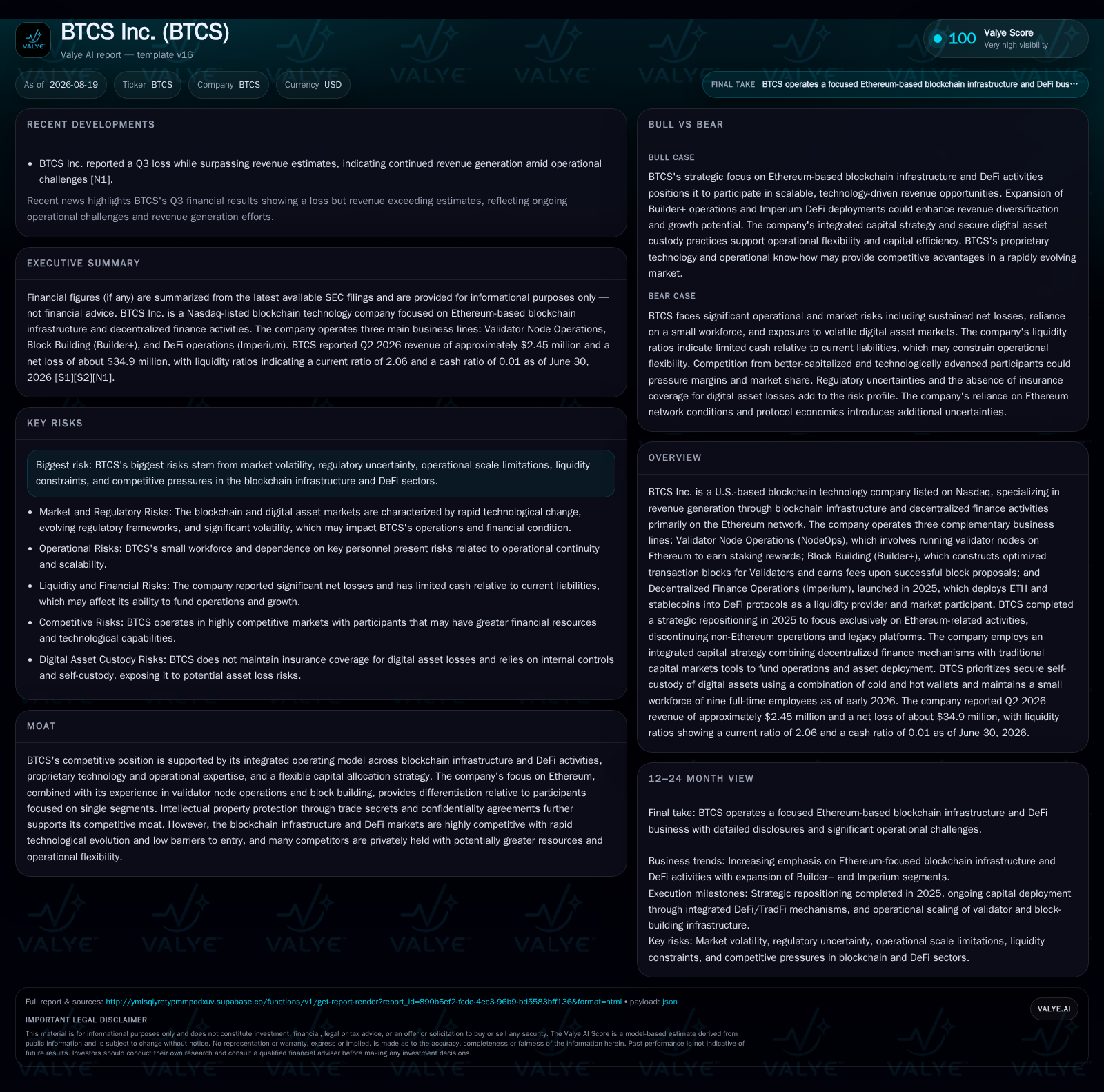
BTCS Inc. reported its operating and financial results for the quarter ended June 30, 2026, highlighting growth in revenues from its Validator Node Operations and Block Building business lines, alongside maintaining stable liquidity with a current ratio of 2.06 [S2]. These developments demonstrate BTCS's ability to generate revenue from its Ethereum-focused blockchain infrastructure and decentralized finance activities while sustaining a balance sheet that supports ongoing operations during sector volatility and evolving regulatory risks. The company's business model centers on three primary lines—Validator Node Operations, Block Building, and Decentralized Finance Operations—each integral to its strategy of leveraging Ethereum network adoption and infrastructure demand, as outlined in its 2025 annual filing [S1].
Validator Node Operations involve running Ethereum validator nodes that perform consensus and block proposal functions, generating ETH-denominated staking rewards and execution layer transaction fees. This business line remains foundational to BTCS’s revenue generation [S2]. Builder+ constructs optimized transaction blocks for submission to validators, earning fees from successful block proposals while incurring direct costs in the form of validator payments made in digital assets
Additionally, BTCS’s DeFi business line, Imperium, deploys ETH and stablecoins into decentralized finance protocols to generate variable returns based on protocol utilization and market conditions [S1][S2]. The company’s ETH holdings are actively deployed across these business lines to support revenue generation rather than held passively, aligning capital allocation with operational activities
As of June 30, 2026, BTCS maintained a current ratio of 2.06, with current assets totaling approximately $88.7 million and current liabilities around $43.1 million [F1]. This liquidity position indicates sufficient working capital to cover short-term obligations, critical given the inherent price volatility of ETH and regulatory uncertainties in blockchain and DeFi sectors. Cash and equivalents stood at about $262,000 at quarter-end, reflecting a limited cash buffer but overall liquidity supported by current assets [F1].
The stable balance sheet with no material changes in debt or leverage supports BTCS’s operational continuity during market fluctuations and sector-specific risks [S2][F1]. Maintaining adequate liquidity is essential in an industry where digital asset prices and network conditions can rapidly impact revenue and cash flow.
BTCS’s integrated business model combines Ethereum validator node operations, proprietary block building technology, and decentralized finance activities to generate revenue denominated primarily in ETH [S1][S2]. Revenue streams arise from staking rewards and transaction fees earned by validator nodes, fees from block building operations net of payments to external validators, and variable returns from assets deployed in DeFi protocols.
This multi-pronged approach differentiates BTCS from competitors who may focus solely on staking or DeFi segments. However, the company’s operations remain exposed to rapid technological changes, competitive pressures in transaction execution markets, and risks inherent in DeFi protocols, including smart contract vulnerabilities and liquidity risks [S1][S2]
Margins and cash conversion depend heavily on operational efficiency in node and block building activities, the cost structure related to validator payments, and the performance of deployed digital assets. The company’s ETH holdings function as operating assets, actively supporting these revenue-generating activities rather than serving as passive investments.
BTCS operates in a rapidly evolving and volatile sector characterized by significant price fluctuations of digital assets, shifting network protocols, and an uncertain regulatory landscape [S1][S2]. The company’s revenue and operating results are materially impacted by the price volatility of Ethereum and other digital assets, as well as changes in Ethereum network rules and market participant behavior.
Regulatory developments affecting blockchain infrastructure and DeFi protocols pose ongoing risks, including potential enforcement actions and changes in compliance requirements. Additionally, the competitive environment in block building and transaction execution markets is intense, with the need to maintain access to private order flow and optimize infrastructure efficiency.
Operational risks also include reliance on third-party infrastructure providers and decentralized protocols, which may experience disruptions or failures. Furthermore, DeFi activities expose BTCS to smart contract risks, liquidity risks, and potential liquidation events that could materially impact financial results.
BTCS’s Q2 2026 results demonstrate that its strategic focus on Ethereum validator and block building operations has enabled revenue growth, supported by expanded private order flow and improved infrastructure efficiency [S2]. The company’s stable liquidity position, with a current ratio above 2 as of June 30, 2026, provides a buffer to manage short-term obligations amid sector volatility [F1][S2].
Key watchpoints include monitoring quarterly revenue and margin trends within Validator Node Operations and Block Building segments, fluctuations in ETH price and their effects on staking rewards and DeFi returns, and regulatory developments impacting Ethereum network operations and DeFi protocols. Additionally, ongoing assessment of liquidity and working capital metrics in future filings will be important to evaluate BTCS’s financial flexibility. Operational scale and efficiency improvements in block building and DeFi deployments will also be critical to sustaining revenue growth and managing risks.
These factors collectively shape BTCS’s ability to navigate the dynamic blockchain infrastructure and decentralized finance landscape while generating ETH-denominated revenues through its integrated business model.
Disclaimer: This is research-only, informational analysis and not investment advice. It may include AI-generated interpretation and general industry context. Always verify important details using primary sources.

Comments