
Ocean Power Technologies Initiates Strategic Investment Review Amid Liquidity Challenges
Ocean Power Technologies announced a strategic investment review in August 2026 amid ongoing operating losses and liquidity constraints.
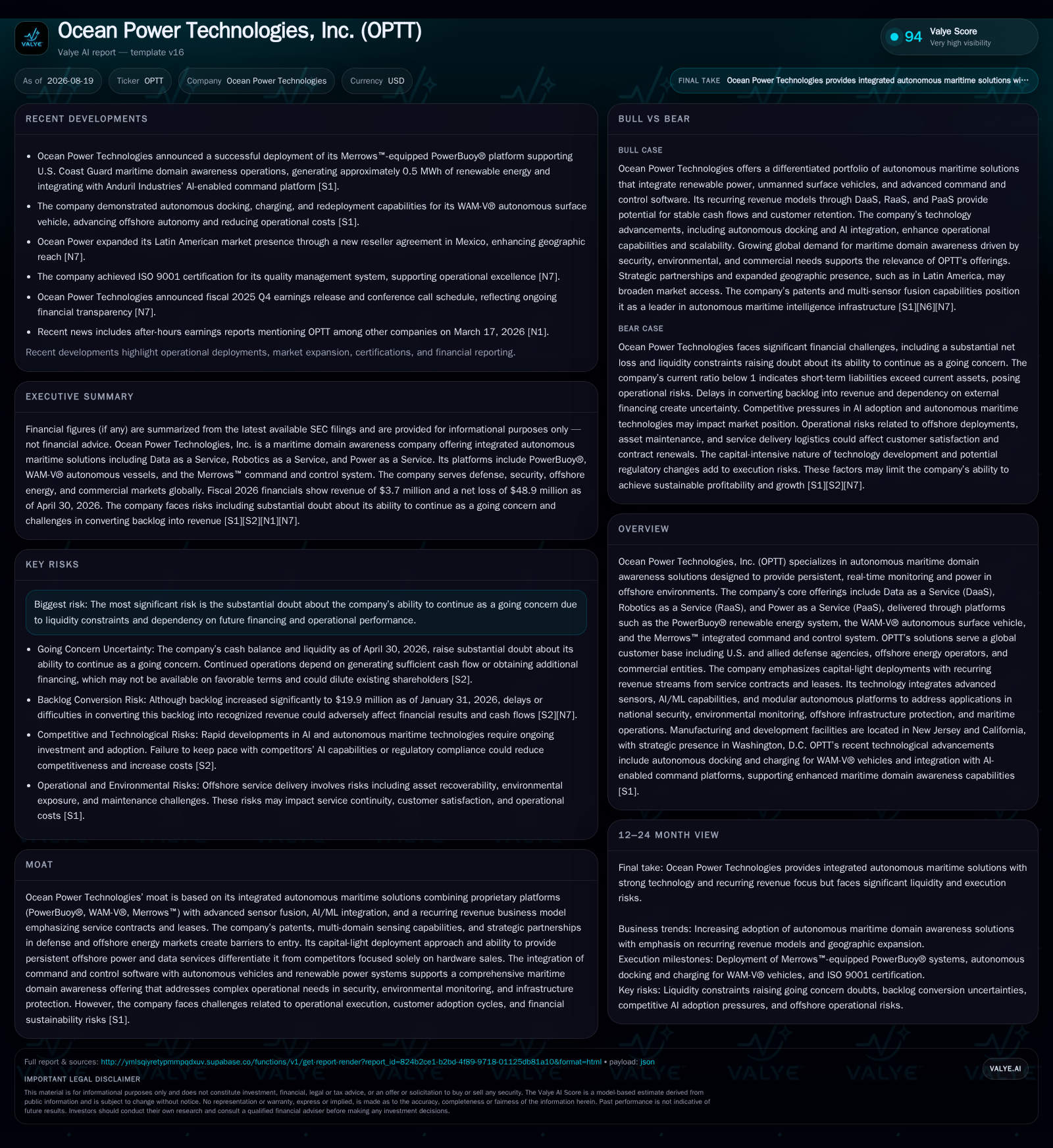
Ocean Power Technologies, Inc. (OPTT) initiated a strategic investment review on August 17, 2026, reflecting significant financial and operational challenges. As of April 30, 2026, the company reported a cash balance of $8.7 million and a current ratio of 0.6, indicating liquidity shortfalls against current liabilities of $26.4 million. Despite a capital-light, recurring revenue business model centered on autonomous maritime platforms, OPTT faces substantial doubt about its ability to continue as a going concern without additional financing or operational improvements.
(OPTT) announced the initiation of a strategic investment review to evaluate alternatives for strengthening its financial position and advancing its business operations [S3]. This development comes during ongoing financial pressures, with the company’s liquidity profile as of April 30, 2026, revealing a cash and equivalents balance of $8.7 million against current liabilities of $26.4 million, resulting in a current ratio of 0.6 [F1].
The strategic review signals management’s recognition of these challenges and the need for potential restructuring, capital raising, or strategic partnerships to sustain operations. Its offerings include Data as a Service (DaaS), Robotics as a Service (RaaS), and Power as a Service (PaaS), delivered through integrated platforms such as the PowerBuoy®, WAM-V® autonomous unmanned surface vehicles, and Merrows™ command and control systems. These platforms incorporate artificial intelligence and machine learning (AI/ML)-enabled sensor systems designed to provide persistent, autonomous maritime monitoring and data collection [S1].
The company’s customer base spans U.S. and allied defense agencies, offshore energy operators, subsea infrastructure entities, commercial maritime interests, marine research, and communication markets. Revenue generation relies on a combination of direct sales, leases, strategic partnerships, and long-term service and maintenance agreements [S1]. This model emphasizes recurring revenue streams and high-margin technology sales while minimizing capital expenditure through capital-light deployments.
Financial Condition and Operating Performance
Despite the promising technology and market positioning, OPTT’s financial results reflect ongoing operational challenges. The company reported net losses of $48.9 million in fiscal 2026 and $24.5 million in fiscal 2025, driven largely by continued investment in R&D and SG&A functions [S1]. These losses have resulted in negative operating cash flow, with no evidence of positive cash flow generation from commercialization activities as of the latest fiscal year.
The balance sheet snapshot as of April 30, 2026, highlights a working capital deficit of approximately $10.5 million, with current liabilities exceeding current assets by a substantial margin [F1]. This deficit places pressure on the company’s ability to meet short-term obligations without additional financing. Historically, OPTT has raised capital through equity and debt issuances totaling $28.7 million in fiscal 2026, demonstrating reliance on external funding sources [S1].
The company’s 10-Q filing from March 2026 explicitly notes substantial doubt about its ability to continue as a going concern, contingent on securing additional capital or achieving positive cash flow from operations [S2]. This uncertainty introduces material risk to ongoing commercialization efforts and operational continuity.
Industry Context and Competitive Landscape
In the industrial hardware sector, particularly within autonomous maritime systems, key performance indicators include recurring revenue growth, book-to-bill ratios, gross margin composition between hardware and services, working capital management, and supply chain efficiency. OPTT’s capital-light, recurring revenue approach aligns with broader industry trends favoring sustainable growth through service contracts and platform scalability.
However, the sector also faces structural and cyclical challenges. Structural demand is driven by defense modernization initiatives and regulatory mandates for maritime monitoring, while cyclical risks stem from government budget constraints and procurement timing. Competitors vary in their integration of AI/ML capabilities and hardware offerings, with defense and offshore energy customers prioritizing reliability, security clearances, and persistent monitoring capabilities.
Outlook and Key Risks
The initiation of the strategic investment review underscores the critical importance of securing additional financing or operational improvements to sustain OPTT’s commercialization trajectory. Key risks to monitor include the outcomes of this review, subsequent capital raises, quarterly financial performance updates, government contract awards, and maintenance of security clearances necessary for classified work.
Given the company’s current liquidity constraints as of April 30, 2026, with a current ratio of 0.6 and cash and equivalents of $8.7 million against current liabilities of $26.4 million [F1], the company faces significant financial and operational challenges that require resolution to support ongoing operations.
Investors and stakeholders should closely watch announcements related to financing arrangements, contract wins, and operational milestones that could alleviate liquidity pressures and validate the business model’s scalability and profitability potential.
In summary, while Ocean Power Technologies offers differentiated autonomous maritime solutions with a capital-light recurring revenue model, its current financial condition and ongoing losses present substantial near-term risks. The strategic investment review represents a critical juncture in addressing these challenges to enable sustainable growth and operational viability.
Disclaimer: This is research-only, informational analysis and not investment advice. It may include AI-generated interpretation and general industry context. Always verify important details using primary sources.

Comments