
Capital Strategy and Clinical Progress Shape Allarity Therapeutics’ Near-Term Outlook
Allarity Therapeutics reports continued clinical program advancement for its oncology candidates alongside elevated financing risks amid costly development demands.
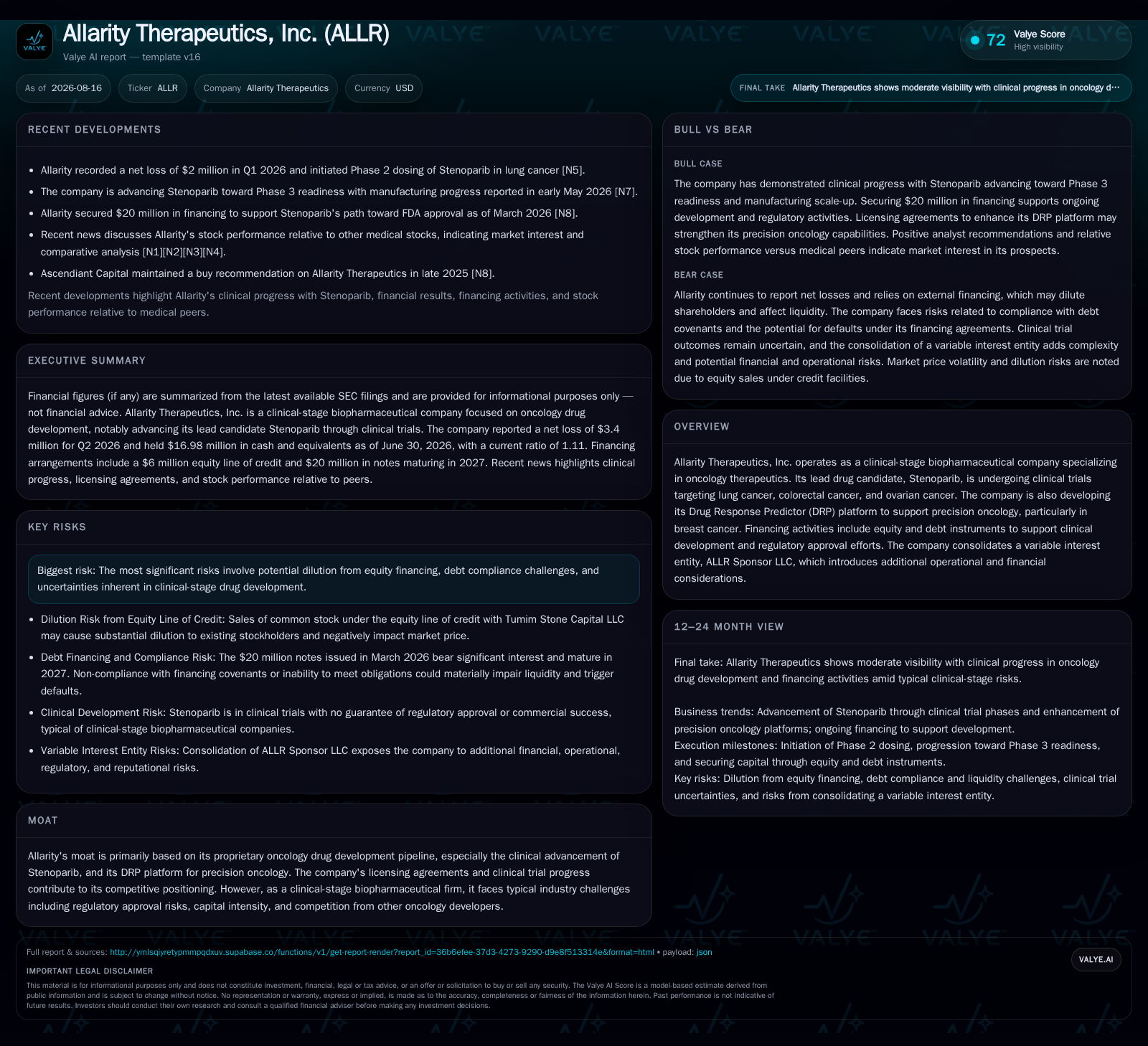
Allarity Therapeutics’ latest quarterly filing highlights ongoing momentum in its clinical pipeline, notably with Stenoparib targeting lung, colorectal, and ovarian cancers. The company’s Drug Response Predictor platform advances precision oncology efforts. However, substantial debt obligations from a $20 million note issuance and dilution potential under a $6 million equity line impose significant liquidity constraints. These capital structure dynamics shape Allarity’s runway and strategic options as it navigates expensive late-stage development and seeks regulatory milestones.
Q2 2026 Operational Update Highlights Clinical Pipeline Momentum and Capital Moves
In its latest 10-Q filing dated August 14, 2026 [S2], Allarity Therapeutics underscores ongoing development activities focused on its lead drug candidate Stenoparib, which targets lung, colorectal, and ovarian cancers. While the filing does not specify granular patient enrollment figures or trial phase advancements this quarter, the maintenance of this diversified oncology pipeline remains critical amid the costly late-stage clinical environment. The company also recently secured a key patent for its stenoparib-specific Drug Response Predictor (DRP) platform in the U.S., bolstering intellectual property protection around this precision oncology tool [S17].
On the funding front, Allarity drew upon a $20 million debt issuance completed in March 2026 with Streeterville Capital that comprises an A-1 Note ($10.93 million principal including discounts) at a steep 9% compounded interest rate plus a B Note ($10 million principal) at 5%, both maturing September 2, 2027 [S2][S4]. This sizable financial leverage raises the company’s fixed cost burden significantly and constrains near-term liquidity.
Complementing the debt structure is an equity line of credit with Tumim Stone Capital LLC allowing up to $6 million in common shares sales [S2]. Minimal utilization occurred in Q2 (only about $2,000 raised) leaving nearly full capacity available; however, future draws remain dilutive and subject to market-price impact risks. This dual financing architecture—high-cost debt coupled with potentially dilutive equity—is emblematic of clinical-stage biotechs reliant on external capital to finance long development timelines
Financially, Allarity reported approximately $17 million cash & equivalents as of June 30, 2026 with current assets totaling around $31.7 million offset by current liabilities near $28.6 million [F1]
Clinical-Stage Biopharma Relevance: Allarity’s Oncology Portfolio and Precision Platform Economics
Allarity's business model centers on developing novel oncology therapeutics primarily through late-stage clinical trials with Stenoparib as its flagship compound. Addressing major solid tumor types including lung cancer—a notoriously difficult indication—colorectal cancer with high incidence globally, and ovarian cancer characterized by unmet treatment needs situates the company within large addressable markets requiring rigorous clinical validation. This multi-indication approach diversifies single-candidate risk but requires extensive resource allocation across separate regulatory pathways.
Concurrently, their proprietary Drug Response Predictor (DRP) platform targets precision oncology by leveraging biomarker-driven patient stratification to improve therapeutic outcomes particularly in breast cancer. This platform-based technology could evolve from a supporting companion diagnostic into a licensing asset generating milestone payments before any commercial product launch. Such dual revenue potential—drug candidates plus precision diagnostic tools—is consistent with biopharma firms expanding beyond conventional small-molecule pipelines into integrated biomarker technologies.
The economics of this model are inherently capital intensive given protracted clinical trial phases (Phase 1–3), costly manufacturing processes demonstrated by ongoing active pharmaceutical ingredient production for Stenoparib scheduled through Q3 2026 [S14], and significant regulatory submission hurdles ahead. Margins are expected to be negative until successful approvals or partnerships materialize; thus milestone payments and licensing deals will be critical interim value inflections.
Capital Structure Strains: Debt Obligations and Equity Facility Dilution Risk Analysis
Allarity’s capital structure reflects common challenges for clinical-stage biotech companies dependent on external funding cycles amid no recurring product revenue yet. The March 2026 Streeterville note issuance introduced fixed interest obligations of approximately $20 million principal at coupon rates substantially above investment-grade norms (5%–9% compounded daily), evidencing credit risk perceived by lenders given uncertain cash flows [S4]. These terms amplify pressure on future operating budgets as higher interest accrual accelerates cash burn.
Likewise, the Tumim Stone Capital equity purchase agreement adds a dilutive lever allowing up to $6 million new share issuances at management’s discretion within agreed limits [S2]
Compliance with debt covenants thus becomes a pivotal watchpoint; any breach could prompt acceleration clauses forcing immediate repayment or enforcement actions against pledged collateral including restricted cash or subsidiary guarantees encompassed by consolidated variable interest entity exposures [S4]. Failure to remedy such events could materially impair Allarity’s ability to sustain its R&D programs or secure more favorable financing alternatives.
Relative to peers in clinical-stage oncology biotechnology—many managing similar profiles but often on larger cash war chests or better access to non-dilutive grants—Allarity faces above-average refinancing risks combined with costlier debt servicing burdens. The balance between leveraging low-cost equity when feasible versus servicing expensive notes will dictate whether the firm can extend its runway sufficiently to reach key clinical inflection points and regulatory submissions.
Comparative Lens: How Allarity’s Clinical Progress and Financing Stack Against Biotech Peers
Industry benchmarking indicates that oncology drug candidates commonly encounter multi-year timelines from Phase 1 initiation through pivotal trials, with failure rates remaining high due to efficacy or safety setbacks. While specific data on Allarity’s trial enrollment speed or progression rates are not detailed here, sustaining momentum across multiple indications aligns with peers seeking diversification to mitigate binary trial outcomes.
Capital efficiency among similar-sized biotechs varies widely; firms demonstrating disciplined burn rates relative to patent life expectancy tend to secure superior valuations.
Additionally, proprietary platforms such as the DRP position Allarity uniquely versus some pure-play oncologic drug developers lacking companion diagnostic integration.
Financing arrangements involving expensive convertible notes paired with equity lines are prevalent industry tools but differ materially in cost structures and shareholder dilution profiles depending on negotiation power and market conditions; Allarity's instruments currently fall within typical parameters for biotechs at this stage but represent meaningful constraints on strategic maneuverability.
Growth Catalysts: Upcoming Trials Milestones, Regulatory Pathways, and Platform Expansion Potential
The near- to medium-term value drivers for Allarity revolve around progressing Stenoparib through defined clinical phases toward registrational endpoints while expanding the DRP platform’s applications either through new cancer indications or enhanced biomarker panels. Achievement of enrollment targets enabling timely data readouts would signal execution quality important for securing subsequent financing rounds or partnership discussions.
Regulatory submission milestones such as Investigational New Drug (IND) filings or new drug applications (NDAs) represent critical inflection points capable of re-rating company prospects. Additionally, any milestone payments deriving from licensing arrangements leveraging DRP technology could provide non-dilutive cash influxes enhancing financial flexibility.
Investment in ongoing manufacturing campaigns slated for completion by Q3 2026 demonstrates preparation for scale-up contingent on positive trial outcomes [S14], highlighting operational readiness crucial for commercial transition. Moreover, proactive engagement at industry forums such as Precision Medicine Forum Europe signals intent to position DRP technology competitively within emerging precision oncology market trends [S16].
Watchpoints: Financing Execution Risks, Regulatory Timing Uncertainty, Variable Interest Entity Impact
Key risks jeopardizing Allarity’s progress relate primarily to sustaining sufficient capital without material dilution beyond existing agreements; adverse share price movement could increase issuance volumes needed under equity lines far above initial expectations [S2]. Execution failures in meeting clinical trial deadlines or regulatory demands may delay milestone-triggered inflows prolonging reliance on capital markets.
The operational complexity introduced by consolidating ALLR Sponsor LLC as a variable interest entity adds another layer of risk from accounting uncertainties or potential conflicts-of-interest affecting reported results and stakeholder perceptions [S4].
From an industry standpoint, competitive pressure from other oncology developers advancing therapeutics faster or securing partnerships earlier constitutes an external threat that could impact investor sentiment or licensing opportunities.
Signs confirming stress would include covenant breaches reported in upcoming quarterly filings or withdrawal/refusal of Tumim Stone draws due to stock price constraints; conversely successful capital raises executed without disproportionate dilution would mitigate concerns.
Financial Profile Discussion
As of June 30, 2026, Allarity held approximately $17 million in cash and equivalents against total current liabilities near $28.6 million [F1]. Current assets totaled around $31.7 million [F1]. Total debt reported from best-effort estimates stands near $2.67 million based on last known figures from end-2022; however actual indebtedness linked predominantly to March 2026 Streeterville notes aggregates approximately $20 million principal subject to compounding interest charges increasing liabilities over time [S4].
This financial configuration underscores heavy dependence on continuous financing access through either debt refinancing or equity issuance under existing lines of credit. Operating losses remain substantial given pre-revenue status typical for companies at this stage.[F1] Management must strategically balance run-rate expenses against evolving capital sources while positioning pipeline assets favorably before liquidity becomes restrictive.
This analysis synthesizes publicly filed information complemented by standard industry context pertinent to clinical-stage biotech firms specializing in oncology therapeutics and precision medicine platforms. It avoids speculative forecasting or direct investment research views while illuminating operational dynamics shaping Allarity Therapeutics’ near-term outlook.
Disclaimer: This is research-only, informational analysis and not investment advice. It may include AI-generated interpretation and general industry context. Always verify important details using primary sources.

Comments