
GT Biopharma Advances TriKE Immuno-Oncology Pipeline While Confronting Cash Constraints
GT Biopharma progresses Phase 1 trials of its proprietary NK cell engager therapies even as its financial position raises substantial going concern risks.
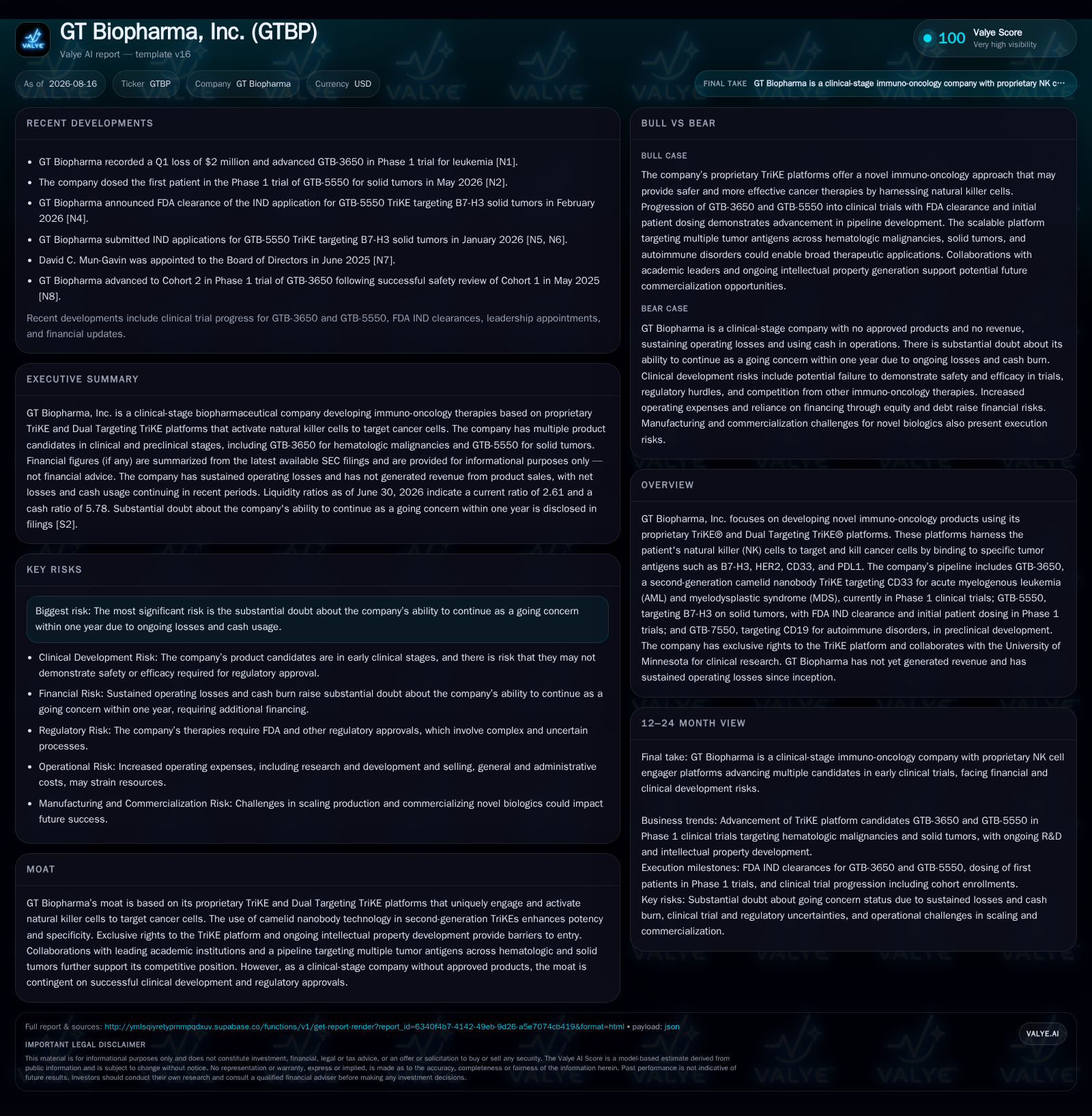
GT Biopharma continues to advance clinical development of its novel TriKE immuno-oncology platform targeting natural killer (NK) cells, with key milestones including FDA IND clearances and patient dosing for lead candidates GTB-3650 and GTB-5550. The pipelines focus on hematologic malignancies and solid tumors leveraging proprietary fusion proteins designed for enhanced NK cell activation and targeted tumor antigen engagement. However, the company remains pre-revenue and faces ongoing operating losses with limited cash reserves, resulting in substantial doubt about its ability to continue as a going concern within the next year. Continued clinical progress alongside securing additional financing are critical near-term priorities.
The Latest Clinical Advances Signal Pipeline Momentum Despite No Revenues Yet
In its latest Form 10-Q filed August 14, 2026 [S2], GT Biopharma reported continued progress in clinical development of its proprietary TriKE platform therapies. Most notably, the company achieved FDA clearance of its IND applications for GTB-3650 – a second-generation camelid nanobody TriKE targeting CD33 for acute myelogenous leukemia (AML) and myelodysplastic syndrome (MDS) – with patient enrollment well underway in Phase 1 dose-escalation cohorts. Similarly, GTB-5550 targeting B7-H3 on solid tumors commenced dosing following its IND clearance earlier this year. These developments underscore tangible advancement from preclinical concepts into active human trials.
This clinical momentum validates the firm’s capacity to translate its immuno-oncology pipeline concepts into regulated investigational new drug programs — a critical early indicator in the protracted biotech value chain where proof-of-concept takes years [S2]. Even though no product revenues have yet materialized, forward movement through Phase 1 trials reflects achievement against key operating KPIs: IND submissions/clearances and patient dosing initiation — essential at this early clinical stage.
TriKE Technology Platforms: A Differentiated Immuno-Oncology Approach Targeting NK Cells
GT Biopharma’s core scientific advancement lies in its exclusive Tri-specific Killer Engager (TriKE ® ) and Dual Targeting TriKE ® fusion protein platforms that harness natural killer (NK) cells by fusing tumor antigen-targeting fragments with IL-15 cytokine moieties [S1][S2]. This approach aims to stimulate a patient’s endogenous NK cells selectively against target cancer epitopes such as CD33 (hematologic malignancies), B7-H3 (solid tumors), HER2, or PDL1 without requiring personalized cellular therapies or ex vivo modification.
Notably, the platforms seek improvement over prevalent T-cell therapies by reducing cytokine release syndrome (CRS) incidence — a common limiting safety concern in CAR-T or bispecific T-cell engager therapeutics. This is achieved through focused activation of NK cells via CD16-directed IL-15 stimulation with minimal unintended T-cell proliferation [S1][S2]. The proprietary use of camelid nanobodies in second-generation compounds theoretically enhances binding affinity and specificity while improving manufacturability.
From a business model perspective, these recombinant fusion proteins represent scalable biologic candidates that could be deployed both as monotherapies or in combination regimens alongside standard-of-care treatments [S1]. Commercialization depends on successful late-stage development followed by regulatory approval; until then, revenue streams hinge on potential milestone-based collaborations or licensing deals.
Biotech Development Dynamics: Intellectual Property Exclusivity and Manufacturing Outsourcing Dependencies
GT Biopharma holds exclusive rights to the underlying TriKE platform via an amended patent license agreement with the University of Minnesota [S1], which secures a meaningful competitive moat by controlling foundational IP necessary for future product optimization and potential biosimilar barriers. Annual license maintenance fees are incremental but manageable recurring costs supporting long-term exclusivity.
Operationally, GT Biopharma lacks internal manufacturing capabilities, consistent with many small biotechs at this stage. It relies entirely on contract manufacturing organizations (CMOs) for production of investigational drug substances [S1]. While this outsourcing mitigates upfront capital expenditure on manufacturing infrastructure, it introduces dependency risks around CMO capacity constraints, timelines, quality control compliance, and cost escalations. Effective supply chain management will be a critical factor enabling timely trial enrollment expansions and eventual commercial scale-up.
The balance between maintaining nimble R&D-focused operations versus manufacturing scalability challenges is typical across the biotech sector but underscores a critical watchpoint as GT Biopharma advances through costly clinical phases requiring increased batch quantities [S1].
Sector Comparisons Highlight Clinical Progress at Early Stage Versus Capital Intensity Challenges
Within the competitive landscape of clinical-stage immuno-oncology developers emphasizing NK cell-based approaches — such as potential peer groups including Fate Therapeutics and Nkarta Therapeutics — GT Biopharma leverages proprietary TriKE technology distinct from T-cell centric platforms. While relative clinical trial timelines for Phase 1 dosing initiation appear broadly comparable, GTBP’s advancement into multiple parallel studies targeting both hematologic and solid tumors signals robust pipeline breadth.
However, this scientific differentiation does not insulate the company from typical sector-wide capital intensity realities. Significant R&D expenditures are required to progress candidates through dose escalation cohorts while navigating complex regulatory demands.
Growth Catalysts: IND Clearances, Trial Progression, Expanding Tumor Antigen Coverage
Near-term growth drivers revolve around continued execution of ongoing Phase 1 studies validating safety and preliminary efficacy of GTB-3650 in AML/MDS patients where approximately half have been dosed since early 2025 commencement [S11]. Positive emerging data or favorable regulatory feedback could accelerate dose expansion or inspire combination therapy trials enhancing product appeal.
Simultaneously advancing GTB-5550 into solid tumor patient cohorts following mid-2026 first dosing extends indication breadth beyond hematologic malignancies – a strategic move addressing diverse oncology markets characterized by high unmet need. Additional preclinical assets like GTB-7550 aimed at autoimmune disorders further supplement pipeline resilience if bolstered by successful IND submissions.
Key Risks: Going Concern Doubts, Cash Burn Trajectory, Regulatory Hurdles, Manufacturing Reliance
The company faces ongoing challenges related to persistent net losses and cash burn typical of early-stage biotech development. For six months ended June 30, 2026, net loss was approximately $7.4 million with cash burn from operations around $6.7 million [S4][S22]. As of June 30, 2026, GT Biopharma held cash and equivalents of approximately $5 million against current liabilities near $2.2 million, yielding a current ratio of about 2.6, which suggests adequate near-term liquid coverage [F1].
Moreover, escalating selling general & administrative expenses — rising nearly threefold year-over-year primarily from marketing and legal fees — exacerbate cash consumption pressures [S24]. Any adverse trial outcomes or delays would likely necessitate additional equity issuance diluting shareholders and adding execution uncertainty.
Manufacturing fully outsourced creates proportional risks if contract partners face capacity bottlenecks or compliance issues potentially delaying trial material availability [S1]. Regulatory agencies’ evolving expectations around novel biologics add further complexity given nascent clinical data sets.
Finally, intellectual property defenses must be vigilantly maintained to protect platform exclusivity critical for long-term value capture amidst advancing competitors in immuno-oncology modalities.
What To Watch For Milestones: Enrollment Paces, Data Readouts, Financing Events, Collaboration Updates
Investors should monitor updates on patient enrollment speed particularly whether later Phase 1 cohorts for GTB-3650 complete enrolment efficiently allowing prompt dose escalation progression. Early safety/tolerability signals reported via interim readouts can shape perceptions about developmental viability.
Tracking similar metrics for GTB-5550’s basket trial in solid tumors commencing May 2026 remains key given differences in tumor biology potentially affecting therapeutic impact.
Equally pivotal will be announcements related to new IND submissions especially expanding antigen coverage or autoimmune indications enhancing portfolio diversification.
On financial fronts, fresh equity raises or partnership deals delivering committed capital would signal alleviation of liquidity constraints enabling unimpeded clinical investment.
Lastly, intellectual property developments—new patents granted or litigation resolutions—may influence assessments of competitive defensibility.
Financial Profile Discussion
Selling general administrative expenses nearly tripled year-over-year partly due to accelerated marketing efforts presumably associated with investor relations or clinical awareness campaigns increasing fixed overheads disproportionate to R&D spend increments [S24]. Research and development expense showed an increase quarter-over-quarter consistent with ramped clinical trial activity especially in materials/production costs needed for biological drug candidate manufacture [S24].
The company’s disclosures elevate caution flags regarding its ability to sustain operations absent successful capital raises or lucrative collaborations within coming quarters—standard challenges among developmental immuno-oncology firms lacking revenue inflows during extended validation phases [S4][S22]. The independent auditor previously expressed substantial doubt about ongoing viability underscoring need for proactive balance sheet reinforcement [S4].
This analysis synthesizes publicly disclosed operating results and financial data strictly without investment advice or forecasts. It frames GT Biopharma’s unique position developing innovative NK cell engager biologics amid typical biotech sector funding hurdles. Stakeholders should continuously assess upcoming trial progress indicators alongside financial health signals when monitoring the company's pathway toward commercialization milestones.
Disclaimer: This is research-only, informational analysis and not investment advice. It may include AI-generated interpretation and general industry context. Always verify important details using primary sources.

Comments