
Nuvera Communications Faces Capital-Intensive Fiber Expansion Amid Competitive and Subsidy Risks
Nuvera’s latest quarterly update underscores challenges in executing its fiber-to-the-premises growth strategy while managing significant debt and subsidy dependencies.
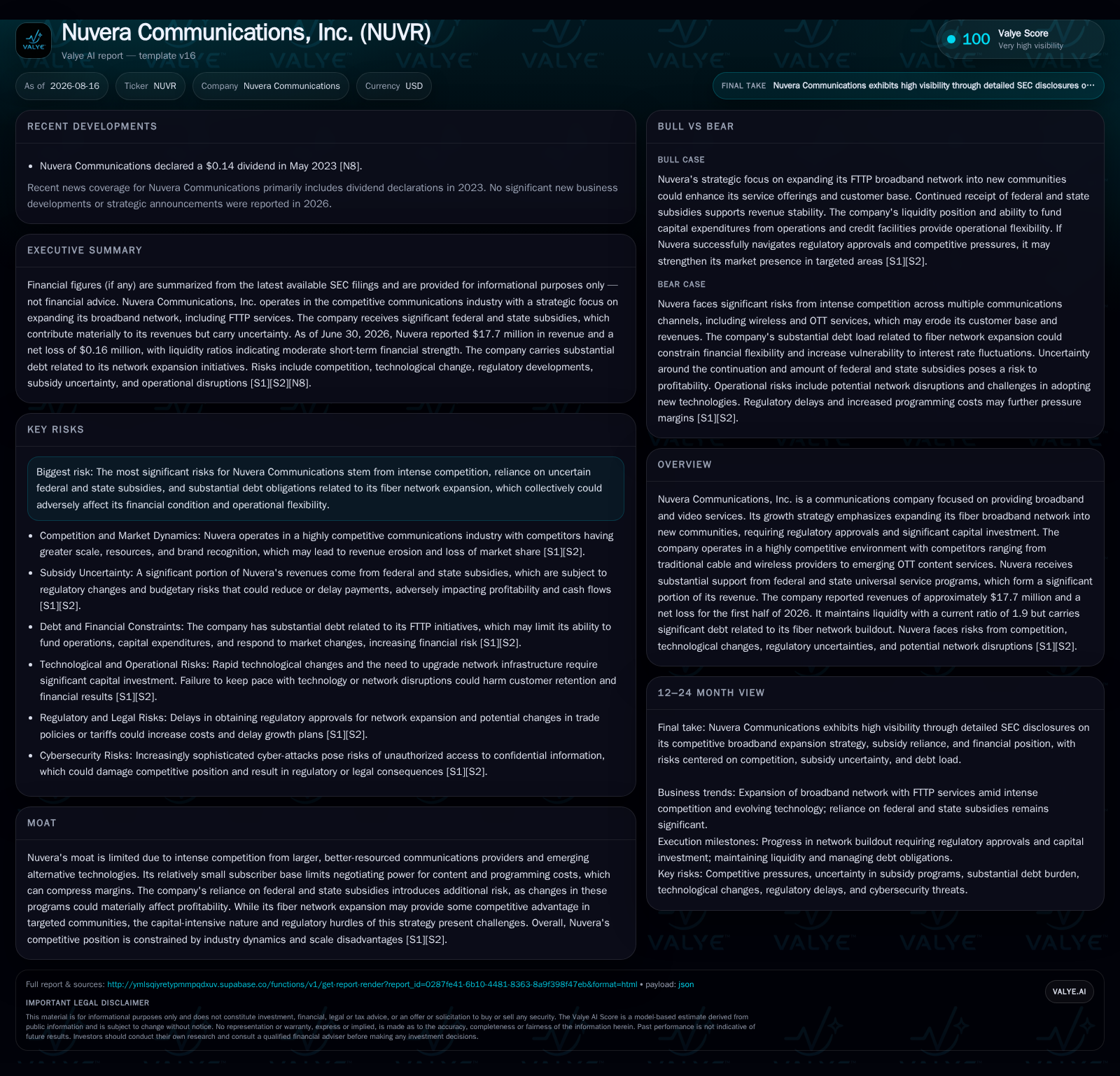
In its Q2 2026 filing, Nuvera Communications highlights ongoing efforts to expand its broadband network via capital-heavy fiber-to-the-premises deployments. The company continues to rely substantially on federal and state universal service subsidies, but faces risks from intense competition, regulatory hurdles, and large debt obligations. Its modest scale and evolving market position constrain pricing power and margin expansion. Execution on network buildouts and timely regulatory approvals will be critical to achieving positive free cash flow and sustainable growth.
Recent Operating Update
Nuvera Communications’ Q2 2026 10-Q filing reiterates the company's strategic emphasis on expanding its fiber-to-the-premises (FTTP) broadband network into new communities adjacent or proximate to its existing footprint [S2]. This growth approach remains capital intensive and fraught with uncertainties around timely receipt of franchise agreements, construction permits, and efficient procurement of contractors and supplies necessary for network deployment. The company acknowledges the risk that delays or resource challenges could disrupt scheduled construction plans, thereby slowing revenue ramp from these expansions [S2]. Additionally, Nuvera faces competitive pushback from incumbents already serving these markets.
The report notes that while this FTTP strategy is poised to drive future growth, it is relatively nascent in the marketplace. The success depends not only on physical network completion but also on effective customer acquisition in unfamiliar regions—a hurdle given Nuvera's limited brand recognition outside existing service areas [S2]. Furthermore, achieving positive free cash flow from these investments remains an open question at this stage.
From a revenue perspective, federal and state universal service funds continue to be a meaningful source of support [S2]. Nuvera collected approximately $8.02 million in subsidy payments from programs like the federal A-CAM and FUSF during the first half of 2026—a slight decline from $8.62 million over the same period in 2025—highlighting sensitivity to regulatory reforms that could impact future funding levels
Business Model Overview
Nuvera operates primarily as a last-mile broadband and video service provider focused on deploying fiber infrastructure directly to residential customers' premises. Revenue accrues from subscription fees for voice, data broadband internet, and video services, supplemented by government subsidies designed to support connectivity in high-cost or underserved areas. The company’s monetization depends heavily on both subscriber acquisition volume across growing network footprints and maintaining a competitive average revenue per user (ARPU).
This model’s capital intensity stems from high upfront investments in fiber optic cables, related hardware, customer premise equipment, and backhaul connections—activities compounded by complex regulatory processes requiring franchise negotiations with municipalities for network access rights [S1][S2]. Capital expenditures (capex) dominate cash outflows during network rollouts.
Margins vary notably by product mix; video services entail rising content programming costs that can constrict operating income despite steady revenue streams [S14]. Nuvera’s limited subscriber base restricts leverage in content licensing negotiations versus larger integrated cable companies. Thus, operational efficiency alongside disciplined capex management is vital to elevating profitability.
Government universal service fund (USF) subsidies mitigate some funding pressures but come with policy uncertainty risks since eligibility criteria and support levels can shift following FCC reforms aimed at channeling funds toward broadband rather than legacy voice services [S2][S13].
Industry Structure and Competitive Position
The telecommunications services sector is characterized by multiple technology platforms vying for consumers: incumbent local exchange carriers (ILECs), competitive local exchange carriers (CLECs), cable television operators delivering bundled video/broadband packages, wireless carriers expanding into fixed broadband offerings, satellite internet providers targeting remote regions, and OTT video providers reshaping consumer viewing habits through Internet-based platforms.
Within this ecosystem, Nuvera faces formidable competition from large cable companies with extensive networks, robust consumer brand recognition, diverse content offerings including exclusive sports rights, and pricing flexibility enabled by scale economies [S1][S23]. Wireless players also pose a rising threat as mobile broadband technologies improve.
Nuvera’s competitive moat is narrow given its relatively modest scale which limits content bargaining power and financial resources available for rapid expansion or marketing investment [S1]. Its core strategic differentiator lies in targeted FTTP buildouts focusing on specific communities underserved by incumbents. However, competitors aggressively upgrading their networks pressure Nuvera’s subscriber acquisition efforts while compressing prices.
Growth Drivers
Key growth drivers include:
- Fiber Network Expansion: Executing the rollout of FTTP networks into new or adjacent communities offers opportunities to capture unmet demand for high-speed broadband Internet access bearing rising consumer adoption trends [S2][S25].
- Increasing Broadband Demand: Trends toward more data-intensive applications —such as OTT video consumption—fuel utilization per subscriber.
- Government Subsidies: Continued support via federal/state universal service programs provide essential revenue contributions that partially offset operational costs especially in rural or high-cost areas.
- Service Bundling Potential: Leveraging combined voice/data/video packages could increase ARPU if successfully marketed within newly expanded markets.
- Technological Enhancements: Upgrading infrastructure capabilities can allow offering higher speeds or value-added services improving customer satisfaction and reducing churn rates.
Nonetheless, these drivers hinge critically on overcoming regulatory friction points including obtaining permits expeditiously as well as efficient supply chain logistics amidst global component constraints affecting network hardware availability [S14][S25].
Risks and Constraints
What to Watch Next
Stakeholders should closely monitor:
- Progress updates on regulatory approvals securing franchising rights in expansion markets.
- Quarterly metrics related to subscriber counts, ARPU evolution, churn rates reflecting market acceptance of FTTP offerings.
- Capital expenditure pacing relative to budget expectations signaling execution efficiency.
- Updates regarding federal/state subsidy policy changes affecting USF/ICC fund availability impacting revenue outlook.
- Debt refinancing developments or interest cost management strategies given considerable leverage exposure.
- Pricing trends amid escalating competition particularly against bundle offers from larger incumbents or wireless alternatives.
These indicators will provide insight into whether Nuvera's fiber rollout strategy can convert into sustainable growth while managing financial health under duress from leverage and sector-wide competitive dynamics.
Financial Profile Discussion
As of Q2 2026-end balance-sheet highlights show current assets totaling roughly $25.3 million against current liabilities near $13.3 million yielding a current ratio of about 1.9—indicating reasonable short-term liquidity available for working capital needs [F1]. However, this liquidity must be contextualized against heavy long-term debt estimated in excess of $146 million associated primarily with aggressive FTTP capital spending programs outlined since prior periods [S9][F1]. The net debt position approximates $47.5 million when accounting for reported cash balances near $2.5 million per latest measurements albeit with some temporal lag in exact cash timing data [F1].
The company's sizable debt constrains free cash flow generation capacity until expanded customer bases meaningfully offset upfront investment burdens. This structural constraint places emphasis on successful execution against the expansion plan combined with stable competitive positioning to foster pricing power supportive of margin expansion over time.
This analysis synthesizes publicly filed SEC disclosures as of August 14, 2026 ([S1],[S2],[F1]) incorporating industry-standard telecommunications sector knowledge relevant for fiber broadband providers competing under subsidy-dependent models.
Disclaimer: This is research-only, informational analysis and not investment advice. It may include AI-generated interpretation and general industry context. Always verify important details using primary sources.

Comments