
Algorhythm Shifts to AI-Driven Logistics Software with SemiCab Amid Liquidity and Competitive Pressures
Post-divestiture of legacy consumer products, Algorhythm focuses exclusively on expanding its AI-enabled SemiCab logistics platform while managing near-term financial constraints.
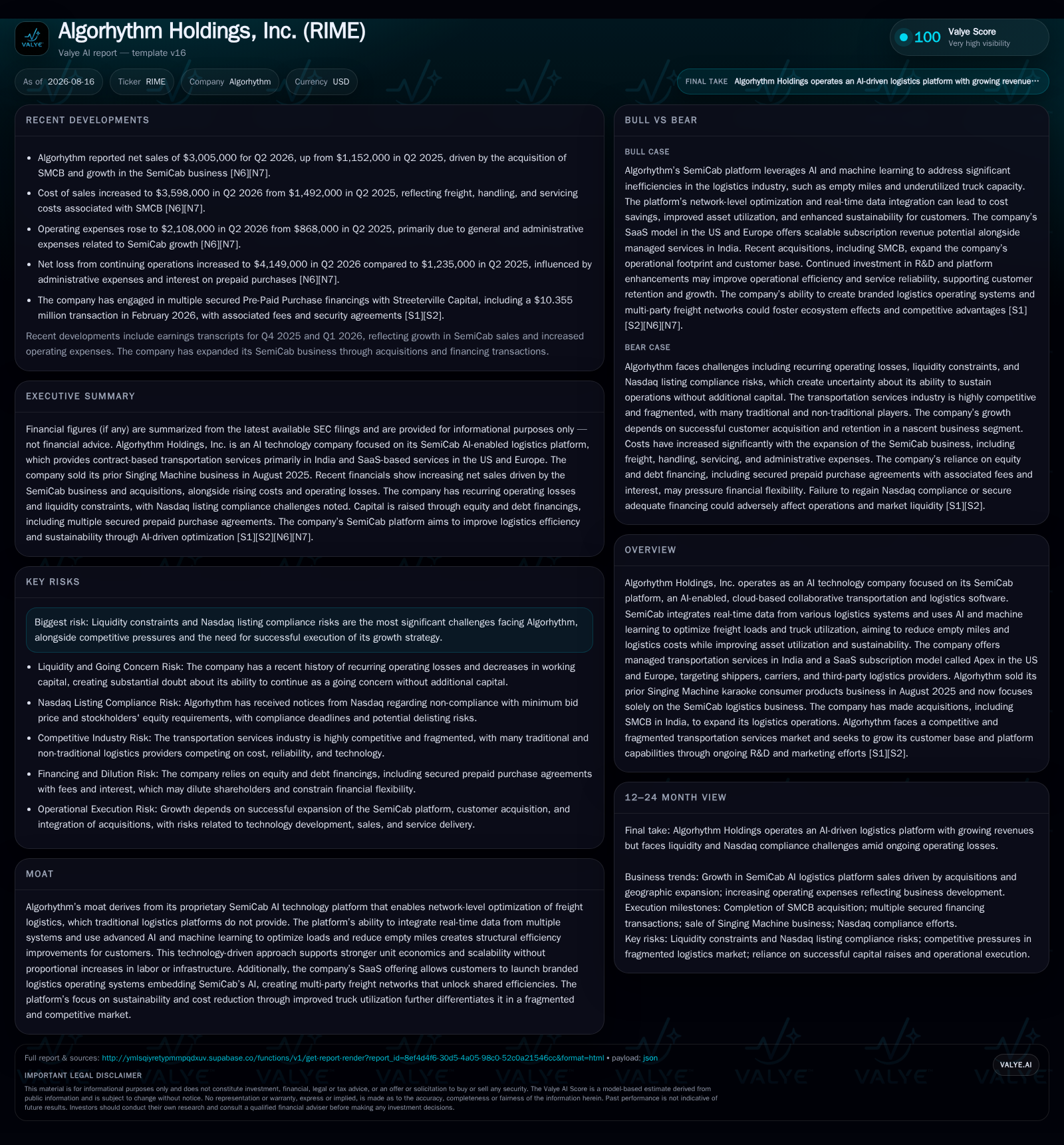
Algorhythm Holdings, Inc. has transitioned into a pure-play AI-enabled transportation and logistics software company centered on its SemiCab platform following the divestiture of its Singing Machine consumer products business in August 2025 [S1][S2]. SemiCab leverages real-time data integration and predictive machine learning to optimize freight load planning and truck utilization, targeting FMCG customers in India and 3PLs/carriers in the US and Europe. While the platform offers distinct competitive advantages over legacy TMS vendors through network-level orchestration and sustainability benefits, the company continues to face significant liquidity challenges and Nasdaq listing compliance risks that may constrain growth investments [S5][S22]. Growth depends on scaling SaaS adoption alongside managed transportation services and improving recurring revenue dynamics, but execution risk remains high amid capital constraints.
Recent Operating Update: SemiCab-Focused Growth during Financial Strains
Algorhythm Holdings reported a significant strategic pivot in recent filings following the August 2025 divestiture of its legacy karaoke consumer products business under Singing Machine. The company now operates solely through its subsidiary SemiCab Holdings focusing on the SemiCab AI-enabled collaborative transportation platform [S1][S2]. This transition establishes Algorhythm as a pure-play SaaS/software company addressing inefficiencies in freight logistics via predictive load optimization and real-time network orchestration.
Operating expenses also grew significantly as the company invests heavily in research & development (R&D), marketing, sales expansion, and back-office infrastructure necessary to scale SemiCab’s technology offering across diverse geographies [S11]. This spending pattern underscores Algorhythm’s focus on building out its SaaS subscription penetration alongside managed service delivery.
Business Model: SaaS Subscription Meets Managed Transportation
Algorhythm generates revenue via two primary channels [S1][S16]. In India, through the acquisition of SMCB, it offers managed transportation services that combine physical freight management with embedded SemiCab AI logistics software capabilities. In Western markets such as the U.S. and Europe, it monetizes primarily through its Apex SaaS subscription model sold directly to shippers, carriers, and third-party logistics providers (3PLs) seeking advanced load optimization solutions integrated with their existing transportation management systems (TMS) or electronic logging devices (ELDs)
The SemiCab platform stands out by orchestrating network-level freight collaboration rather than isolated load planning at an individual shipper or carrier level. It integrates real-time API data streams from multiple infrastructure sources including warehouse management systems (WMS), TMS platforms, ELDs, enabling predictive optimization that continuously adapts route pooling and capacity allocation dynamically [S1][S11]. Revenue recognition aligns with executed deliveries for managed services while SaaS subscriptions follow a monthly recurring model encouraging customer retention.
Industry Structure and Competitive Position
Operative within the growing but fragmented AI-enabled transportation software sector, Algorhythm competes against traditional TMS providers such as Oracle Transportation Management or SAP Logistics who offer relatively static load planning tools without advanced network orchestration capabilities. Emerging AI startups are also vying for share by emphasizing load matching or sustainability but often lack a fully integrated managed transportation offering combining physical operations with SaaS-driven optimization.
SemiCab’s Orchestrated Collaboration™ model gives Algorhythm a structural moat—its ability to reduce empty miles improves truck utilization rates meaningfully without adding fleet size or driver headcount. This not only improves unit economics for customers but accelerates sustainability outcomes by lowering carbon emissions attributable to road freight transport—a key selling point as shippers face rising environmental compliance demands.[S1] Its multi-party platform also enables branded logistics ecosystems where shippers and carriers realize shared efficiencies through improved coordination.
Peer platforms like Project44 or FourKites focus more narrowly on supply chain visibility or spot-market load tracking rather than end-to-end network-level orchestration coupled with managed service delivery. These differences highlight Algorhythm’s unique value proposition despite still being a nascent operator scaling through acquisitions such as SMCB.
Growth Drivers
Market-wide tailwinds supporting Algorhythm’s ambitions include accelerated digitization of supply chains combined with e-commerce growth driving complex freight routing demands; acute driver shortages pressuring trucking capacity; growing regulatory emphasis on carbon footprint reduction incentivizing efficient truck utilization; and globalization requiring scalable AI-powered solutions capable of orchestrating logistics networks across regions.
Within this context, Algorhythm aims to deepen penetration into large fast-moving consumer goods companies in India via SMCB while onboarding U.S./European carriers and 3PLs onto Apex SaaS subscriptions. Expansion opportunities exist by further integrating real-time data sources—such as warehouse automation signals or additional ELD telemetry—to refine predictive models enhancing load consolidation rates and reducing empty miles.
Continuous enhancements to semi-autonomous route adjustment algorithms promise incremental efficiency gains validating customer retention and upsell potential. By creating multi-party networks embedding SemiCab AI as operational fabric for coordinated logistics flows rather than point solutions, Algorhythm seeks durable competitive differentiation aligned with sustainability trends.
Risks / Watchpoints / Growth Constraints
Financially, Algorhythm operates under substantial constraints. As of June 30, 2026, current assets totaled $13.39 million against current liabilities of $14.89 million resulting in a current ratio below unity at 0.9—indicating working capital stress—and limited liquidity buffer without near-term capital raises [F1]. Coupled with continuing operating losses driven by elevated cost bases supporting R&D investments along with servicing expenses linked to managed transportation offerings from SMCB acquisition integration efforts,[S5][S22] substantial doubt persists regarding continued operations absent successful incremental funding or operational turnaround.
Nasdaq listing compliance adds further pressure given share price volatility historically below minimum thresholds which may imperil exchange status unless remedial corporate actions occur [S8][S22].
Operationally, realizing consistent ARR growth depends on overcoming integration complexities when linking disparate TMS/WMS/ELD systems across diverse customer environments internationally—a known industry hurdle impacting SaaS supplier retention. Execution risks related to scaling managed services effectively outside established Indian market also remain material.
Competition is intensifying from both entrenched traditional TMS vendors adapting features towards network optimization stateside and well-funded emerging AI startups innovating on algorithmic sophistication—pressuring pricing power amidst ongoing fragmentation.
Customer concentration is another watchpoint; accounts receivable note sizable exposure (over half tied to three major Indian customers at year-end 2025) implying revenue volatility risk if any key clients renegotiate or churn [S6]
What to Watch Next
Key milestones include monitoring quarterly progression of net sales growth particularly new US/Europe Apex subscription wins versus addition of managed services volume in India reflecting SMCB post-acquisition integration.[S11][S24] Improvement in gross margins on SaaS revenue will provide early evidence of operating leverage as fixed cloud infrastructure costs spread across scale increases.
Liquidity trends will be critical—tracking cash burn rate relative to capital raise announcements or debt covenant compliance disclosures will indicate solvency trajectory.[F1][S22] Enhancements to sales pipeline transparency including contract lengths or average deal sizes could improve visibility into recurring revenue durability.
Finally, corporate governance updates addressing Nasdaq compliance proactively through reverse stock splits or share price support programs add context regarding capital markets positioning.[N3][S8]
Financial Profile Discussion
Algorhythm’s balance sheet shows cash & equivalents at approximately $0.62 million as of September 30, 2024—the latest available figure—and total debt amounts negligible compared historically though this likely excludes more recent prepaid purchase agreements disclosed separately [F1].[S5][S21] Current assets stand at $13.39 million against current liabilities at $14.89 million end-June 2026 yielding tight near-term liquidity reflected by a current ratio below 1 (0.9)[F1], highlighting working capital constraints common in early-stage SaaS/logistics hybrids balancing growth investment with operational scale-up.
Operating income remained negative at -$7.95 million for full-year end-2025 whilst net losses deepened to -$15.9 million pointing to significant R&D spend plus amortization charges inherent in building proprietary AI platforms coupled with integration costs post-SMCB acquisition [F1]
Capital expenditures reflect ongoing investment in internal-use software capitalization supporting proprietary algorithm development relevant for maintaining competitive edge.[S12] Debt facilities consist mainly of secured prepaid purchases structured with attached fees and covenants which impose financial discipline but increase refinancing risks absent strong cash flow conversion.[S20][S25]
Overall financial health frames a company focused on heavy strategic investment phase transitioning out of legacy product lines into core AI-enabled logistics software growth mode yet confronted by pronounced near-term liquidity demands requiring active capital management.
This analysis is based solely on publicly available SEC filings dated up to August 14, 2026 along with recent news disclosures referenced herein. It does not constitute investment advice but aims to provide an informed perspective on Algorhythm Holdings’ evolving business model within the AI-driven transportation logistics software industry context.
Disclaimer: This is research-only, informational analysis and not investment advice. It may include AI-generated interpretation and general industry context. Always verify important details using primary sources.

Comments