
AirJoule’s Integrated Water-Air Systems Enter Critical Scale-Up Phase Amid Execution Challenges
AirJoule Technologies’ recent quarterly filings underscore progress in prototype deployment and partnership validation, while highlighting operational risks as it moves toward commercial production.
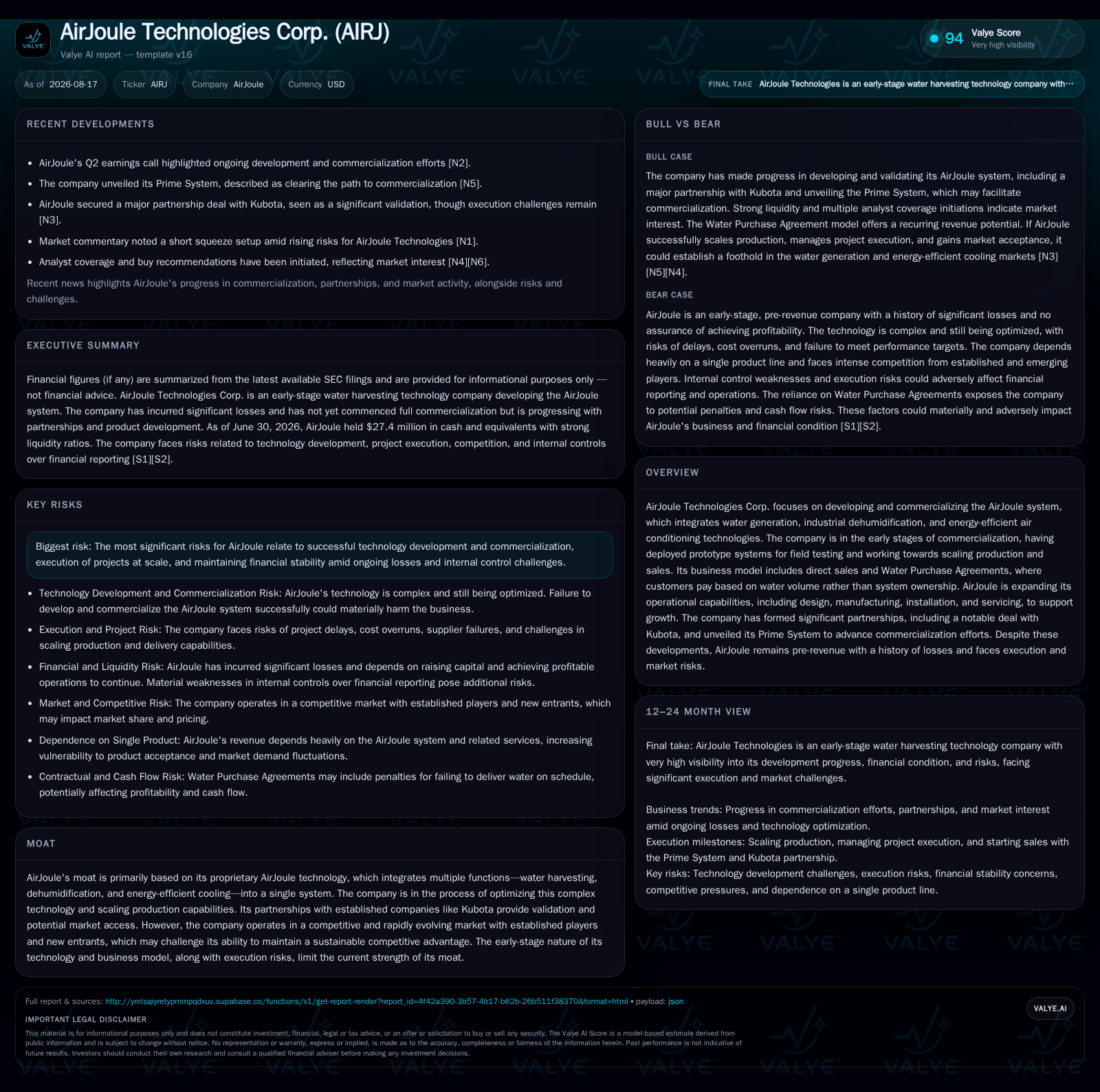
In its Q2 2026 disclosures, AirJoule Technologies revealed ongoing efforts to transition from prototype development to commercial-scale manufacturing of its integrated water harvesting and energy-efficient air systems. The company’s unique Water Purchase Agreements emphasize usage-based revenues, but capital intensity and internal control weaknesses pose execution risks. Strategic partnerships, notably with Kubota, provide technology validation and market access potential amid a competitive landscape dominated by established water technology and HVAC players. Financially, AirJoule maintains a strong liquidity position, supporting near-term scaling investments despite continued operating losses.
Q2 Operational Update Reveals Progress and Execution Risks
AirJoule Technologies’ Q2 2026 filing highlights tangible advancements in moving beyond early-stage prototype deployments toward greater commercialization readiness. The company reported progress on rolling out systems for field testing while emphasizing the strategic importance of its July Kubota partnership as an endorsement of both technology viability and potential market access [S2], [N1], [N2]. Nonetheless, the update also disclosed a persistent material weakness in internal controls over financial reporting identified earlier in the year, posing risks to the reliability of disclosures as the business scales [S2], [S14]. This imperfect control environment underlines typical governance challenges common for emerging growth companies transitioning to more complex operating footprints.
While specific installation counts or water sales volumes remain undisclosed, KPIs such as the number of prototype deployments and evolving commercialization activity suggest incremental but cautious forward momentum. The interplay between deploying integrated hardware systems—which combine atmospheric water harvesting with industrial dehumidification and energy-efficient cooling—and building scalable manufacturing capabilities underscores the operational complexity AirJoule must navigate.
Proprietary Integration: Commercializing Water Harvesting with Energy Efficiency
AirJoule’s core advantage lies in integrating multiple environmental technologies into a single system: atmospheric water generation that leverages humidity extraction; industrial-scale dehumidification critical for various commercial applications; and energy-efficient air conditioning enhancing overall utility. This bundling aims to deliver superior value propositions around resource sustainability and operational cost savings compared to standalone vendors focused solely on water treatment or HVAC functions [S1].
However, this integration raises complexity in design cycles and requires sustained R&D expenditures—as evidenced by ongoing negative operating income—to optimize component interoperability and energy performance. Such sophistication distinguishes AirJoule technologically but also heightens product development timelines common among environmental hardware innovators.
Competitive Positioning within Industrial Hardware & Environmental Tech
Within the broader industry ecosystem encompassing environmental hardware manufacturers, water technology firms like Xylem and Ecolab are notable references due to their established presence in water treatment solutions. Similarly, industrial HVAC providers such as Johnson Controls or Trane offer relevant benchmarks given their scale in delivering energy-efficient climate control systems.
Compared with these peers, AirJoule remains nascent without extensive commercial sales or scale economies. Its moat is primarily anchored in proprietary technology integration rather than established customer bases or widely deployed service networks. Consequently, pricing power is limited presently, further constrained by competition from unbundled single-function providers who benefit from simpler manufacturing and service models.
Scalability Challenges Highlight Manufacturing Bottlenecks and Partner Dependencies
Progressing from prototypes to commercial production involves navigating capital-intensive challenges related to manufacturing throughput, yield optimization, supply chain management, and quality assurance. As detailed in annual disclosures [S1], AirJoule continues investing heavily in expanding production facilities and engineering capabilities essential to assembling its complex systems reliably.
The Kubota collaboration exemplifies leveraging partner ecosystems to offset these burdens by tapping into manufacturing expertise and established distribution channels—critical for de-risking the scale-up phase [N2]. Nonetheless, inherent assembly intricacies typical of contract manufacturers specializing in sophisticated hardware integration underscore ongoing bottleneck risks that could delay volume shipments or inflate unit costs.
Unlocking Growth: Expansion via Water Purchase Agreements and Ecosystem Partnerships
AirJoule’s business model innovation centers on combining traditional hardware direct sales with Water Purchase Agreements (WPAs), where customers pay based on actual water consumption instead of upfront ownership [S1]. This usage-based revenue approach encourages adoption by lowering barriers to entry for industrial clients wary of heavy capital expenditures.
WPAs generate recurring income streams with attractive lifetime value potential but transfer significant capital deployment risk back onto AirJoule during early commercialization phases. Effective contract structuring alongside scaling installation services will be crucial to balancing margin expansion against working capital demands as WPA volumes grow.
The company's partner alliances—including the Kubota deal—also underpin go-to-market acceleration by facilitating broader geographic reach and channel credibility necessary to foster WPA adoption at scale [N2].
Execution Risks: Internal Controls and Market Adoption Barriers
The August 2026 filing restates a material weakness in internal financial controls first identified earlier this year [S2], reinforcing concerns that ongoing rapid organizational growth might strain governance processes. Failure to remediate these deficiencies timely poses risks not only for regulatory compliance but potentially investor confidence if financial reporting errors or delays occur.
Operational execution extends beyond finance controls; scaling installation, after-sales servicing, and maintenance infrastructures present further uncertainties affecting system reliability metrics—key performance indicators directly tied to customer retention under WPAs [S1]. Additionally, market adoption remains unproven at scale given the relatively novel integrated offering amid entrenched incumbents offering segmented solutions.
Upcoming Milestones: Indicators for Commercial Traction and Financial Sustainability
Near-term milestones critical for validating AirJoule’s commercialization trajectory include ramping up commercial system installations beyond pilot phases, measurable increases in water volume sold under WPAs reflective of recurring revenue growth, advancements in manufacturing yield improvements signaling capacity scalability, and securing additional ecosystem partners contributing distribution or service capabilities [S2], [N1].
Tracking improvements in gross margin per system as designs optimize energy efficiency will serve as an important indicator of sustainable unit economics necessary before profitability can be realistically approached.
Financial Profile Discussion: Cash Position Supports Near-Term Scaling Efforts
As of June 30, 2026, current assets stood at approximately $43.2 million against just $2.2 million in current liabilities—implying a strong current ratio near 19.7—that underpins runway for continued production scale-up initiatives without immediate financing pressure [F1]. Available cash reserves reported at $27.4 million (March 31) provide foundational funding though management will need to carefully manage burn rates linked to expanding design/build/install activities until commercial revenues materialize meaningfully.
This analysis focuses exclusively on documented disclosures from AirJoule Technologies’ latest SEC filings supported by industry contextualization relevant to early-stage integrated environmental hardware companies engaged in sustainable water-air management solutions. It incorporates peer insights cautiously without speculative extrapolations regarding customer contracts or detailed production forecasts which remain undisclosed. Readers should monitor upcoming quarterly reports for concrete data points elucidating progression on commercialization milestones amid ongoing internal control remediation efforts.
Disclaimer: This is research-only, informational analysis and not investment advice. It may include AI-generated interpretation and general industry context. Always verify important details using primary sources.

Comments