
Upland Software’s Strategic Refocus Highlights Nasdaq Listing Challenges and Core SaaS Growth Dynamics
Latest quarterly disclosures reveal Upland’s ongoing portfolio streamlining, compliance hurdles with Nasdaq listing requirements, and sustained focus on subscription-driven digital transformation software.
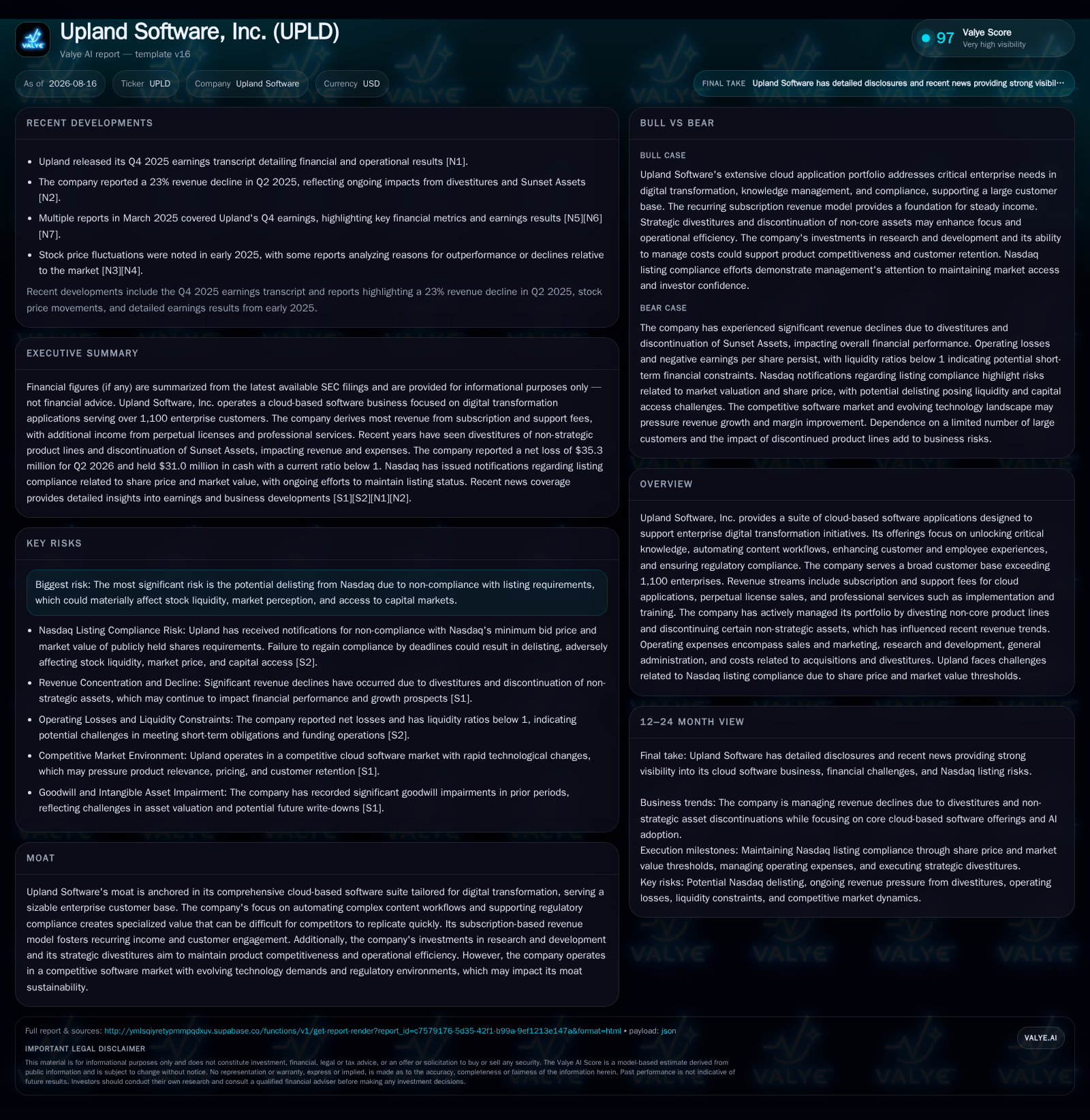
Upland Software in Q2 2026 continues to navigate the aftershocks of recent divestitures of non-core assets while maintaining its cloud-based software offerings tailored to enterprise digital transformation. The company achieved Nasdaq compliance on minimum share price via a reverse stock split but remains at risk due to an insufficient market value of publicly held shares. Upland’s revenue model centers on recurring subscription and support fees supplemented by professional services, with an emphasis on workflow automation and regulatory compliance solutions. Financially, the company holds a sizeable debt load against modest cash reserves and a working capital deficit, reflecting ongoing challenges in balancing growth investments and operational efficiency. Key risks include maintaining Nasdaq listing status and competing effectively in a dynamic Enterprise SaaS market.
Recent Operating Update: Portfolio Streamlining Amid Nasdaq Compliance Challenges
In parallel with business restructuring efforts, Upland grappled with Nasdaq listing rules compliance during the first half of 2026. On April 7, 2026, the company was notified that its common stock’s closing bid price fell below the required $1.00 minimum for over 30 consecutive business days under Rule 5450(a)(1). Prompt corrective action included effecting a reverse stock split which restored compliance by early July [S2]. However, shortly thereafter on July 31, 2026, the market capitalization of publicly held shares dipped below Nasdaq's $15 million minimum threshold requirement (MVPHS), triggering another notice [S2]. The firm has since been granted until January 27, 2027 to regain compliance with this metric or face potential delisting. This dual-layered regulatory scrutiny casts a shadow over near-term trading liquidity and access to capital [S2].
Business Model: Subscription-Centric SaaS with Strategic Divestitures
Upland operates primarily as an Enterprise SaaS vendor delivering cloud-hosted software applications focused on workflow automation, knowledge unlocking through content management, customer/employee experience enhancement, and regulatory compliance. Revenue streams are composed mainly of subscription and support fees derived from contracts typically spanning one to three years recognized ratably over contract terms [S1]. This subscription model fosters predictable recurring revenue streams vital for valuation multiples in SaaS markets.
While subscription revenue is foundational, segments from perpetual license sales and professional services add meaningful contributions. Perpetual licenses recognize upfront revenue when software is delivered but are diminishing in significance as Upland pivots decisively towards cloud-first offerings [S1]. Professional services encompass implementation, integration, data migration, configuration customization and training—services that not only generate additional income but materially affect customer retention by ensuring smoother adoption [S1].
Operating expenses reflect this mixed model: cost of product revenue includes cloud hosting costs borne for maintaining SaaS infrastructure alongside personnel deploying customer success teams [S1]. Sales & marketing expenditures remain substantial given the competitive necessity to acquire enterprise customers capable of multi-year contracts. R&D spending targets sustaining product relevance amid rapid technological evolution while managing cost-efficiencies through termination of legacy vendor contracts post-divestitures [S1].
Industry Structure and Competitive Position
The Enterprise SaaS market is highly competitive with large incumbents such as Salesforce (CRM) dominating subscription growth narratives due to strong CRM integrations; ServiceNow (NOW) excels in workflow automation platforms digitizing enterprise processes; Box (BOX) commands significant mindshare in cloud content management; while Workday (WDAY) leverages deep HR/accounting SaaS expertise coupled with strong recurring revenue models. Against these scale giants, Upland positions itself as a specialized provider focused on automating complex content workflows intertwined with regulatory compliance needs often underserved by larger broad-based SaaS players.
Upland serves over 1,100 enterprise customers across industries requiring regulatory adherence—sectors where workflow complexity and data governance form high switching costs. Its moat arises from specialized domain knowledge embedded in its modular application suite tailored for customer needs including AI integration paths designed to accelerate digital transformation journeys [S1]. However, sustaining this competitive position demands continuous innovation investment amidst marketplace price pressures and evolving regulation frameworks adjusting customer priorities.
Growth Drivers
Key growth drivers for Upland hinge on macro trends accelerating cloud adoption for legacy modernization—specifically enterprises transitioning away from on-premise installations towards scalable cloud environments offering workflow automation gains. The rising complexity of regulatory regimes internationally spurs demand for dedicated compliance software embedded into operational workflows rather than standalone tools.
Additionally, expansion in embedded AI capabilities within Upland’s applications aims at augmenting productivity gains that resonate well within customer ROI justifications leading to higher net dollar retention rates [S1]. Multi-year subscription contracts underpin visibility into future revenues enhancing planning efficiency. Cross-selling opportunities within the installed base provide organic growth levers alongside potential geographic expansions targeting emerging markets where digital transformation initiatives are maturing
Professional services continue as vital enablers converting pipeline generating customers into long-term retained users given the complexities involved in deployment across heterogeneous IT landscapes.
Risks / Watchpoints / Growth Constraints
Among salient risks is Upland's ongoing battle to comply fully with Nasdaq listing requirements, notably regarding public float valuation which directly impacts liquidity and investor access to future financing rounds or secondary offerings [S2]. Failure here could severely impair investment inflows.
Operationally the threat of customer churn remains an ever-present challenge characteristic of subscription businesses especially amid increasing competition driving pricing power erosion [S1]. Furthermore rapid technology shifts necessitate elevated R&D expenditures imposing margin pressure despite efforts to optimize through internal development centers replacing outsourced vendors post-divestitures
Dependence on third-party cloud hosting providers exposes Upland to infrastructure cost volatility affecting gross margins. Regulatory changes or unexpected breaches related to data privacy could undermine customer trust impacting contract renewals.
Finally, concentration risk tied to large enterprise accounts requires diversification focus to mitigate disproportionate impact from any single customer's contract termination or downsizing.
What To Watch Next
Key upcoming milestones center squarely around Upland’s ability to either regain or sustain Nasdaq market value threshold compliance before the January 27, 2027 deadline—a material inflection point for stock market presence stability [S2]. Contract renewal rates within core subscription deals will elucidate underlying demand durability amidst portfolio recalibration.
Monitoring subscription and support revenue growth trends versus legacy perpetual license declines will indicate execution effectiveness on transitioning fully towards recurring revenue dominance. Reported churn rates or net dollar retention metrics disclosed subsequently would further clarify customer loyalty dynamics.
Continued divestiture outcomes influencing expense structure should be assessed alongside R&D spend effectiveness measured by new feature rollouts or product enhancements enabling competitive differentiation over peers.
Profitability trajectory examination will reveal if operating leverage gains accompany top-line stabilization following strategic focus consolidation.
Financial Profile Discussion
As of June 30, 2026, Upland reported cash and equivalents of approximately $31 million, with current assets totaling $70.1 million and current liabilities of $80.2 million, resulting in a current ratio of about 0.87 [F1]. Total debt stood at approximately $238.5 million as of December 31, 2025, with net debt around $207.5 million at that date [F1].
This financial position reflects working capital deficits and ongoing leverage headwinds. The company faces liquidity pressures requiring prudent cash management, especially as capital expenditures continue to focus on platform innovation while servicing significant interest obligations tied to credit facilities bearing floating rates near elevated levels [F1]
Operating cash flows suggest moderate internal funding capacity but may not fully cover debt servicing and investment spending, indicating potential need for external funding or refinancing depending on market conditions.
Disclaimer
This analysis is based solely on publicly available filings as of August 16, 2026. It does not constitute investment advice or research views but serves as an informed industry perspective grounded strictly in disclosed corporate data combined with standard industry knowledge.
Disclaimer: This is research-only, informational analysis and not investment advice. It may include AI-generated interpretation and general industry context. Always verify important details using primary sources.

Comments