
UMeWorld Inc. Q2 2026: Concentrated Supply and Distribution Risks Amid Early-Stage DAGola™ Growth
UMeWorld's Q2 2026 update reveals continued DAGola™ revenue growth alongside significant supplier and distributor concentration and a working capital deficit.
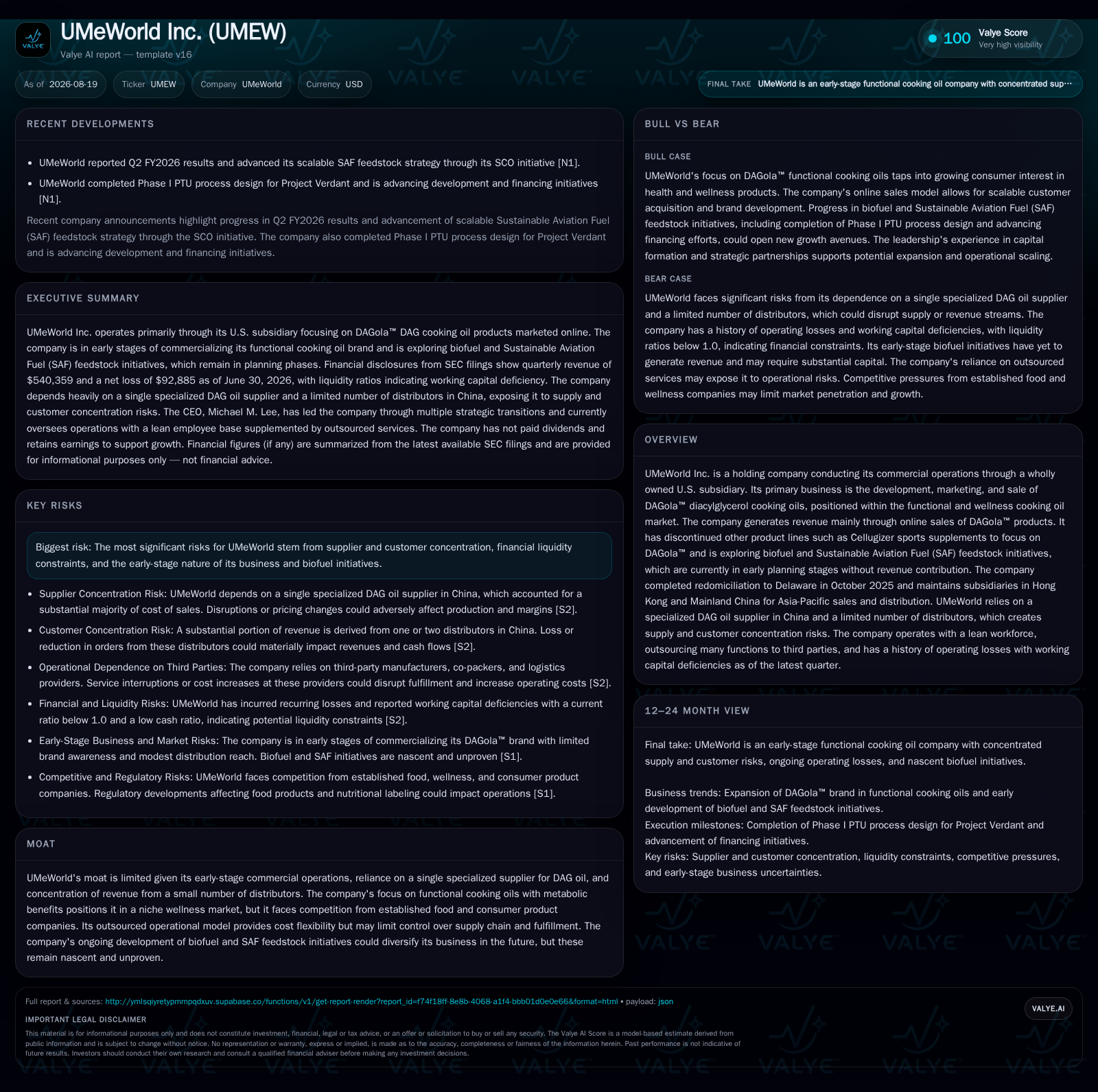
UMeWorld Inc. reported ongoing revenue growth in the second quarter of 2026 driven by its DAGola™ diacylglycerol cooking oil sold primarily online. However, the company faces substantial operational risks due to heavy reliance on a single specialized DAG oil supplier and two major distributors in China. As of June 30, 2026, UMeWorld had a working capital deficit with a current ratio of 0.83, highlighting liquidity constraints amid its early-stage commercialization. Its biofuel and Sustainable Aviation Fuel (SAF) feedstock initiatives remain in nascent stages without revenue contribution, underscoring the company's financial and operational vulnerabilities.
Q2 2026 Operating Update and Revenue Growth
UMeWorld Inc. reported continued revenue growth in the second quarter of 2026 primarily driven by online sales of its DAGola™ diacylglycerol cooking oil products [S1][S2]. This revenue growth aligns with the company's focus on developing DAGola™ as a functional wellness cooking oil brand marketed for metabolic and health benefits. Notably, the company did not generate any revenue from its biofuel or Sustainable Aviation Fuel (SAF) feedstock initiatives during this period, as these projects remain in early planning and feasibility assessment stages.
The company's revenue mechanics depend largely on online retail platforms and a limited number of distributors, with end consumers purchasing DAGola™ products through these channels [S1][S2]. Marketing efficiency, customer acquisition dynamics, and supply chain logistics are critical factors influencing revenue growth and operating results given the early-stage scale of the business. The reliance on digital advertising and online marketplaces means that fluctuations in platform algorithms, advertising costs, and fulfillment fees can materially affect sales performance and margins.
Supplier and Distributor Concentration Risks
UMeWorld's operations in Q2 2026 were materially affected by significant concentration risks in both supply and distribution [S2][S15]. A single specialized DAG oil supplier located in China accounted for a substantial majority of the company's cost of sales during the quarter. This supplier concentration exposes UMeWorld to risks of supply interruptions, pricing volatility, and potential production delays, which could adversely impact margins and operational stability. The specialized nature of DAG oil production, which requires technical capabilities and supplier qualification procedures, limits the pool of qualified suppliers, thereby exacerbating this risk.
On the customer side, two distributors in China accounted for a substantial portion of UMeWorld's quarterly revenue [S2][S15]. This distributor concentration presents a risk that future orders may decline in volume or price, which could materially affect the company's revenues, cash flows, and overall results of operations. The company's reliance on a narrow distributor base in a geographically concentrated market underscores its vulnerability to shifts in distributor relationships or purchasing patterns. Any loss or reduction in purchases by these distributors could have a disproportionate negative impact on the company's financial performance.
Additionally, UMeWorld depends on third-party manufacturers, co-packers, and logistics providers for production and fulfillment [S2][S15]. These third-party relationships introduce further operational risks, including potential service interruptions, capacity constraints, and cost increases. Such disruptions could delay product availability, increase operating expenses, and complicate margin management. Given the company's early-stage scale, these risks are particularly acute as the company may have limited leverage or alternative options to mitigate such disruptions.
Liquidity and Working Capital Position
As of June 30, 2026, UMeWorld reported current assets of $1.51 million against current liabilities of $1.82 million, resulting in a working capital deficit and a current ratio of 0.83 [F1]. This working capital deficit reflects ongoing liquidity challenges that may constrain the company's operational flexibility and ability to fund growth initiatives without additional financing.
Historical disclosures indicate that UMeWorld has incurred recurring operating losses and has relied primarily on equity issuances and shareholder advances to finance working capital, inventory procurement, marketing, and administrative costs [S1][S3]. The company expects to continue financing operations through these means, but there is no assurance that such financing will be available on acceptable terms or at all. The liquidity constraints raise substantial doubt about the company's ability to continue as a going concern absent successful capital raises or operational improvements.
Margins are influenced by raw material costs—dominated by the single specialized supplier in China—packaging, international freight, import duties, and fulfillment fees associated with online sales [S1][S2]. Volatility in international shipping costs and raw material availability can further pressure margins. The company's early-stage scale also results in higher relative fixed costs, which can exacerbate losses if revenue growth does not accelerate sufficiently.
Business Model and Competitive Positioning
UMeWorld's business model centers on selling functional wellness cooking oils containing diacylglycerol (DAG) primarily through online retail platforms and a limited distributor network [S1][S2][S5]. End consumers purchase DAGola™ products for their purported metabolic and health benefits, positioning the brand within a niche but growing segment of science-backed wellness products.
Revenue generation depends heavily on the company's ability to reach new customers, encourage repeat purchases, and maintain competitive pricing relative to other specialty and conventional cooking oils. Marketing efficiency and customer acquisition costs are critical drivers of financial performance, given the company's reliance on digital advertising and online marketplaces.
The company faces significant operational constraints due to its early-stage operations, supplier and distributor concentration, and competition from established food and wellness companies with broader supply chains and distribution networks [S1]. The company's reliance on a single supplier and a narrow distributor base increases operational risk and margin volatility, while competition from larger, more established brands may pressure pricing and market share.
Early-Stage Biofuel Initiatives
UMeWorld has begun exploring biofuel and Sustainable Aviation Fuel (SAF) feedstock initiatives as potential diversification avenues [S1][S2]. However, these efforts remain in early planning and feasibility assessment stages without any current revenue contribution. While these initiatives may represent future growth opportunities, they currently add uncertainty and do not mitigate the company's near-term operational and financial risks.
The company’s strategic focus remains on expanding the DAGola™ brand, with biofuel and SAF projects representing longer-term, unproven diversification paths. Capital allocation toward these initiatives will need to be balanced against the immediate need to address liquidity constraints and operational risks associated with supplier and distributor concentration.
Analytical Conclusions and Outlook
UMeWorld's operational and financial profile in Q2 2026 remains constrained by structural risks related to supplier and distributor concentration [S2][S15]. The reliance on a single specialized DAG oil supplier in China for the majority of cost of sales, combined with revenue concentration from two distributors, structurally increases margin volatility and operational risk. This concentration heightens the company's exposure to supply chain disruptions and shifts in distributor purchasing behavior, which could materially affect financial results.
The company's working capital deficit and current ratio below 1.0 as of June 30, 2026, further illustrate liquidity challenges that may limit operational flexibility and growth potential absent additional financing [F1]. Recurring operating losses and dependence on equity issuances and shareholder advances underscore the need for effective capital management and potential fundraising to sustain operations.
Biofuel and SAF feedstock initiatives, while potentially valuable long-term diversification paths, remain unproven and do not currently contribute to revenue, underscoring the early-stage nature of UMeWorld's business expansion efforts [S1][S2]. These projects add strategic optionality but also introduce uncertainty regarding future capital requirements and operational focus.
Watchpoints
Key areas to monitor include any changes in supplier concentration or efforts to diversify DAG oil sourcing, which would reduce supply risk and margin volatility. Expansion or diversification of the distributor base, particularly in China and the broader Asia-Pacific region, could mitigate revenue concentration risks and improve operational resilience.
Quarterly revenue growth trends for DAGola™ products will provide insight into market acceptance, brand traction, and the effectiveness of marketing and distribution strategies. Improvements in working capital and liquidity, whether through operational cash flow improvements or additional financing, will be critical for sustaining and scaling operations.
Progress and capital allocation toward biofuel and SAF feedstock initiatives should be tracked to assess their potential future impact on the company's business model and financial profile. Given the early-stage nature of these projects, their development pace and capital intensity will influence the company's strategic direction and resource allocation.
In summary, UMeWorld's Q2 2026 update highlights early-stage commercial progress with DAGola™ cooking oils but underscores significant operational and financial vulnerabilities due to concentrated supply and distribution relationships and constrained liquidity [S2][S3]. Addressing these structural risks and liquidity challenges will be essential for the company to transition from a nascent brand to a more stable and scalable business.
Disclaimer: This is research-only, informational analysis and not investment advice. It may include AI-generated interpretation and general industry context. Always verify important details using primary sources.

Comments