
RNAi Oncology Pioneer Silexion Balances Trial Progress with Tight Liquidity
Silexion advances its RNAi candidate SIL204 into pivotal late-stage trials amidst pressing financial constraints.
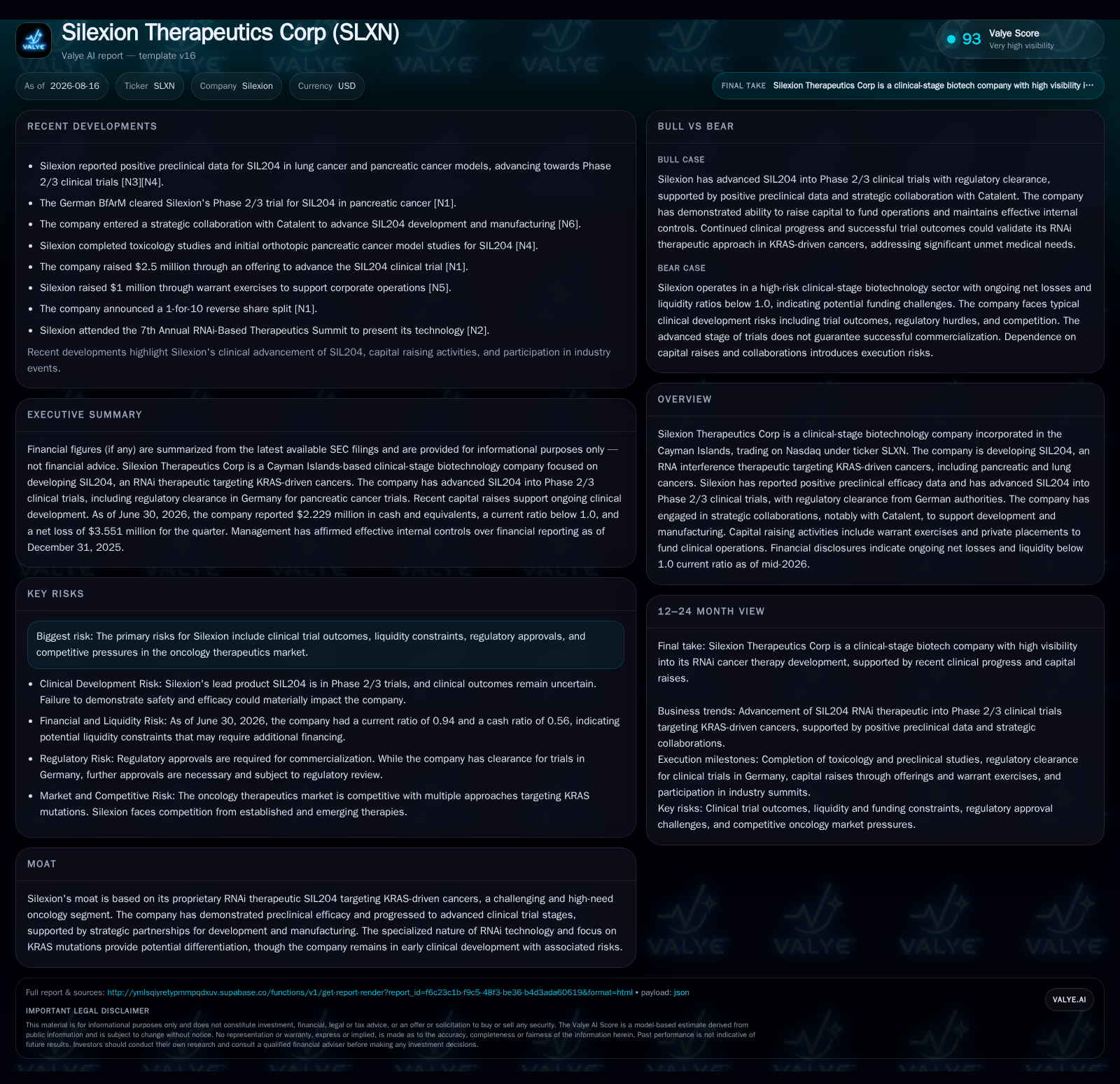
Silexion Therapeutics Corp has progressed its SIL204 RNA interference therapeutic targeting KRAS-driven pancreatic and lung cancers into Phase 2/3 clinical trials, with regulatory clearance achieved in Germany. This advancement validates the company’s scientific platform and strategic direction but coincides with a liquidity position under 1.0 current ratio as of mid-2026, signaling an urgent need for additional capital to sustain operations. Manufacturing collaboration with Catalent strengthens operational readiness, yet inherent risks from clinical outcomes, funding adequacy, and regulatory hurdles persist. Next quarter’s enrollment rates, partnership developments, and cash management are critical to monitor.
Q2-2026 Clinical Milestones Validate RNAi KRAS Strategy Under Capital Constraints
In its August 14, 2026 Q2 filing and accompanying earnings release, Silexion Therapeutics confirmed continued advancement of its lead candidate SIL204 into Phase 2/3 clinical trials targeting KRAS-driven pancreatic cancer with regulatory clearances secured in Germany [S2][S3][S4]. This marks a critical inflection point transitioning from preclinical validation towards pivotal studies that will define clinical efficacy and safety parameters. The company's ability to maintain enrolment pace and achieve multi-site approvals—especially across Europe—will be key early indicators of trial viability.
However, these developmental strides come against a backdrop of financial pressure: as of June 30, 2026, Silexion reported cash and equivalents of roughly $2.2 million while current liabilities outpaced current assets ($3.7 million vs $3.9 million), resulting in a sub-1.0 current ratio (0.94) [F1][S3]. Such a liquidity profile poses execution risk unless offset by ongoing capital raises or collaboration milestone fees.
RNA Interference Platform: From Preclinical Promise to Phase 2/3 Oncology Trials
Silexion’s core product SIL204 employs RNA interference (RNAi) technology to silence KRAS oncogene expression—a long-sought mechanism given the historically undruggable nature of KRAS mutations prevalent in pancreatic and lung cancers [S1]. Positive preclinical data demonstrating multi-mechanism immune sensitization bolstered confidence in SIL204's approach earlier this year [S8]. The company's move into late-stage outpatient clinical testing reflects maturation beyond proof-of-concept to a stage requiring robust patient recruitment, safety monitoring, and regulatory engagement.
This business model follows classic biotech archetypes focused on investing heavily in R&D through expensive phased trials without generating commercial revenue—funding sourced predominantly via equity financings and milestone payments tied to development progress or partnering agreements.
Industry Benchmarks Highlight Silexion's Position Amidst RNAi Peers Advancing KRAS Therapies
Within the biotech therapeutics landscape, Silexion competes with firms like Alnylam Pharmaceuticals and Arrowhead Pharmaceuticals that also pioneer RNAi or gene-silencing platforms targeting disease-causing genes including oncogenes. Progression through expensive late-phase oncology trials demands steady enrollment rates; delays or slow site approvals can compress timelines and inflate costs.
Strategic CDMO partnerships are industry norms given the complex manufacturing processes required for RNAi therapeutics. Silexion’s relationship with Catalent aligns it with a top-tier contract developer/manufacturer familiar with advancing nucleic acid therapies toward commercialization—a positive signal regarding readiness for scaled production if trials succeed [S1][N1]
'Capital Lifeline': Fundraising Drives Sustainability But Liquidity Below Par Raises Risks
Financially, the company remains deep in the developmental investment phase with persistent net losses pressuring cash reserves [F1]. To extend its limited runway amid high burn rates intrinsic to pivotal oncology studies, Silexion completed a $2.5 million offering in August 2026 involving warrant exercises and private placements supplemented by ATM sales earlier this year [N1][S3]. These injections alleviate short-term funding gaps but underscore vulnerability to market conditions and dilution risks.
'Patient Enrollment Pace' and Regulatory Clearances: Trial Execution As A Key Test
Investor attention should focus sharply on enrollment velocity within the Phase 2/3 program since delayed recruitment extends timelines exponentially given fixed protocol durations [S4]. Regulatory clearances already obtained in Germany demonstrate some regional acceptance but future site approvals—especially in Israel and other EU member states—and eventual U.S. FDA interactions are crucial pending broader study expansion.
Moreover, maintaining favorable safety/tolerability profiles will influence trial continuity; adverse events derailing phase progression remain an omnipresent risk factor in RNAi therapeutic development.
'Manufacturing Collaboration' with Catalent Confirms Operational Framework Growing More Complex
The partnership with Catalent reflects a strategic outsourcing approach common among RNAi biotechs to tap specialized expertise for drug substance production scalability ahead of commercial needs. This reduces direct capex burden while providing flexibility against clinical data variability. However, reliance on third-party manufacturing introduces supply chain dependencies that require coordination around batch quality consistency and timelines.
This operational setup aligns with peers who successfully transitioned from early-stage experimentation toward regulated-scale manufacturing necessary for late-stage trials and eventual market supply.
'Risks Remain': Trial Outcomes, Funding Adequacy, and Regulatory Hurdles Shape Next Steps
Despite technical promise there remain significant uncertainties—from achieving meaningful clinical endpoints within acceptable timeframes to navigating complex regulatory landscapes across multiple jurisdictions [S24]. The narrow liquidity cushion amplifies risk: failure to raise adequate funds before depletion threatens trial suspension or forced dilution at unfavorable terms.
Competitive pressure intensifies as alternative molecular modalities (small molecules, biologics) advance KRAS-targeted therapy pipelines worldwide. Intellectual property protection timing will also define competitive insulation but was not newly elaborated in latest filings.
'Forward-looking Indicators': Enrollment Velocity, Additional Partnerships, and Cash Burn Monitored Closely Next Quarter's Signals
Upcoming quarterly disclosures should provide clarity on actual phase enrollment numbers relative to protocol targets—an important barometer of development momentum [S2][N1]. Announcements regarding new collaborations or licensing agreements could introduce milestone revenues easing funding pressures.
Monitoring burn rate trajectories vis-à-vis cash balance will reveal if the recent fundraising sufficiently extends runway through key inflection points such as initial interim efficacy reads or expanded regulatory submissions.
Taken together, these operating metrics form the performance dashboard shaping longer-term valuation dynamics for speculative clinical-stage biotech investors exposed to novel RNAi oncology platforms.
Financial Profile Discussion
As of June 30, 2026 end-Q2 reporting indicates Silexion held approximately $2.23 million in cash & equivalents against current liabilities totaling about $3.98 million resulting in a current ratio just shy of parity at 0.94 [F1]. This imbalance implies existing working capital shortages needing immediate rectification through capital markets activities or partner infusions to avoid operational curtailments. The company reported ongoing net losses consistent with R&D-stage biotech without commercial revenues [F1][S3]. Recent capital raises cumulatively approximating $2.5 million have partially alleviated near-term funding constraints but signal sustained dependency on equity instruments amid volatile investor appetite for high-risk oncology drug developers [N1]. Monitoring quarterly cash burn patterns aligned with trial progress updates will be essential to gauge real sustainability moving forward.
Disclaimer: This report is an industry analysis based solely on publicly available filings and industry knowledge principles as of August 2026. It neither constitutes investment advice nor suggests any buy or sell decisions regarding securities issued by Silexion Therapeutics Corp.
Disclaimer: This is research-only, informational analysis and not investment advice. It may include AI-generated interpretation and general industry context. Always verify important details using primary sources.

Comments