
Mainz Biomed’s Strategic Pivot From Colorectal to Pancreatic Cancer Diagnostics and Quantum Cybersecurity
Following a significant strategic refocus, Mainz Biomed is transitioning away from colorectal cancer testing towards pancreatic cancer diagnostics and post-quantum cybersecurity, reshaping its product portfolio and business trajectory.
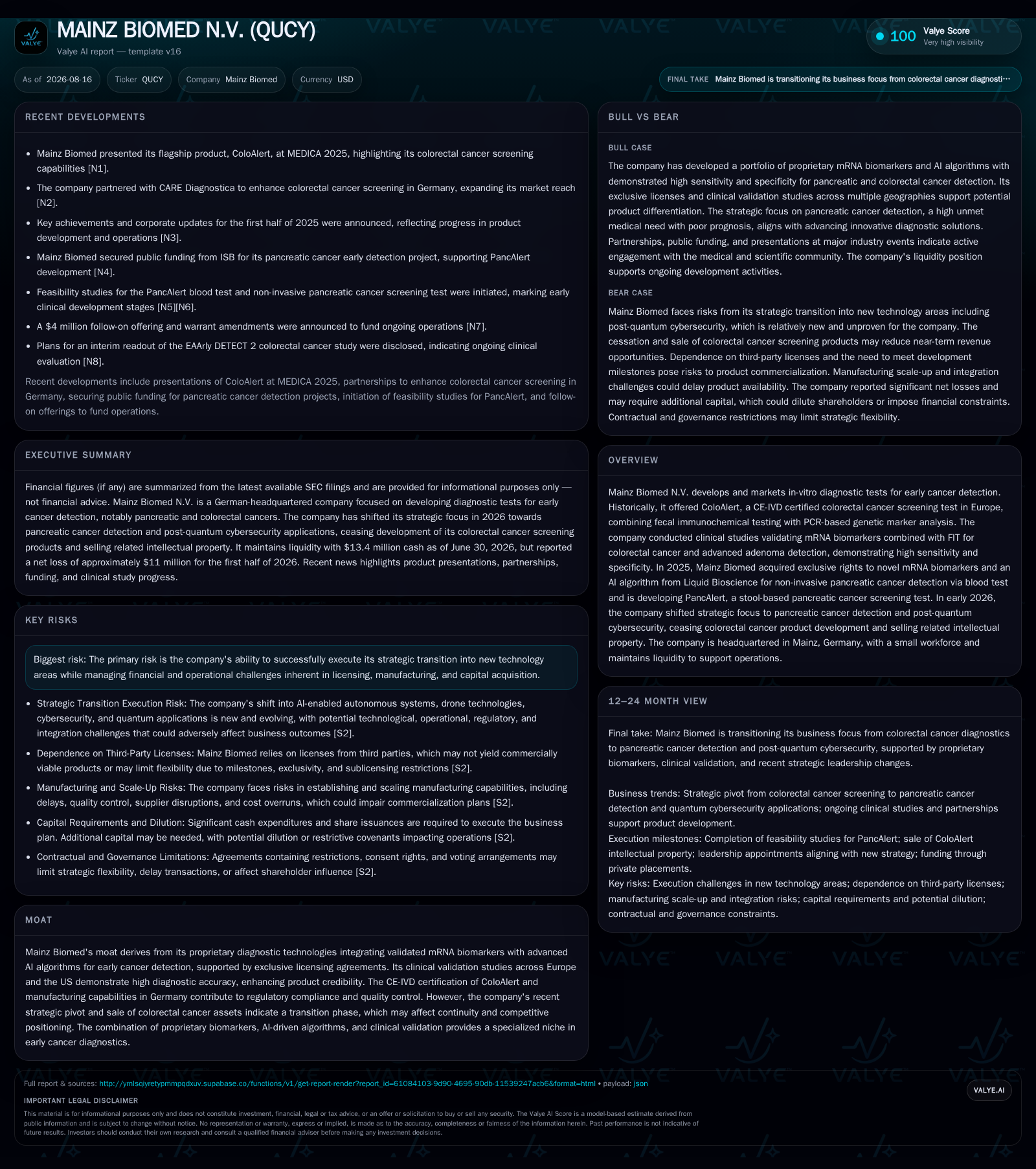
Mainz Biomed N.V.’s latest quarterly filing reveals a decisive shift in strategy from its historically focused colorectal cancer diagnostic offerings, notably ColoAlert, towards developing non-invasive pancreatic cancer detection tests utilizing novel mRNA biomarkers and AI algorithms. The company sold its colorectal intellectual property in early 2026 and realigned management to expand into post-quantum cybersecurity technologies. This transition compresses near-term commercialization risks but introduces execution challenges relating to new technology integration, manufacturing scale-up, and capital needs. Industry context underscores the high regulatory and validation barriers in in vitro diagnostics (IVD), with Mainz’s moat currently anchored in proprietary biomarker-analytics combinations and CE-IVD compliance. Financially, Mainz maintains adequate liquidity with $13.4 million cash and a strong current ratio but faces execution risk amid evolving focus and potential capital demands.
Recent Operating Update
Simultaneously, Mainz has acquired exclusive licenses to advanced mRNA biomarkers coupled with proprietary AI diagnostic algorithms from Liquid Bioscience for blood-based pancreatic cancer detection [S1]. These biomarkers underpin two promising product candidates: a blood test for non-invasive early pancreatic cancer screening and PancAlert, a stool-based analog. The PancAlert development is bolstered by non-refundable government grants covering part of project costs [S1]. However, clinical validation remains ongoing, as expected given the inherently lengthy timelines typical in molecular diagnostics.
Alongside this product portfolio reorientation, Mainz expanded executive leadership with the appointment of David Lazar as co-CEO and Robert Liscouski as non-executive Chairman early 2026 [S1]. These governance changes align with the company’s concurrent foray into quantum-related cybersecurity applications — an entirely different technological domain featuring AI-enabled autonomous systems and drone technologies [S2]. Importantly, the firm plans a name change to Quantum Cyber N.V., reflecting this broadened strategic scope [S1].
Business Model Overview
Historically anchored in the In Vitro Diagnostics (IVD) industry niche of early cancer detection through non-invasive molecular assays, Mainz generated revenues primarily through sales of its CE-IVD certified ColoAlert test kits in European markets [S1]. These products leveraged fecal immunochemical testing (FIT) combined with PCR-based analysis of genetic markers including mRNA biomarkers — delivering clinically validated sensitivity and specificity that enhanced early detection effectiveness.
Revenue was drawn mostly from direct test kit sales to laboratories or healthcare providers as consumables usable with standard PCR instrumentation [S1]. Patent-protected biomarker sets formed part of long-term licensing relations supporting exclusivity along with regulatory certifications under evolving EU frameworks (IVD Directive transitioning to IVD Regulation)
With cessation of colorectal products, Mainz’s current business model will pivot toward development-stage revenue levers including milestone fees tied to licensing agreements and grant-funded R&D activities. Commercialization will hinge on successful completion of regulatory approvals for PancAlert or blood-based screenings that integrate proprietary AI diagnostic algorithms — which aim to enhance diagnostic accuracy by identifying complex biomarker signatures not detectable by conventional methods alone.
The strategic expansion into quantum cybersecurity represents an entirely distinct monetization pathway relying on licensing innovative hardware/software solutions such as quantum antenna arrays and autonomous drone systems developed via acquired technologies from third-party partners like BP United [S2]. This segment’s business model entails technology licensing fees, manufacturing operations supported initially through technical assistance contracts, and eventual product sales in emerging quantum security markets.
Industry Structure and Competitive Position
Mainz operates within the highly regulated IVD landscape characterized by stringent clinical validation demands and prohibitive barriers to entry due to required biomarker discovery expertise, certification processes (notably CE-IVD under EU regulations), and manufacturing quality controls. The value chain includes biomarker research partnerships, assay development teams, contract manufacturing organizations (CMOs), clinical laboratories executing tests at scale, healthcare payors deciding reimbursement levels, and regulatory bodies vetting product safety/efficacy.
Peer firms range from large global entities like Exact Sciences focusing on molecular colon cancer diagnostics to smaller biotechnology players specializing in biomarker-driven oncology assays such as Guardant Health or Foundation Medicine. Mainz’s differentiated moat stems mainly from exclusive licenses to novel mRNA biomarkers paired with an AI diagnostic algorithm — together forming a proprietary technology stack purportedly enhancing early pancreatic cancer detection sensitivity/specificity beyond standard methods [N #], [S1].
Yet this competitive edge remains contingent on timely product development milestones amid growing competition exploring liquid biopsy approaches utilizing circulating tumor DNA or exosomes. Regulatory compliance under newer IVD Regulation regimes also imposes elevated certification challenges compared with legacy directives requiring adaptable quality systems.
Manufacturing scale-up constitutes another competitive hurdle; Mainz aims to internalize production capacity following arrangements with BP United that involve technical consulting for process implementation [S2]. Successful integration here will be critical to cost-effective market supply versus reliance on external CMOs.
Growth Drivers
Growth prospects center on rising demand for early-stage pancreatic cancer screening tools driven by increasing incidence rates worldwide coupled with poor prognosis under current late-detection standards. The integration of novel mRNA biomarkers into accessible non-invasive specimen types coupled with AI algorithms promises improved diagnostic performance — key criteria influencing physician adoption and payer reimbursement decisions.
Regulatory trends favoring non-invasive diagnostics support easier adoption pathways versus invasive tissue biopsies. Government grants demonstrated willingness to financially support R&D efforts indicating public health interest alignment.
Additionally, the strategic pivot into quantum cybersecurity targets a rapidly emerging field projected for exponential growth related to secure communications needing quantum-resistant technologies — thus opening alternative revenue streams less sensitive to traditional healthcare sector cyclicality.
Risks and Constraints
Execution risk dominates as Mainz catalyzes multiple transitions simultaneously. Risks include failure or delay obtaining necessary regulatory clearances for pancreatic cancer diagnostics amid evolving EU frameworks. Clinical validation setbacks could further delay revenue generation deadlines.
The company remains heavily dependent on licensed intellectual property whose ongoing validity or enforceability could be challenged. Restrictions such as field-of-use limitations or sublicensing constraints can impair strategic flexibility [S2].
Manufacturing buildout risks are pronounced; assembling competent facilities that comply with medical device Good Manufacturing Practices while managing component shortages or supplier reliabilities poses potential bottlenecks.
From a capital perspective, sustained R&D expenditure combined with new business investments necessitates further fundraising which could dilute shareholders or impose covenant constraints [S2]. Failure to secure adequate funding may force deprioritization of key initiatives.
Moreover, transitioning management attention toward unfamiliar quantum cybersecurity markets might distract from core diagnostic program momentum compromising progress.
What To Watch Next
Key near-term milestones include progress updates on PancAlert clinical study completions validating diagnostic accuracy metrics such as sensitivity/specificity relative to conventional standards [S1]. Regulatory submission timelines under IVD-R rules should offer signals about commercialization prospects.
Management guidance improvements around manufacturing ramp-up feasibility or pilot production volume targets would clarify operational readiness.
Further corporate developments such as completion of the proposed name change or final board composition adjustments may indicate strategic conviction level behind new directions [S1].
Capital raising events or license milestone achievements linked to Liquid Bioscience agreements will materially shape financial runway visibility.
Monitoring any updates related to legal disputes around license rights or potential IP enforcement actions is advisable given their impact possibility on asset utilization.
Financial Profile Discussion
Operating losses persist consistent with pre-commercial biotech profiles; reported net income at December 31, 2025 was negative $16.2 million reflective of ongoing R&D spending scaled against sparse revenues stemming principally from legacy ColoAlert sales prior to divestiture [F1]. This loss magnitude emphasizes continued reliance on equity financing or external capital injections for sustaining operations amid strategic shifts.
The financial position affords some cushion during this transitional phase but underlying operating burn rates relative to available funds should be monitored closely given anticipated increased expenditures associated with dual technology domain developments—pancreatic diagnostics commercialization plus emerging quantum cybersecurity investments per latest filings [S2].
This analysis integrates detailed operating disclosures from Mainz Biomed’s latest quarterly filings alongside broader industry insights pertinent to in vitro diagnostics emphasizing molecular biomarker innovation coupled with emergent AI applications. The company stands at a strategic crossroads balancing legacy legacy asset divestitures against ambitious yet capital-intensive exploratory ventures across biotechnologies and quantum cybersecurity fields—each requiring specialized execution capabilities within distinct competitive ecosystems. Cautious monitoring of technical progress milestones alongside prudent capital management will be pivotal in assessing Mainz's evolving viability as a specialty diagnostics innovator transforming into multi-domain advanced-tech enterprise.
Disclaimer: This report is an independent analytical summary designed for institutional understanding only. It does not constitute investment advice or research views.
Disclaimer: This is research-only, informational analysis and not investment advice. It may include AI-generated interpretation and general industry context. Always verify important details using primary sources.

Comments