
Genvor Inc Advances AI-Driven Peptide Platform Amid Funding Constraints
The latest quarterly update highlights Genvor's continued R&D progress in sustainable agricultural peptides alongside ongoing liquidity challenges.
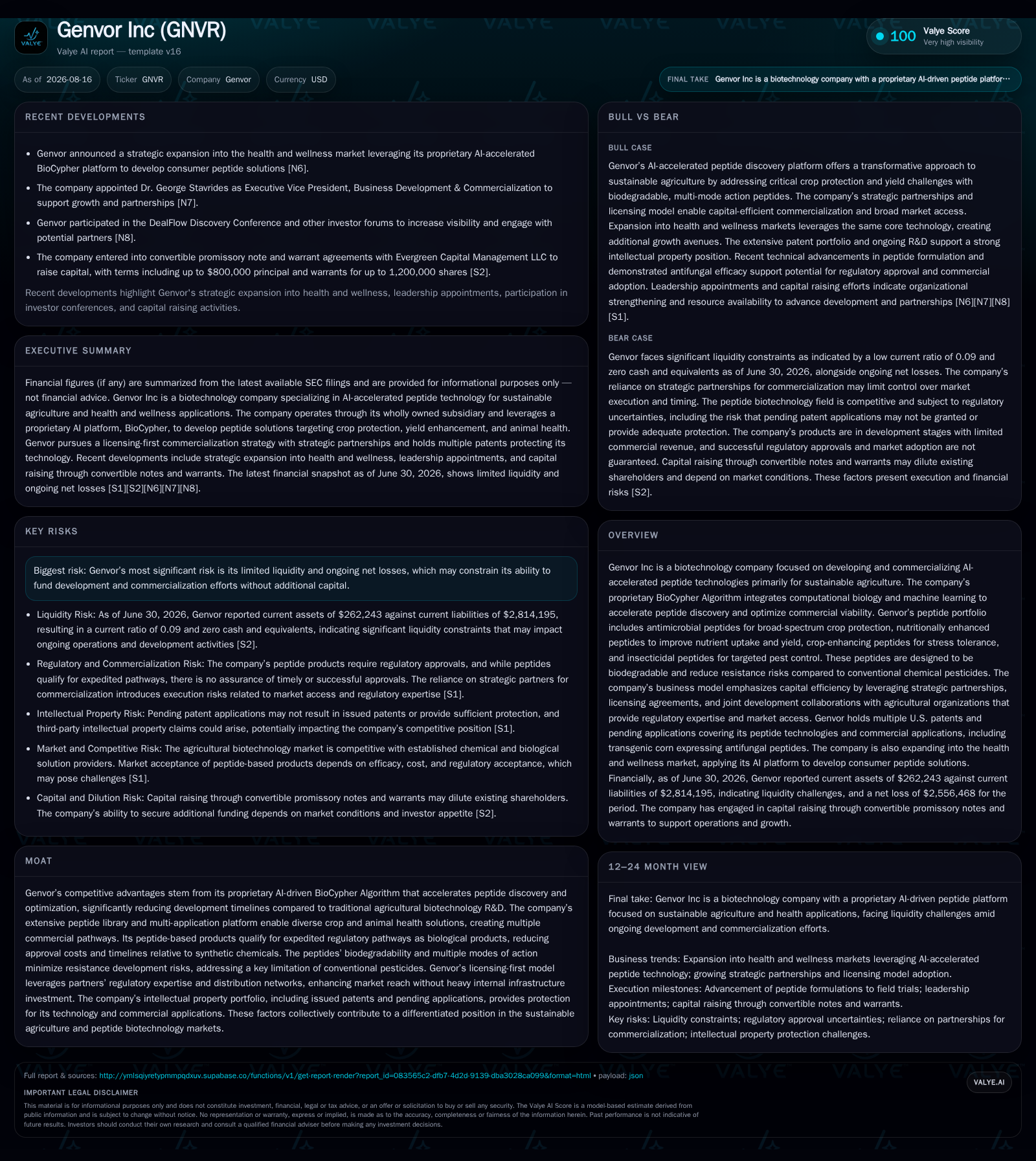
Genvor Inc, a pioneer in AI-accelerated peptide technologies for sustainable agriculture, reported no revenue but sustained investment in its core BioCypher Algorithm-driven pipeline as of Q2 2026. The company’s licensing-first business model leverages strategic partnerships to commercialize biodegradable antimicrobial and crop-enhancing peptides addressing global crop stressors. However, limited liquidity and net losses remain critical headwinds, underscoring the importance of capital-raising efforts recently accelerated through warrant financings. Genvor’s long-term growth hinges on regulatory approvals, scaling peptide production capacity, and expanding strategic collaborations to translate AI-enabled discovery into commercial products.
Recent Quarterly Operating Update
Genvor Inc's latest quarterly report filed August 14, 2026, reveals that while the company has yet to generate meaningful revenue from its peptide platforms, significant internal efforts continue toward advancing its AI-enabled discovery pipeline [S2]. The absence of sales is consistent with an early-stage ag biotech enterprise operating primarily at the R&D stage. Notably, no material change in operating expenses or development timelines was highlighted specifically, indicating steady progression rather than acceleration or delay.
This steady-state progress is important because Genvor’s value proposition hinges on rapidly shortening the typically protracted timelines of agricultural biotechnology development through its proprietary BioCypher Algorithm. This AI-driven platform integrates computational biology and machine learning to discover and optimize peptides tailored for sustainable agriculture applications—a capability that could set the firm apart if it can translate discovery into commercially viable products swiftly relative to traditional methods [S1].
Business Model Specifics
Genvor operates primarily as a developer and licensor of peptide technologies aimed at enhancing global agriculture sustainability. Its offerings include antimicrobial peptides (AMPs) for broad-spectrum crop protection against pathogens; insecticidal peptides targeting specific pests with minimized environmental impact; peptides that enhance crop stress tolerance under abiotic factors like drought or salinity; and nutritionally enhanced peptides that boost nutrient uptake efficiency and yield [S1]. These product categories correspond to significant market segments currently dominated by synthetic chemical pesticides and fertilizers.
The company’s commercial approach relies heavily on forming licensing agreements and joint development collaborations rather than building out extensive manufacturing or distribution infrastructure internally. This licensing-first business model enables Genvor to leverage partners' strengths—particularly their regulatory experience navigating expedited biological product approvals—and established market channels for greater scale deployment [S1].
Revenue is expected principally from upfront license fees, milestone payments tied to developmental or regulatory progress, royalties on sales of licensed products, and potentially direct product sales once commercial-scale manufacturing ramps up through partner networks. Margins in such models tend to improve as partners assume scaling costs while licensors benefit from capital-efficient royalty streams.
Industry Structure and Competitive Position
Genvor operates within the Agricultural Biotechnology sector focused tightly on peptide technologies—an emergent niche aiming to replace or supplement chemical pesticides with biologically derived solutions offering sustainability benefits. Its closest peers broadly fall into biopesticide developers working on protein or peptide-based products (e.g., companies like Marrone Bio Innovations or BiOWiSH Technologies) or AI-driven molecular discovery firms specializing in bioactive agricultural compounds.
Genvor’s core competitive advantage is the BioCypher Algorithm enabling faster candidate identification coupled with an extensive and diverse peptide library spanning multiple functional applications. This breadth across crop protection modalities (antimicrobial, insecticidal) plus crop yield enhancement diversifies its development risk footprint versus peers focused on narrower segments. Moreover, peptides’ inherent biodegradability combined with multi-mode-of-action mechanisms reduces ecological persistence and resistance development challenges undermining conventional chemistries—a growing regulatory and environmental priority worldwide.
Strategically leaning on a licensing-first approach aligns Genvor with several peer ag biotech startups that have successfully scaled via partnerships with multinational agrochemical firms possessing global reach and regulatory proficiency. This approach mitigates upfront capital intensity needed for manufacturing scale-up and distribution.
Growth Drivers
Several key factors underpin Genvor’s potential growth trajectory:
- AI-Accelerated Pipeline Expansion: Continued efficiency gains in the BioCypher Algorithm are critical to rapidly advancing candidates from discovery through optimization stages. Reducing time-to-peptide designation directly compresses costly R&D cycles typical in ag biotech.
- Regulatory Milestones: Peptides qualify under expedited biological product regulatory pathways in many jurisdictions—accelerating approval timelines compared to synthetic chemicals—thus successful navigation here unlocks earlier market entry points.
- Strategic Partnerships: Ongoing formation of joint development agreements or licensing deals provides access to capital for development efforts plus channels for commercial-scale manufacturing/distribution essential for eventual product adoption.
- Cross-Sector Applications: Expansion into animal health applications (gut health improvement, feed conversion efficiency) leverages existing technical platforms for diversified revenue potential beyond crop-centric markets.
- Growing Global Demand: Heightened international regulatory pressure against chemical pesticides alongside increasing farmer demand for sustainable inputs creates a favorable macro environment driving adoption of novel bioactive technologies.
Tracking KPIs such as number of peptides entering late-stage development pipelines, new partnership/licensing announcements, regulatory approval achievements, and demonstration of production scalability will be crucial indicators of execution progress.
Risks and Constraints
Despite promising technology foundations and secular tailwinds favoring sustainable solutions, Genvor faces substantial execution risks:
- Liquidity Limitations: The company’s low current ratio (~0.09 as of June 30, 2026) signals constrained short-term financial flexibility with current liabilities vastly exceeding current assets [F1], raising concerns about operational continuity absent successful capital raises.[S2]
- Ongoing Net Losses: Continued heavy R&D investment without revenue generation extends the cash burn runway requirement; further dilution through equity financing remains likely given recent warrant arrangements with Evergreen Capital doubling potential warrants issued but providing limited immediate funding (<$0.4 million gross proceeds) [S3].
- Regulatory and Market Adoption Risks: Even expedited pathways carry uncertainty; registration failures or delays could stall commercialization. Additionally, farmer adoption depends on competitive product efficacy perceptions versus entrenched chemistries which often benefit from decades-long familiarity.
- Partner Dependency: Reliance on third-party licensees introduces execution risk over commercialization pacing and market commitments beyond Genvor’s direct control.
- Technology Scaling: Manufacturing peptides at required commercial scales presents technical challenges; supply chain bottlenecks could delay market entry despite successful candidate selection.
Managing these risks will require clear operational milestones adherence combined with prudent financial management including securing meaningful new capital inflows on favorable terms.
What to Watch Next
Investors and stakeholders should monitor several key developments over the coming quarters:
- Announcements of new or expanded licensing agreements evidencing external validation of technological value proposition.
- Regulatory update disclosures signaling advancement through biological product registration pathways.
- Pipeline progression metrics such as number of candidates reaching pre-commercial validation or field testing stages.
- Further financing transactions beyond Evergreen Capital’s warrant tranche acceleration indicating capital sufficiency efforts.
- Updates on cross-sector application progress especially in animal health which could broaden addressable markets substantially.
- Operational scale-up news encompassing manufacturing capacity enhancements necessary to support commercialization scalability.
These indicators will reveal whether the company is successfully translating its AI-enabled discovery into tangible commercial opportunities despite balanced against challenging liquidity conditions.
Financial Profile Discussion
As of June 30, 2026, Genvor shows limited working capital adequacy with $262 thousand in current assets versus $2.81 million in current liabilities resulting in a current ratio around 0.09—a level signaling material short-term liquidity stress [F1], [S2]. Total debt is modest relative to liabilities at approximately $904 thousand based on latest available data ending September 2024 snapshots [F1]; however, this debt level must be contextualized within overall negative working capital dynamics.
Recent financing activity involving Evergreen Capital included a side letter agreement that increased warrants issued from 600K up to 1.2 million shares while accelerating funding tranches that injected gross proceeds totaling approximately $333 thousand in mid-June 2026—offering a modest but necessary liquidity infusion to maintain operations [S3]. Nonetheless, this funding scale is unlikely sufficient as a standalone measure given ongoing R&D overheads noted historically.[S3]
Operating losses remain substantial given no top-line revenue generation; net income was significantly negative in preceding reporting periods reflecting sustained investment typical in pioneering biotech ventures without commercialized products yet realized [F1]. The company confirms expectations requiring additional capital raises potentially through equity financings or strategic partnerships to fund research activities including cooperative agreements (e.g., USDA CRADA), regulatory filings, peptide production scale-up for testing/validation phases alongside general corporate overhead.[S1]
Overall financial positioning underscores an urgent dependency on effective cash management combined with near-term success in raising incremental financing or closing licensing deals capable of generating milestone income streams required for medium-term sustainability.
This analysis synthesizes publicly available filings through mid-August 2026 without offering investment advice or price targets. The outlook reflects typical early-stage agricultural biotech dynamics balancing cutting-edge technology development against capital-intensive operational demands under uncertain regulatory timelines.
Disclaimer: This is research-only, informational analysis and not investment advice. It may include AI-generated interpretation and general industry context. Always verify important details using primary sources.

Comments