
VerifyMe’s Strategic Position Hinges on Precision Logistics Growth Amid Capital Constraints
Latest quarterly results highlight VerifyMe’s cash runway and ongoing net losses within a capital-intensive authentication and logistics niche.
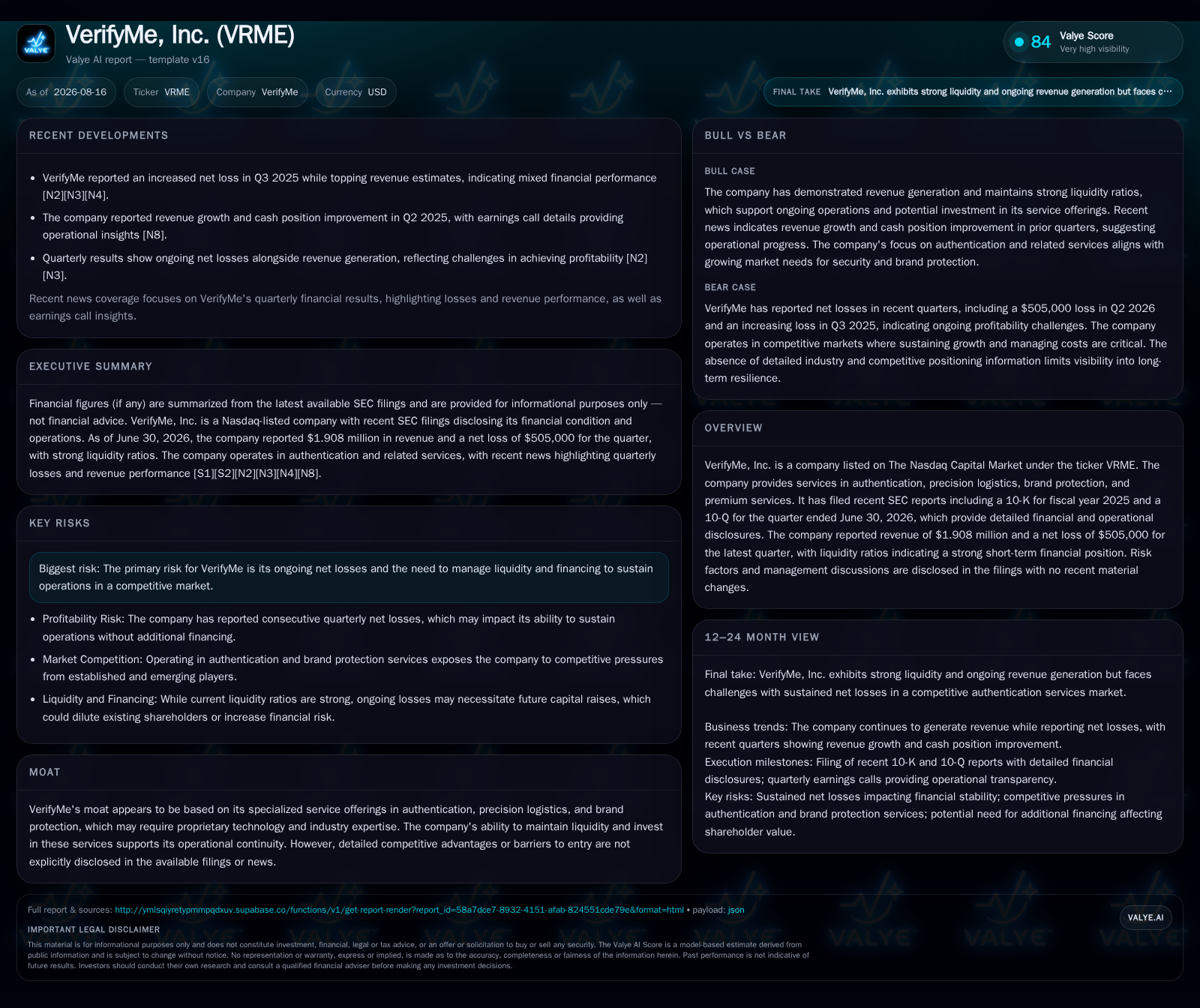
VerifyMe, Inc. reported revenue of $1.9 million with a net loss of $505,000 for Q2 2026, reflecting continued investment in its specialized authentication, precision logistics, and brand protection services. The company operates within an industry characterized by capital intensity and rapid technological evolution, focusing on service contracts and proprietary technology licensing to secure product integrity across supply chains. Despite stable liquidity supported by a strong current ratio of 4.3, VerifyMe faces risks from its sustained net losses, competitive pressures, and marketplace compliance challenges. The upcoming merger with Open World Ltd., extended to October 2026, presents a material catalyst to watch for operational scale and strategic repositioning.
Recent Operating Update: Q2 2026 Financials and Strategic Developments
Alongside these financial results, VerifyMe has extended the deadline for its merger with Open World Ltd. via amendments to their Agreement and Plan of Merger; the latest extension pushes the outside closing date to October 31, 2026 [S14][S16]. Such amendments signal challenges in completing transformational transactions but also underscore potential strategic benefits through acquisition-led scale.
Business Model: Dual Focus on Authentication Technologies and Precision Logistics Services
VerifyMe operates at the intersection of authentication technology provision—emphasizing product integrity and anti-counterfeiting—and precision logistics services that optimize supply chain transparency and operational efficiency [S1]. Revenue streams derive primarily from recurring service contracts that involve proprietary authentication protocols integrated into clients’ distribution networks alongside premium brand protection solutions.
The monetization mechanics revolve around both fees for ongoing logistics operations—as clients outsource complex supply chain functions to VerifyMe—and licensing fees tied to proprietary technologies embedding traceability features directly into products or packaging. This combination provides multiple touchpoints for value capture: from verification technologies that combat fraud to logistical services assuring correct delivery sequencing and timing.
However, this business remains capital intensive due to significant upfront investments required for logistical infrastructure such as warehousing capabilities or specialized transport systems adapted for secure goods handling [S1]. Consequently, scalability depends not only on customer acquisition but also efficient capital deployment aimed at reducing per-unit costs over time while maintaining service reliability—a key operating metric in the sector.
Industry Structure and Competitive Position
Operating within the Authentication and Precision Logistics Services industry situates VerifyMe among firms offering secure identification solutions (e.g., Avery Dennison or Zebra Technologies) and third-party logistics providers (3PLs) like XPO Logistics that facilitate outsourced supply chain efficiencies. Its niche is characterized by an emphasis on anti-counterfeiting technologies combined with precise distribution management—a hybrid positioning that leverages technology licensing alongside traditional logistics operations.
The industry demands continuous technological innovation—especially with advancements such as RFID tags or blockchain-backed traceability—and sustained investment due to long asset lifecycles inherent in logistics infrastructure. Given these traits, companies must navigate intense competition both from specialized technology vendors developing cutting-edge authentication solutions and established logistics firms widening their service scope.
VerifyMe’s moat rests arguably on its integrated offering combining authentication protocols embedded in product cycles with precision delivery oversight that promises end-to-end brand protection—not merely product tracking but active fraud prevention along distribution pathways [S1]. Though specific proprietary advantages are not explicitly quantified in filings or news releases, ongoing R&D expenditures imply efforts toward differentiation.
Growth Drivers
Market forces supporting VerifyMe’s expansion include rising global demand for supply chain transparency driven by consumer awareness and regulatory pressure mandating serialized tracking across industries such as pharmaceuticals or luxury goods. The increasing prevalence of counterfeit goods elevates client interest in multi-layered brand protection services encompassing both product-level authentication and distribution monitoring.
Outsourcing trends further bolster demand; companies focusing on core competencies often seek third-party experts like VerifyMe to manage complex logistics functions more cost-effectively while enhancing operational efficiency [S1]. Moreover, growth in e-commerce intensifies need for reliable precision logistics capable of handling intricate fulfillment scenarios coupled with authenticity assurances.
Technological advancements remain pivotal—adoption rates for solutions employing RFID-based tagging or blockchain verification could accelerate contract volumes and revenue per client if VerifyMe successfully integrates these innovations into its offerings.
Risks / Watchpoints / Growth Constraints
A pressing risk revolves around liquidity management as the company endures recurring net losses requiring careful cash flow oversight amidst capital intensity [S2][F1]. Sustained deficits could hinder ability to invest adequately during critical scaling phases unless mitigated by external financing or successful mergers.
Compliance concerns present another vulnerability; previous Nasdaq notifications regarding minimum bid price non-compliance put external listing status at risk, potentially affecting investor confidence and capital raising prospects [S19][S25]. While not recently altered materially, this remains an important watchpoint.
Competitive pressures are multifaceted: technological innovation cycles necessitate ongoing R&D investment; failure here could erode competitiveness versus peers like SICPA or Descartes Systems Group offering specialized authentication or supply chain software solutions. Additionally, dependency on client outsourcing budgets subjects VerifyMe's revenues to economic cycles impacting customer expenditure tightness.
Regulatory shifts imposing stricter serialization or transparency standards could demand rapid adaptation but also offer growth if leveraged promptly. Cybersecurity threats affecting authentication systems represent additional systemic risks.
What to Watch Next
Key near-term milestones include the successful completion of the merger with Open World Ltd., which could expand VerifyMe’s operational footprint or technology base if closed by October 31, 2026 as now scheduled [S14]. Monitoring any updates regarding Nasdaq compliance status remains critical for assessing market access stability.
On the operating front, changes in number and length of active service contracts would provide insight into client adoption dynamics; improvements in profitability margins would suggest operational effectiveness gains from streamlining initiatives mentioned in prior annual discussions [S1][S2].
Technological developments announced through future press releases may indicate shifts toward higher-value service tiers anchored on emerging authentication solutions boosting revenue per client.
Financial Profile Discussion
VerifyMe’s liquidity position appears solid heading into H2 2026—with current assets totaling approximately $6.15 million against liabilities around $1.42 million as per June quarter-end data—yielding a comfortable current ratio near 4.32 that signals ample short-term financial flexibility [F1]. Cash and equivalents were reported at about $2.82 million at end-2024, with no more recent exact cash balances publicly disclosed; nevertheless, liquidity seems sufficient for near-term operational support amid investments.
Operating income remains negative with cumulative losses reflecting funding needs tied to scaling investments in both physical logistics assets and proprietary technologies demonstrated by operating expense levels in filings [F1][S2]. The absence of significant debt (total debt was minimal historically at $114,000 reported through older metrics) moderates leverage risks but heightens reliance on equity raises or strategic partnerships such as mergers for capital infusion.
Capital expenditures required for sustaining logistics infrastructure likely absorb notable portions of available funds given industry typical asset intensity characteristics [S1]. Prudent cash management aligned with contract expansions will be crucial to shift trajectory toward positive operating cash flows.
Conclusion
VerifyMe occupies a nuanced niche blending authentication technologies with precision logistics services critical to modern brand integrity amid increasing counterfeiting threats and supply chain complexity. Its latest quarter underscores steady revenue generation yet continued losses paired with operational scaling challenges that typify capital-intensive environments requiring patient capital deployment supported by favorable market trends toward outsourcing and regulatory-driven traceability needs.
The company’s robust short-term liquidity offers runway while pending merger activity may reshape scale economics if consummated timely—both factors warrant close observation alongside execution against streamlined operational targets. Inherent risks around Nasdaq compliance status and competitive innovation sustain vigilance needs; however growth drivers appear fundamentally structural given rising global interest in secure supply chains.
This analysis refrains from speculative extrapolations absent explicit disclosures but highlights essential KPIs such as contract volumes, client retention dynamics, technological adoption rates, and margin evolution critical to assessing future viability within this sector known for high barriers tied to tech expertise coupled with logistic asset commitment.
Disclaimer: This analysis is prepared solely for informational purposes based on publicly available SEC filings up to August 2026 without any investment research view or forecast assurance.
Disclaimer: This is research-only, informational analysis and not investment advice. It may include AI-generated interpretation and general industry context. Always verify important details using primary sources.

Comments