
Zapata Quantum Struggles with Liquidity Amid Early-Stage Quantum Software Development
Latest quarterly filings show zero revenue and funding-driven operations as Zapata advances partnerships in the nascent quantum software space.
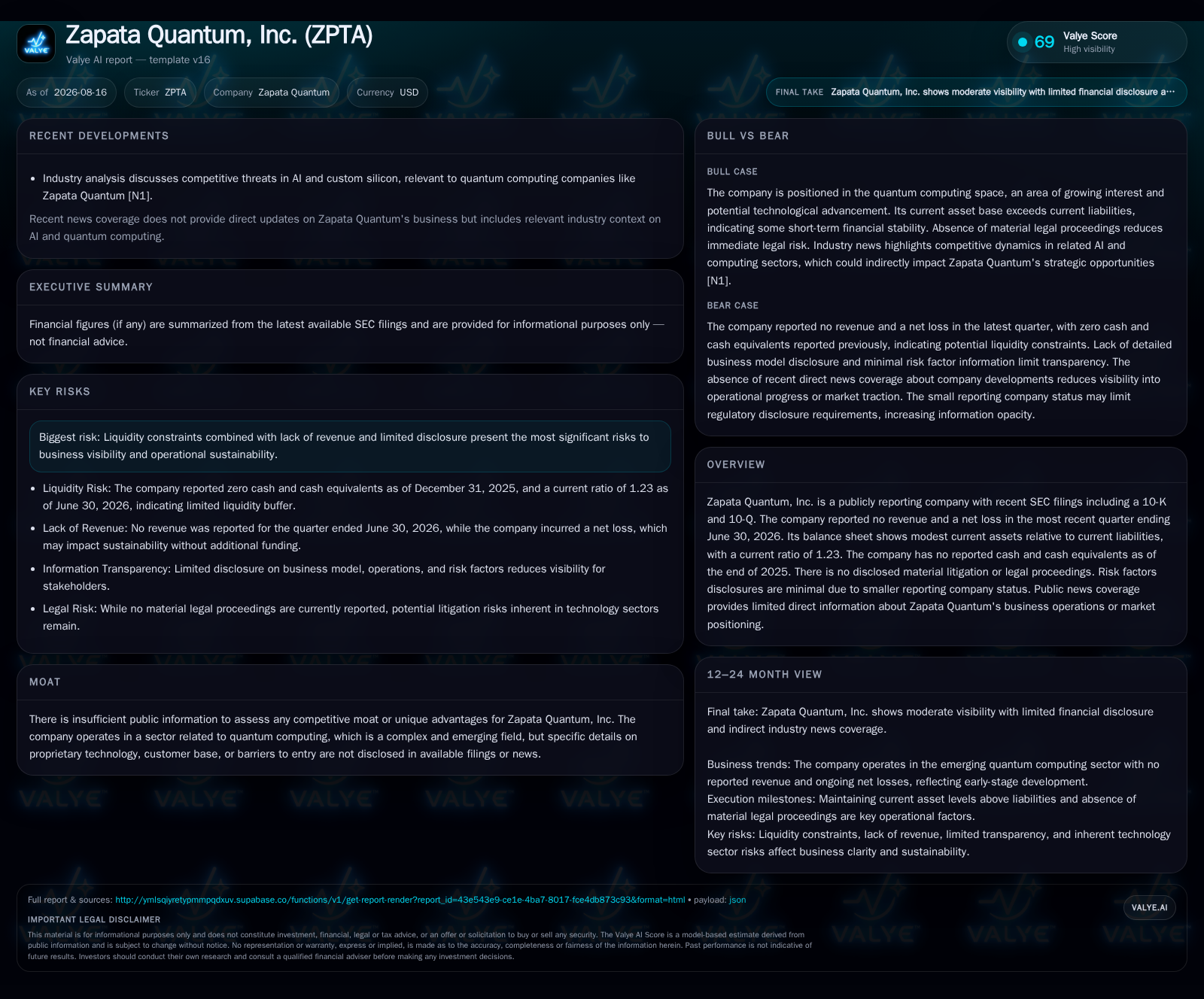
Zapata Quantum, Inc. remains in an early development phase with no reported revenue in the latest quarter ending June 2026, reflecting the typical pre-commercial stage of quantum computing software firms. The company’s recent partnership with QuEra signals ongoing ecosystem engagement, though liquidity constraints persist given a modest current ratio of 1.23 and no cash balance at year-end 2025. The business model centers on developing quantum algorithms and software platforms to bridge quantum hardware capabilities with end-user applications, but commercial traction remains unproven. Key risks include sustained funding needs, dependence on advancing quantum hardware, and limited market demand for quantum software solutions today.
Recent Operating Update
Zapata Quantum's latest quarterly filing dated August 14, 2026 underscores its continuing development-stage status with no recognized revenue for Q2 ending June 30, 2026 [S2]. This zero top-line is consistent with many early-stage quantum computing software entities that are still focused on R&D rather than commercialization. Despite the absence of revenue, Zapata announced a significant partnership with QuEra on August 12, 2026 aimed at co-developing solutions that leverage QuEra’s neutral atom-based quantum hardware [S3]. This partnership indicates active efforts to embed Zapata’s quantum algorithms and software stack within a growing ecosystem of emerging quantum hardware providers.
While the collaboration signals strategic alignment within the industry value chain, operational progress toward revenue generation remains distant. No customer contracts or monetization milestones have been disclosed alongside these announcements.
Business Model Analysis
Zapata Quantum operates primarily as a software developer within the quantum computing value chain—a segment focused on creating proprietary quantum algorithms and platforms that enable practical utilization of quantum hardware. The company targets complex computational problems facing sectors like pharmaceuticals, finance, and advanced logistics through hybrid quantum-classical computing approaches.
Its value proposition lies in building scalable quantum software stacks capable of delivering optimized circuit compilation, error correction routines, and machine learning-enhanced simulations targeting key application domains. Monetization would typically arise from licensing its software platform or offering consulting services that help enterprise clients deploy pilot projects using cloud-based quantum access or direct integrations with partner hardware providers.
Currently, however, Zapata's commercial offer is undeveloped publicly; reported revenues remain absent owing to the sector's nascent state and ongoing research-intensive product development cycles [S1]. The company's recent equity financings suggest a focus on capital raising to sustain R&D efforts rather than immediate sales.
Industry Structure and Competitive Context
Quantum computing software represents an embryonic but highly strategic niche intersecting advanced algorithms research and emerging quantum hardware capabilities. Firms like Zapata Quantum act between companies manufacturing quantum processors—e.g., IonQ or Rigetti—and end-users requiring practical applications.
Compared to peers such as Cambridge Quantum Computing or IBM Quantum's cloud service offerings, Zapata is smaller scale with less visible commercial traction but participates actively in ecosystem partnerships such as with QuEra. The industry features heavy collaboration among startups, academic institutions, and large tech companies due to technical complexity and rapid innovation cycles.
Hurdles remain substantial: the pace of hardware advances heavily constrains usable software timelines; cloud-quantum usage metrics remain limited; adoption rates are experimental at best; and intellectual property battles are common given overlapping algorithmic innovations.
Growth Drivers
Demand-side growth hinges fundamentally on escalating interest from industries exploring quantum computing for solving optimization problems beyond classical capacities. As hardware qubit counts improve through vendors like QuEra—and integration into cloud services expands—the necessity for sophisticated quantum software platforms intensifies.
Governmental funding bolster research initiatives creates an enabling environment for firms like Zapata to accelerate R&D investment efficiency. Additionally, hybrid quantum-classical methods evolve rapidly alongside emergent SDKs enhancing developer productivity.
Strategic partnerships between software developers (like Zapata) and hardware makers (such as QuEra) further catalyze ecosystem maturation by aligning complementary capabilities—both critical to scaling platform adoption rates.
Success indicators will be how swiftly Zapata can transition pilot algorithm deployments into scalable commercial platforms attracting real user engagement.
Risks and Constraints
The principal risks are typical of early-stage deep tech ventures in quantum computing: ongoing high capital burn rates driven by extensive R&D without concurrent revenue inflows impose liquidity constraints exacerbated by zero cash reserves reported at December 31, 2025 [F1]. With total debt around $1.23 million also present [F1], financing sustainability is a material watchpoint.
The commercial viability timeline remains vague given dependence on underlying hardware progress—delays or shifts in the competitive landscape could render expensive delivered algorithms obsolete quickly or limit market size expansion.
Limited present-day market demand curtails immediate monetization potential while talent acquisition challenges in this specialized domain elevate operational risks. Intellectual property disputes are plausible given technology complexity and overlapping research fields.
Moreover, regulatory controls around export or usage of quantum technologies present additional compliance burdens often underappreciated but impactful for ecosystem participants.
What to Watch Next
Industry observers should monitor Zapata’s ability to operationalize its QuEra partnership through demonstrable joint product developments or pilot projects involving end customers [S3]. Such milestones would provide insight into time-to-algorithm deployment—the critical metric signifying movement beyond theoretical research.
Further clarity on adoption rate metrics for any forthcoming beta versions of its software platform or cloud access integration would signal progressing commercialization capability.
Financially, quarterly filings revealing changes in cash runway or new capital raises would indicate how well Zapata manages liquidity constraints amid continued operating losses.
On the innovation front, announcements regarding patent grants or expansions within their proprietary algorithm portfolio would reflect deepening intellectual property moats critical for long-term defensibility.
Lastly, any updates on expanded strategic alliances beyond QuEra—including government research collaborations—could validate Zapata’s positioning within the evolving quantum computing ecosystem.
Financial Profile Discussion
As of mid-2026 filings and latest balance-sheet data at June 30, 2026 [F1], Zapata Quantum exhibits typical characteristics of a pre-revenue technology start-up operating in a capital-intensive emerging field. Current assets amount to approximately $12.96 million against liabilities recorded at roughly $10.54 million as of year-end 2025 [F1], yielding a modest current ratio near 1.23—indicative of limited short-term liquidity cushions but not alarmingly weak immediately.
However, no cash or cash equivalents were reported at December 31, 2025 [F1], implying working capital largely comprises receivables or other non-liquid current assets which may pose short-term conversion risk under pressure scenarios. Total debt stood near $1.23 million around September 2025 [F1], modest yet meaningful when balanced against absent operating income streams.
The company’s net loss trends historically align with intensive R&D spend patterns inherent in early-stage quantum firms whose operating margins have yet to benefit from scale or recurring license revenues—inherent characteristics that delay positive gross margins common among established SaaS peers.
Recent Series D convertible preferred stock issuances totaling up to $15 million during early-mid 2026 (as disclosed in April filings) provide infusion relief but also introduce dilution considerations—and bind management under registration rights agreements that could influence future capital strategy flexibility [S23][S27]
Management’s challenge lies in optimizing burn rate while advancing commercialization readiness before sequential financings become prohibitively dilutive or investor appetite diminishes amid extended time-to-market horizons.
Conclusion
Zapata Quantum typifies an ambitious early-stage participant within the emerging quantum computing software sector—committed to developing cutting-edge algorithmic frameworks while navigating considerable operational and financial headwinds typical for this frontier technological space. Its latest partnership moves show strategic intent inside the evolving hardware-software nexus foundational for future value creation but lack near-term commercial validation or revenue momentum so far.
Liquidity constraints framed by zero cash buffers necessitate vigilant funding strategies paired with milestone-driven R&D execution to sustain investor confidence amid competitive pressures from integrated hardware-software vendors boasting more mature offerings.
Monitoring partnership outcomes alongside financial updates will be key indicators framing whether Zapata can transcend developmental status toward tangible market presence as the broader quantum computing ecosystem matures incrementally over coming years.
This analysis is based exclusively on publicly available SEC filings as of August 16, 2026 ([S1], [S2], [S3]) complemented by validated financial data from companyfacts ([F1]) and industry context knowledge layers tailored for early-stage quantum computing software firms. It does not constitute investment advice nor predict future share price movements.
Disclaimer: This is research-only, informational analysis and not investment advice. It may include AI-generated interpretation and general industry context. Always verify important details using primary sources.

Comments