
Non-Invasive Monitoring Systems Navigates Shell Status with Merger Strategy amid Financial Strain
NIMS maintains shell company status since 2019, aiming to pivot through a merger while facing acute liquidity and operational challenges.
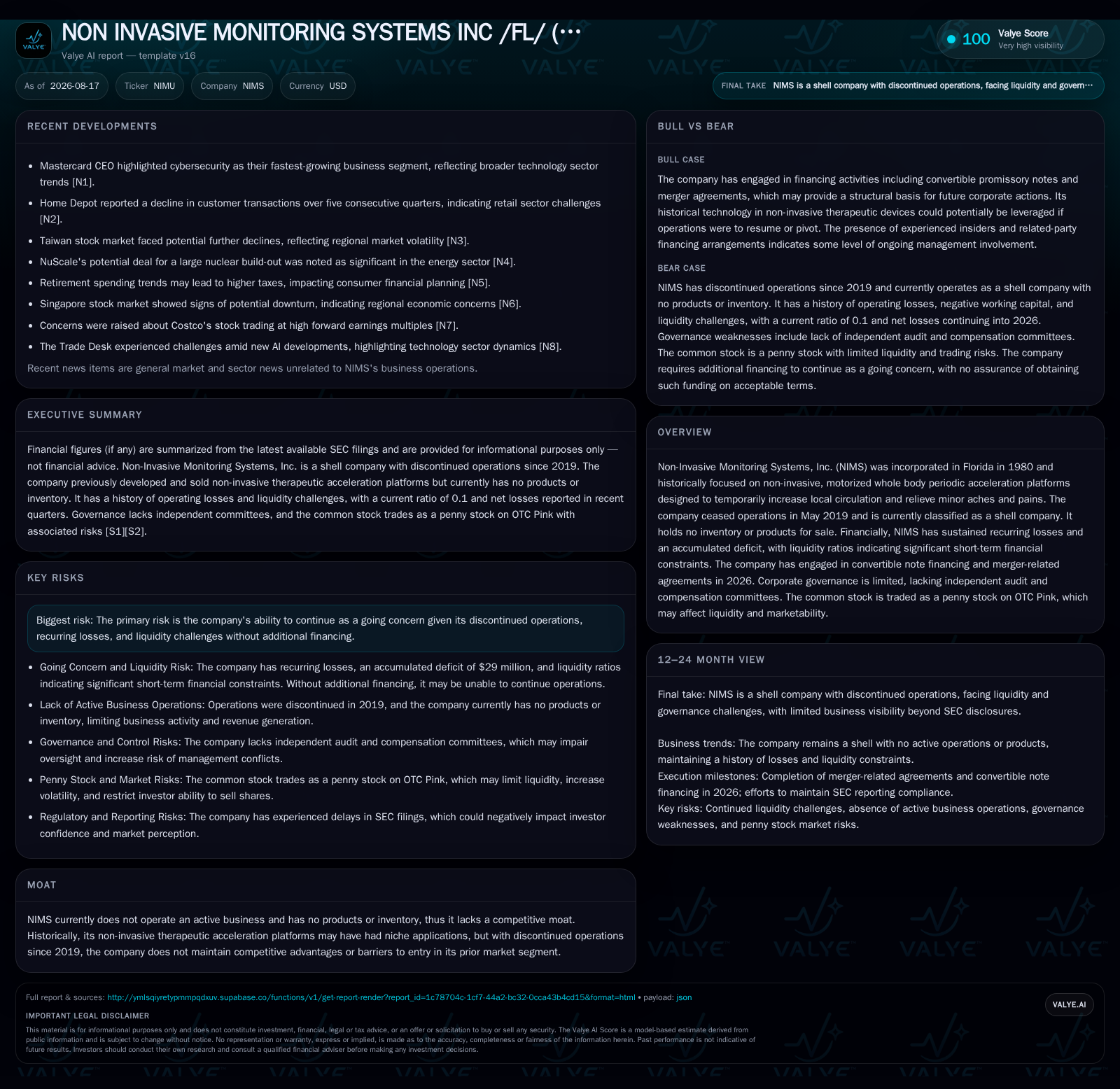
Non-Invasive Monitoring Systems, Inc. (NIMS) has not operated an active medical device business since May 2019, retaining no inventory or revenue-generating products. The company’s legacy involved non-invasive, motorized whole body periodic acceleration platforms designed for therapeutic relief of minor aches and circulatory improvement. Despite historical niche relevance in the medical devices sector, NIMS currently functions as a shell company, burdened by recurring losses, accumulated deficit near $29 million, and severe liquidity constraints marked by a precarious current ratio of 0.1. Recent filings show efforts to secure financing via convertible notes and pursue a transformative merger with an aerospace technology entity, Gravitics, signaling a strategic shift away from its former product focus. The merger process entails governance restructuring and financing adjustments but faces typical risks attendant to shell companies and capital-starved entities in the healthcare equipment domain.
Recent Operating Update
Non-Invasive Monitoring Systems, Inc. (NIMS) filed its latest quarterly report on August 14, 2026, consolidating its status as an inactive entity without ongoing commercial operations or product sales [S2]. Since ceasing active development and sales of its non-invasive therapeutic platforms in May 2019, the company has shifted toward reorganizational efforts involving merger agreements with Gravitics, Inc., a space structures design firm [S22]. This pending reverse merger represents a fundamental pivot away from NIMS's historical footprint in medical devices toward aerospace manufacturing. Importantly, the firm recently amended promissory notes extending their maturities to September 2026—an accommodation signaling persistent liquidity stresses that have constrained operational flexibility over several years [S25]. Governance changes aligned with the anticipated merger include board resignations and appointment of new directors proposed by Gravitics under Nasdaq listing rules compliance [S22], underscoring transitional corporate governance.
Business Model Overview
Historically, NIMS operated in the midstream segment of the medical devices value chain centered on research, product development, regulatory clearance pursuit, manufacturing, marketing, and sales of motorized whole body periodic acceleration platforms [S1]. These devices were positioned as non-invasive therapeutic aids intended to temporarily improve local circulation to relieve minor aches and stiffness—applications relevant in clinical rehabilitation but niche in clinical adoption. Revenue generation relied primarily on direct sales to healthcare providers or clinics supplemented potentially by service contracts; however, the absence of inventory or active sales since 2019 means revenue mechanics have effectively ceased for nearly three years [S1].
Given discontinuation of operations and classification as a shell company per SEC definitions (Rule 12b-2), no current products exist in inventory or market channels [S1]. This cessation halts all typical unit sales volume KPIs critical to sustaining margins or cash conversion cycles such as average selling price (ASP), service contract renewal rates, inventory turnover, or customer retention metrics.
In terms of strategic strengths historically underpinning NIMS's offering: non-invasive approaches align well with increasing healthcare preferences for outpatient therapies avoiding surgeries or pharmacologic interventions; however, competitive pressures from larger diversified medical equipment suppliers featuring broader portfolios and scale—such as Medtronic or Boston Scientific—likely limited market penetration opportunities.
Industry Structure and Competitive Position
The medical devices industry segments into vast categories ranging from diagnostics through therapeutic equipment necessitating rigorous FDA clearances and compliance. NIMS's focus on whole body periodic acceleration machines placed it within the subset of rehabilitation and therapeutic device companies emphasizing non-invasive treatment modalities.
This sector demands continuous R&D investment to maintain regulatory approvals and innovate product pipelines against technological obsolescence risks. Larger peers maintain competitive moats supported by scale manufacturing efficiencies, global distribution networks, bundled service offerings post-sale (e.g., maintenance), expansive reimbursement navigation expertise for healthcare payors, and entrenched relationships with providers.
NIMS's three-year dormancy has nullified its prior competitive advantages due to halted R&D spending and absence from clinical trials or regulatory update processes. Its peer comparison would highlight disparities in product development cycle time efficiency and regulatory success rate metrics critical to market relevance.
Growth Drivers
Under normal operating conditions within therapeutic device niches like those served by NIMS’s legacy products:
- Aging populations underpin sustained demand for musculoskeletal pain relief therapies.
- Rising chronic disease prevalence elevates outpatient therapeutic needs.
- Expanded adoption of non-invasive medical technologies driven by patient preference for low-risk treatments.
- Healthcare infrastructure growth in emerging markets provides expanded addressable opportunities.
- Regulatory approvals unlocking new indications or markets can enable refreshed growth trajectories.
However, NIMS's current status overshadows these drivers since it holds no active biomedical offerings nor ongoing development programs to capitalize on any secular industry tailwinds.
Risks and Watchpoints
Primary risks derive from prolonged inactivity leading to erosion of technological relevance amidst intense competition requiring continuous innovation [S1]. The firm's severe financial weakness poses existential threats:
- Accumulated deficit near $29 million demonstrates chronic unprofitability burdens constraining reinvestment capacity [F1], [S1].
- Current ratio at approximately 0.1 evidences extreme short-term liquidity deficits risking inability to fund administrative obligations absent external capital infusions [F1].
- Recurring need for amendments on promissory note maturities indicates reliance on insider financing without broad market access [S25].
- Delays in SEC filings previously noted may impair investor confidence affecting capital raising prospects [S1].
- Absence of independent board committees weakens corporate governance safeguards vital during restructuring phases [S1].
- The success of the reverse merger hinges on securing regulatory approvals for up-listing coupled with financial close events that remain subject to substantial uncertainties inherent in such transactions [S22], [S14].
Monitoring these developments will provide concrete indicators around turnaround execution likelihood beyond perpetual shell-company limbo.
Financial Profile Discussion
As of June 30, 2026, NIMS reported current assets totaling approximately $164,000 against current liabilities around $1.6 million—a stark imbalance yielding a critically precarious current ratio near 0.1 that reflects dire short-term solvency risks absent refinancing measures [F1]. Cash balances reported earlier stood at roughly $64,000 as of April 2024 but financial disclosures suggest this has not materially improved recently given consistent losses reported up to December 2025 culminating in net losses near $49,000 during that period alongside operating income deficits around negative $21,000 [F1], [S1].
The accumulated deficit approaching $29 million cumulatively over decades underscores sustained operational unprofitability exacerbated by discontinued activities commencing mid-2019 resulting in absent sales streams since then. Without successful closing of capital raises or merger-driven asset/liability restructuring expected imminently based on filings describing amendments extending financing deadlines and modifying closing conditions tied to obligated equity conversions or repayments,[S25] cash burn concerns present material going concern limitations requiring investor caution.
Conclusion
Non-Invasive Monitoring Systems occupies an unusual position within the medical devices sector as an essentially dormant shell attempting resurrection through transformative merger activity outside its original industry focus. While historically it contributed specialized therapeutic platforms utilizing whole body periodic acceleration mechanisms relevant in non-invasive pain management contexts within rehabilitation medicine niches,[S1] prolonged operational inactivity eroded technical viability alongside extreme financial distress characterized by negative working capital ratios,[F1] failed profitability,[F1][S1] illiquid trading status,[S1] poor governance,[S1] and dependency on insider debt extensions.[S25] This presents considerable barriers obstructing any straightforward return to competitiveness in its original segment without significant fresh capital commitment alongside strategic direction resetting via mergers such as the pending transaction with Gravitics focused on aerospace technologies.[S22] Stakeholders should closely monitor upcoming merger closing milestones plus regulatory clearances as pivotal catalysts potentially unlocking new value creation pathways distinct from prior device-centric frameworks. Meanwhile structural fundamentals remain challenged exhibiting typical risks posed by small-cap inactive entities seeking revival amid complex financing landscapes common across sub-scale medical technology enterprises.
Disclaimer: This is research-only, informational analysis and not investment advice. It may include AI-generated interpretation and general industry context. Always verify important details using primary sources.

Comments