
Mills Music Trust: Assessing Stability and Risks in a Historic Royalty Income Stream
The August 2026 quarter reaffirms the trust’s steady contingent royalty income from a legacy music copyright catalogue amid looming expiry headwinds.
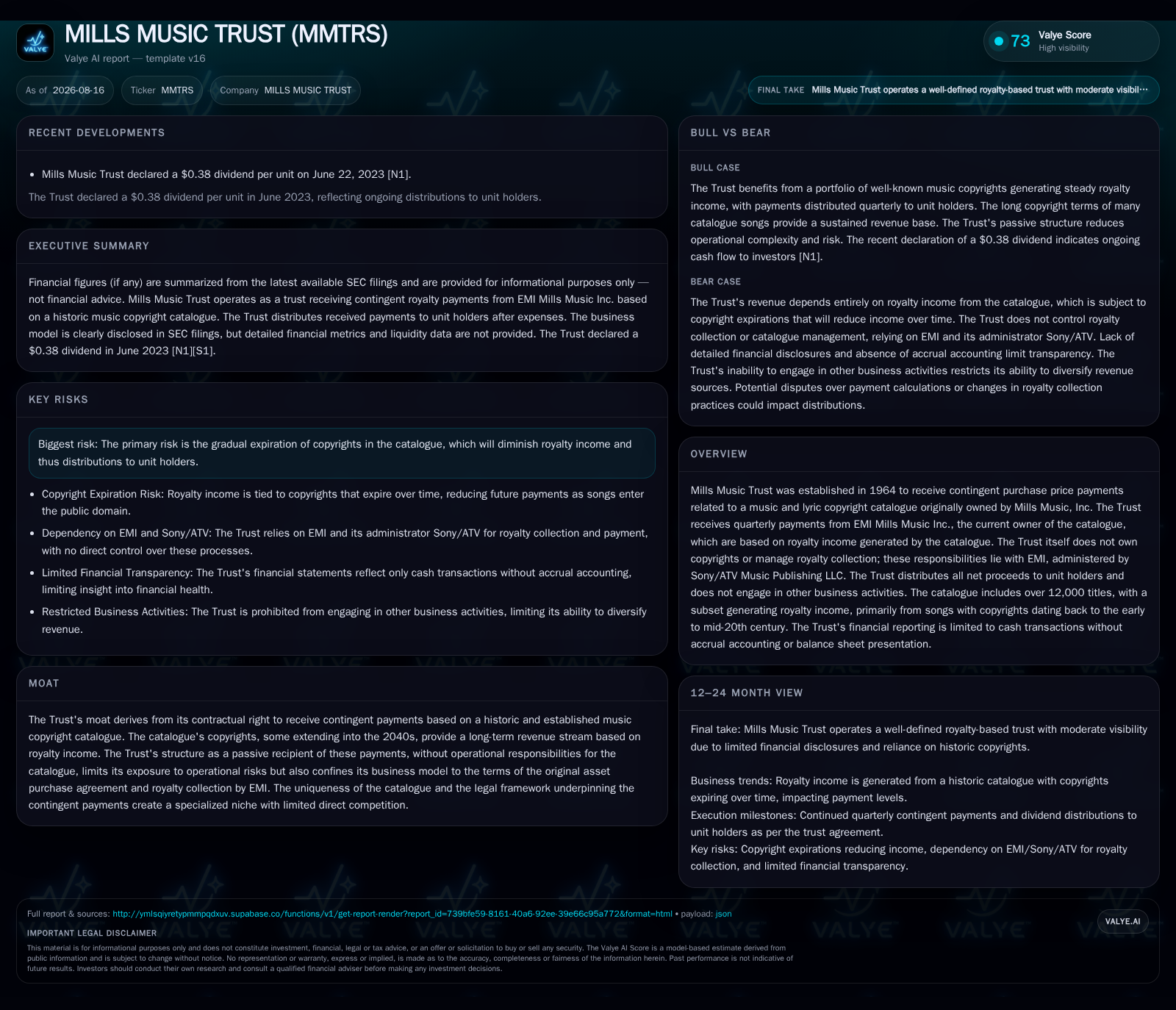
Mills Music Trust continues to operate as a passive income vehicle receiving quarterly contingent purchase price payments derived from royalty income generated by a historic catalogue owned and administered externally. The August 2026 quarterly filing confirms stable cash inflows consistent with contract terms and steady distributions to unit holders. While the trust benefits from long copyright durations extending into the 2040s for some titles, the aging catalogue will inevitably suffer revenue attrition as copyrights expire without renewal. This dynamic, combined with reliance on EMI/Sony for royalty collection underpins both its moat and risk profile. Monitoring quarterly payment fluctuations and copyright expiration timelines remains key to assessing future distribution sustainability.
August 2026 Quarterly Distribution Update Validates Stable Cash Flow
The Trust’s latest quarterly filing dated August 14, 2026 reinforces operational stability through consistent receipt of contingent portion payments reflective of underlying catalogue royalty income [S2]. Although exact payment amounts were not explicitly itemized in the summary excerpts, the routine nature of these payments coupled with the June 24 distribution report affirms that expected royalty flows persist reliably under the terms of the Asset Purchase Agreement governing this legacy arrangement [S3]. There is no indication of disruption or disputes affecting recent settlements, which supports predictable cash distributions to unit holders after deduction of nominal expenses. In an asset class where cash flow transparency often hinges on external collection agents, this steadiness is critical for validating near-term income reliability.
This operational update matters because it anchors the trust’s business model squarely in cash-based contingent royalties without accrual complexity or balance sheet assets beyond cash receipts. Given that the revenue source is fully outsourced to external entities (EMI Mills Music Inc., administered by Sony/ATV), maintaining stable payment cadence is fundamental for sustaining confidence in the trust's passive income mandate.
Contractual Framework: Passive Receipt of Contingent Purchase Price Royalties
Mills Music Trust originated in 1964 via a Declaration of Trust and an accompanying asset purchase agreement whereby it acquired the right to receive deferred contingent purchase price payments from Mills Music Inc. in exchange for a music and lyric copyright catalogue sale [S1]. These contingent payments depend strictly on royalty income generated by the catalogue now owned by EMI Mills Music Inc., which does not translate ownership or operational control to the Trust itself.
EMI’s administration responsibility is subcontracted to Sony/ATV Music Publishing LLC, who manages licensing agreements, royalty collection across mechanical royalties (e.g., physical media reproduction), performance royalties (e.g., public broadcast), and other exploitation streams typical in music publishing. The Trust does not engage in copyright management or licensing strategy but acts as a pure conduit distributing net proceeds from these contingent payments – calculated per a precise formula stipulated in the original sale contract – directly to unit holders quarterly after administrative deductions [S1].
This framework delineates a clear value chain placement downstream of original content creation and publishing firms plus upstream of ultimate end-user licensors such as broadcasters or streaming services. The Contingent Portion payment formula functions similarly to deferred payment obligations common in intellectual property asset sales but uniquely ties directly to ongoing economic performance via royalties rather than fixed installments.
Catalogue Composition and Copyright Expiry Shape Medium-Term Income Potential
The Trust’s underlying asset comprises over 12,000 titles predominantly copyrighted through the early- to mid-20th century with renewals extending well into later decades, including copyrights approaching expiration as late as the 2040s [S1]. However, only a fraction actively generates royalties at any given time due to market relevance fluctuations and usage patterns.
This catalog age profile implies an inevitable shrinkage trajectory in royalty revenue as older copyrights lapse into public domain without renewals—constraining long-term growth prospects. The erosion effect is a structural risk intrinsic to legacy IP trusts based primarily on finite legal rights rather than perpetual content pipelines. Industry knowledge flags such expiry schedules as paramount KPIs influencing distribution sustainability: monitoring the proportion of titles remaining protected versus in public domain directly correlates with future royalty income stability.
Conversely, certain evergreen classics within the catalogue preserve moderate longevity advantages generating residual mechanical and performance royalties from licensing agreements spanning films, advertising sync deals, and growing digital consumption channels. Thus, while attrition is unavoidable over decades-long horizons, intermittent rejuvenation via licensing innovations can partially mitigate decline.
Positioning Among Music Royalty Trusts Highlights Unique Moat and Limitations
Within music royalty income vehicles, Mills Music Trust distinguishes itself by narrowly focusing on a historical contingency payment right entirely divorced from direct ownership or operational involvement with copyrights—contrasting with broader funds like The Blackstone Music Royalty Fund that actively acquire diverse music rights portfolios across genres and timelines.
MMTRS’s moat stems from its legally enforceable contractual entitlement to receive contingent portions linked exclusively to this unique catalogue originally sold decades ago—a niche with limited substitutes or direct competitors due to specialized origin and structural design.
However, this exclusivity also confines growth avenues since the trust cannot expand its catalogue or renegotiate terms; it is inherently a declining asset base betting on contractual compliance by EMI/Sony coupled with ongoing marketplace consumption of aged songs. Its absence of management responsibilities means operational risks concentrate purely around external administrator effectiveness rather than internal execution.
Growth Drivers Centered on Music Consumption Trends and Licensing Expansion
Though structurally constrained by aging copyrights, macro trends in music consumption offer plausible tailwinds that might stabilize or modestly augment revenues temporarily. Growth in digital streaming platforms globally expands licensee bases requiring synchronization licenses for television, films, ads, video games, etc.—all potential sources for classic song utilization beyond traditional radio or physical formats.
Renewed interest in vintage music through cultural revivals can also spur ancillary synchronization deals enhancing royalty incomes albeit episodically. Additionally, improvements in international rights enforcement and data-driven royalty tracking technology administered by Sony/ATV may increase collection efficiency lifting net payments slightly.
These sector-wide demand drivers align logically with MMTRS’s asset base despite its non-operational role; incremental licensing expansion represents upside potential against an otherwise declining principal asset pool. However, absent new assets or rights acquisitions by the trust itself, these positive variables can only partially counterbalance natural expiry losses.
Risks Spotlighted by Copyright Longevity and Third-Party Administration Dependence
The foremost risk remains the gradual expiration schedule eroding protected copyrights within the catalogue—reducing royalty income streams progressively over time with no renewal mechanism under current agreements [S1]. This depletion dictates long-term distribution ceilings irrespective of short-term revenue spikes.
Further risks attach to reliance on EMI Mills Music Inc. along with Sony/ATV as delegated administrators responsible for comprehensive royalty collection across multiple jurisdictions. Inefficiencies or disputes arising within their processes could delay payments or reduce remittances impacting trust cash flows [S2][S1]. While no recent disputes have been reported publicly, this dependency places governance limits because Trustees cannot directly influence collection strategies or contractual terms.
Additional exposures include shifting copyright legislation potentially altering qualification periods or permissible royalties plus market consumption shifts altering demand mix toward different repertoire less represented in this catalogue. Concentration risk also arises given disproportionate reliance on limited high-value titles driving majority royalties versus broader asset diversity found in larger funds.
Forward-Looking Indicators: Key Data Points to Monitor for Future Distribution Quality
Going forward stakeholders would do well to track several quantifiable indicators from periodic reports that signal distribution health or stress points:
- Quarterly Contingent Portion payments received as absolute values verify ongoing royalty inflow consistency [S2][S3]
- Number of active catalogue titles generating measurable royalties indicates breadth versus concentration dynamics affecting sustainability
- Distribution per unit trends reveal net payout fluctuations after expenses impacting unitholder returns directly [S3]
- Public announcements involving any claims disputing contingent payment computations or updates on contract amendments provide crucial event risk visibility [S2]
Monitoring these factors collectively provides early warning flags if systemic declines accelerate beyond anticipated copyright expirations or operational frictions emerge within administration. Conversely stable or improving metrics would reinforce investment narratives emphasizing reliable passive income despite inherent longevity risks.
This analysis underscores Mills Music Trust’s position as a highly specialized financial instrument capturing contingent royalty flows from a singular historic music catalogue managed outside its structure yet bound firmly by legal contract terms creating predictability mixed with inevitable gradual decline tied chiefly to copyright expiry timelines. The investment characteristics align closely with typical music royalty trusts emphasizing cash distribution stability anchored by intellectual property rights duration rather than active growth initiatives.
Disclaimer: This is research-only, informational analysis and not investment advice. It may include AI-generated interpretation and general industry context. Always verify important details using primary sources.

Comments