
Sundance Strategies Q2 2026: Advisory Role Strength Amid Liquidity and Financing Challenges
Sundance Strategies maintains its advisory focus in life settlements while confronting severe liquidity shortages and financing dependencies in Q2 2026.
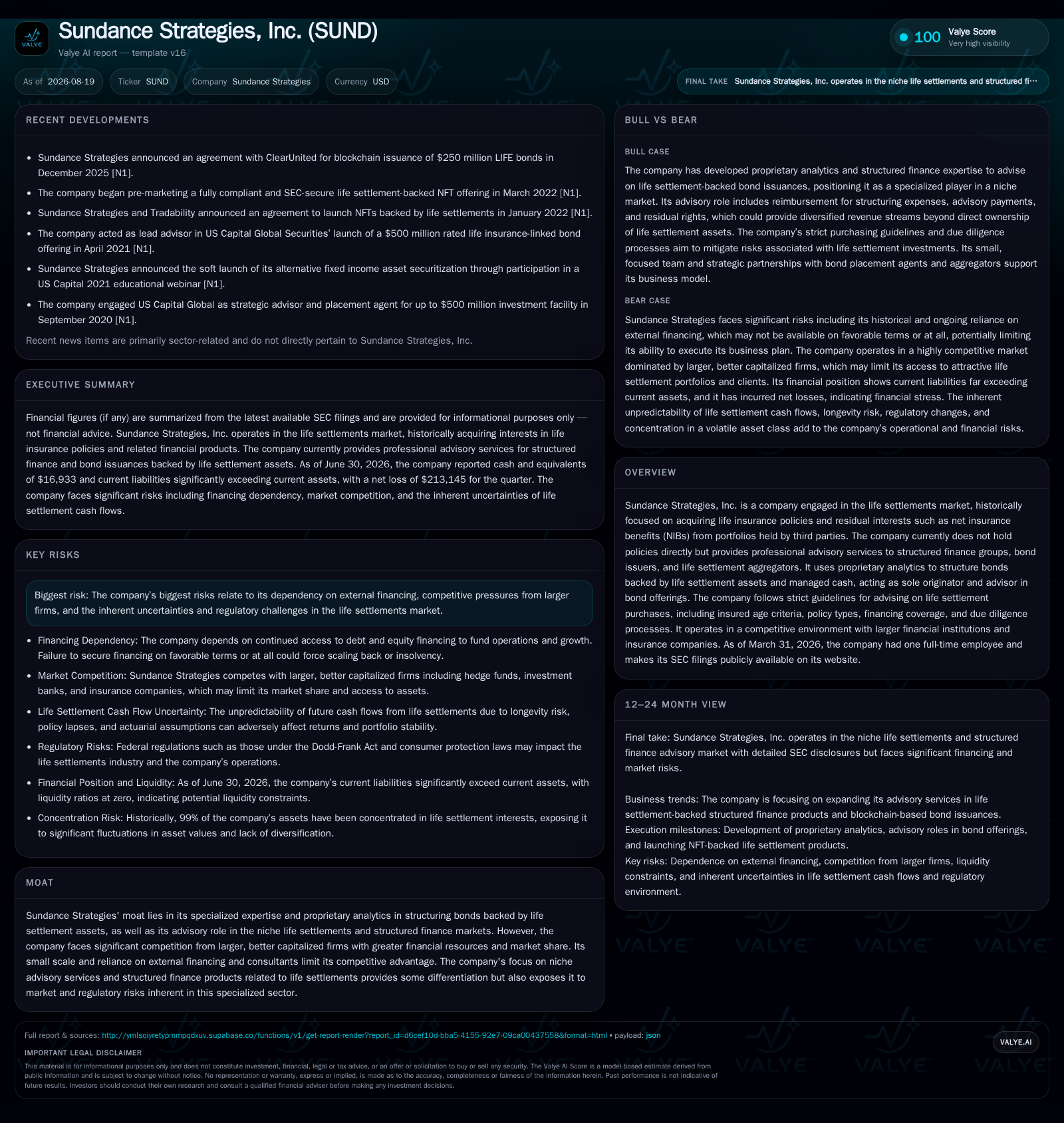
Sundance Strategies, Inc. reported its Q2 2026 operating and financial results highlighting its role as an advisory and bond structuring firm in the life settlements market. The company does not hold life insurance policies directly but provides specialized advisory services supported by proprietary analytics. However, Sundance faces significant liquidity constraints with a current ratio of zero and heavy reliance on external financing, which poses risks to its operational sustainability and competitive positioning. Regulatory and market risks further complicate the outlook.
Sundance Strategies, Inc. reported its operating results and financial position for the quarter ended June 30, 2026, revealing a critical liquidity shortfall with current liabilities totaling $4,823,714 and a current ratio effectively equal to zero [S2]. This negative working capital position highlights the company's ongoing reliance on external financing to sustain operations, which poses significant challenges to executing its business plan in the highly competitive life settlements advisory market where competitors often have greater financial resources and lower costs of capital [S1].
The latest quarterly filing does not explicitly disclose revenue or profitability figures but indicates that Sundance continues to operate with negative cash flows and depends on financing activities to sustain its business [S2]. The company’s operating model does not involve direct ownership of life insurance policies or net insurance benefits (NIBs); instead, it provides professional advisory services to structured finance groups, bond issuers, and life settlement aggregators [S1][S2][S12].
Business Model and Market Position
Sundance Strategies functions primarily as an advisory and structuring firm within the life settlements market. It acts as the sole originator and advisor in bond offerings related to life settlements, leveraging proprietary analytics to structure bonds backed by life settlement assets and managed cash [S1][S12]. The company’s revenue arises from reimbursement of structuring expenses, advisory fees upon bond closings, and residual rights on assets after bond retirement [S1][S12].
Despite its specialized expertise and proprietary analytical capabilities, Sundance does not hold life insurance policies or NIBs directly. Instead, it collaborates with third-party holders who own the underlying portfolios. This business model positions Sundance as a niche professional services provider rather than a direct asset owner [S1][S2][S12].
The life settlements industry is highly competitive, with many larger, better-capitalized firms including hedge funds, investment banks, secured lenders, specialty finance companies, and insurance companies competing for portfolios of life insurance policies [S1]. These competitors often benefit from lower costs of funds and greater financial resources, which limits Sundance’s ability to compete effectively for larger pools of life settlement assets and restricts its market share growth [S1].
Liquidity and Capital Structure Risks
Sundance’s financial disclosures highlight a critical dependency on external financing to fund its operations and business development. The company has historically relied on related-party notes payable, convertible debentures, and other debt instruments to finance its activities [S3][S4][S8]. The absence of substantial cash reserves and the negative working capital position as of Q2 2026 pose material risks to the company’s operational continuity without additional financing [F1][S2].
The company’s ability to secure further financing on favorable terms remains uncertain. Failure to obtain such funding could force Sundance to delay, reduce, or eliminate its business initiatives or potentially lead to insolvency [S3][S4][S8]. The company’s filings explicitly caution that inadequate funding will impede the execution of its business model and that default under debt arrangements could accelerate repayment obligations and limit access to future capital [S3][S4][S8].
Additionally, Sundance’s management relies heavily on outside consultants for industry expertise, valuation, actuarial analysis, and other specialized services critical to its advisory role [S1][S11]. This reliance introduces potential conflicts of interest and dependency risks, as the company competes with larger firms for access to these consultants and must manage associated costs [S11].
Regulatory and Industry Risks
Sundance operates in a regulatory environment subject to evolving federal oversight, notably under the Dodd-Frank Act. The company acknowledges that current and future regulations, including consumer protection provisions and potential reclassification of life settlement products as securities, could materially increase compliance costs and constrain business operations [S1][S11][S14].
The life settlements secondary market is relatively illiquid, and market conditions can be volatile due to economic cycles and capital market liquidity [S1]. Regulatory changes could also require intermediaries involved in life settlement transactions to register as broker-dealers or investment advisers, subjecting them to additional oversight and operational costs [S14]. These factors collectively heighten the risk profile for Sundance and its clients.
Business Economics and Competitive Constraints
Sundance’s business economics are driven by its advisory fees and structuring expense reimbursements, which depend on the successful closing of bond offerings backed by life settlement portfolios [S1][S12]. The company’s proprietary analytics provide differentiation in structuring these financial products, but the lack of direct policy ownership limits potential upside from asset appreciation.
Margins and cash conversion remain constrained, as the company has historically incurred operating losses and negative cash flows, necessitating ongoing financing support [S2][F1]. The small scale of operations and capital limitations restrict Sundance’s ability to compete against larger, well-capitalized firms that possess lower cost of funds and greater financial resources [S1]. This competitive dynamic limits Sundance’s access to attractive portfolios and its ability to scale its advisory business.
Watchpoints
Key factors to monitor include Sundance’s ability to secure additional financing on terms that enable continued operations and business development. Progress in closing structured finance bond offerings will directly impact advisory fee recognition and cash flow generation. Regulatory developments affecting life settlements and structured finance products could increase compliance burdens and operational costs. Competitive pressures from larger market participants remain a persistent challenge, especially regarding access to outside consultants critical to Sundance’s valuation and advisory services. Sustained liquidity constraints and dependency on external financing represent ongoing risks to the company’s growth and financial stability.
Conclusion
Sundance Strategies continues to serve as a specialized advisory and bond structuring firm in the life settlements market, leveraging proprietary analytics to support its clients. However, the company’s Q2 2026 financial position reveals significant liquidity constraints, with a current ratio of zero and cash and cash equivalents of $16,933 as of June 30, 2026 [F1]. These factors underscore material risks to sustaining operations without additional financing. Its business model, while differentiated by expertise and analytics, is limited by small scale, reliance on external capital, and competitive pressures from larger, better-resourced firms. Regulatory uncertainties and dependency on outside consultants add further complexity to Sundance’s operating environment. These factors collectively shape a challenging outlook for the company’s growth and financial health in the near term.
Disclaimer: This is research-only, informational analysis and not investment advice. It may include AI-generated interpretation and general industry context. Always verify important details using primary sources.

Comments