
USANA Health Sciences Q2 2026: Revenue Decline and Goodwill Impairment Impact Operating Results
USANA reported lower net sales and a significant goodwill impairment in Q2 2026, resulting in an operating loss despite maintaining strong liquidity.
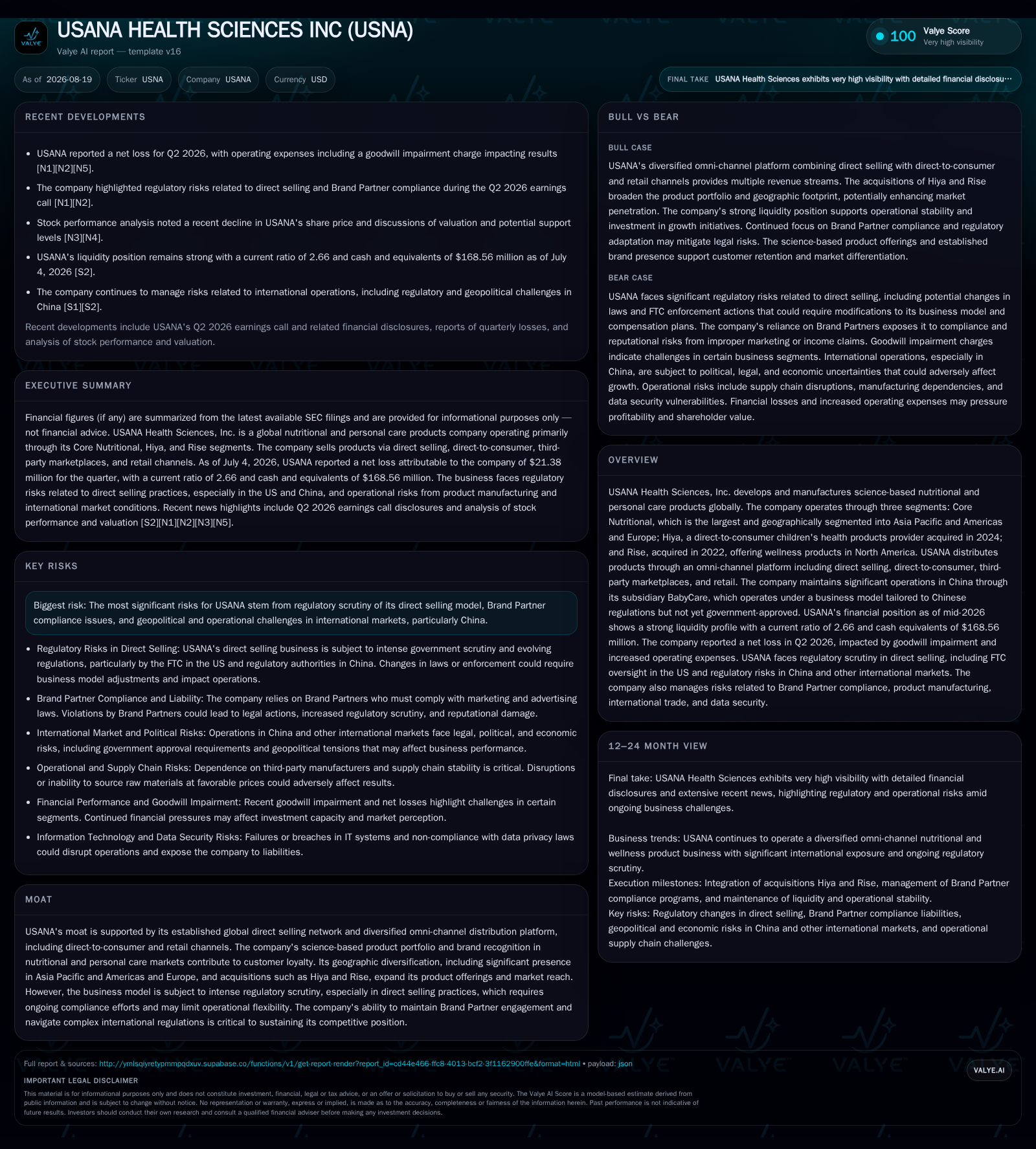
In the second quarter of fiscal 2026, USANA Health Sciences experienced a decline in net sales to $223.3 million from $235.8 million a year earlier. The company recorded a $29.1 million goodwill impairment charge related to recent acquisitions, which, combined with higher operating expenses, led to an operating loss of $20.0 million compared to operating income of $16.7 million in Q2 2025. Despite these challenges, USANA's liquidity remains solid with $168.6 million in cash and a current ratio of 2.66 as of July 4, 2026. The company continues to face regulatory and operational risks, particularly in its China operations.
Q2 2026 Operating Performance and Goodwill Impairment
USANA Health Sciences reported net sales of $223.3 million for the second quarter ended July 4, 2026, down from $235.8 million in the same period of 2025, representing a 5.3% decline [S2]. This revenue decrease reflects pressure in key markets, including the Greater China region, which is a significant contributor to the company's sales. The decline in net sales was accompanied by an increase in operating expenses to $194.9 million in Q2 2026 from $168.9 million in Q2 2025, driven primarily by Brand Partner incentives and a non-recurring goodwill impairment charge of $29.1 million related to recent acquisitions [S2].
As a result, USANA recorded an operating loss of $20.0 million in Q2 2026, a sharp reversal from the operating income of $16.7 million reported in Q2 2025 [S2]. The goodwill impairment charge indicates that the acquired assets, particularly from the Hiya (2024) and Rise (2022) acquisitions, have not met performance expectations, suggesting structural challenges in integration and market conditions [S1, S2]. This impairment reduced the carrying value of goodwill from $138.0 million at the start of the year to $109.1 million as of July 4, 2026 [S2].
The increase in Brand Partner incentives, which rose to $83.5 million from $87.0 million in the prior year quarter, reflects ongoing efforts to support and retain the direct selling network despite revenue pressures [S2]. Selling, general and administrative expenses remained relatively stable at $82.3 million compared to $81.9 million in Q2 2025, indicating controlled overhead costs amid the challenging environment [S2].
Liquidity and Capital Structure
USANA's liquidity position remains robust despite the operating loss and goodwill impairment. As of July 4, 2026, the company held $168.6 million in cash and cash equivalents, with total current assets of $281.1 million against current liabilities of $105.7 million, resulting in a current ratio of 2.66 [F1]. This strong short-term liquidity provides a significant buffer to manage ongoing operations and potential investments.
The company also reduced its leverage during the period, with no outstanding balance on its $75 million revolving credit facility as of July 4, 2026, down from $14 million at the beginning of the year [S2]. The credit agreement includes covenants based on consolidated EBITDA and debt ratios, which the company continues to meet comfortably [S4]. The absence of revolving credit borrowings enhances financial flexibility amid operational challenges and regulatory uncertainties.
The company’s capital structure provides a foundation for absorbing short-term shocks and funding strategic initiatives [S2].
Business Model and Market Risks
USANA operates primarily through a direct selling model, generating revenue from Brand Partners and direct consumers worldwide, with a substantial portion of its business concentrated in the Greater China region [S1]. The company offers science-based nutritional and personal care products, including wellness and children's health items. Revenue is driven largely by Brand Partner sales, supplemented by direct-to-consumer channels.
However, USANA faces significant regulatory and operational risks, especially in China. Its BabyCare subsidiary, which targets the Chinese market, operates under a business model that has not yet received government approval. This lack of regulatory sanction exposes the company to potential restrictions or adverse enforcement that could impact growth prospects in this key market [S1]. BabyCare’s operations are subject to significant government oversight, scrutiny, and monitoring, and failure to obtain necessary approvals could limit expansion and harm financial results.
Direct selling activities globally are also subject to intense government scrutiny, with risks related to marketing practices and compensation plans for Brand Partners [S1]. The company must navigate regulatory compliance carefully, as violations or negative perceptions of its Brand Partner Compensation Plan could adversely affect recruitment, retention, and overall business performance.
The integration of recent acquisitions, such as Hiya and Rise, has expanded USANA's product portfolio but also introduced integration costs and goodwill impairment risks, as evidenced in the latest quarter [S1, S2]. These acquisitions have increased the complexity of operations and contributed to the elevated operating expenses and impairment charges.
USANA's revenue decline and operating loss in Q2 2026 contrast with prior periods of profitability, reflecting both structural and cyclical pressures [S2]. The company’s geographic diversification, particularly its significant exposure to China, presents both opportunity and risk. Regulatory developments in China can materially affect operations, while competitive dynamics in the global nutritional products market require effective Brand Partner engagement and product innovation.
USANA's financial flexibility and established distribution network provide some resilience amid these challenges. However, the company must continue to manage regulatory risks, integration costs, and market pressures to restore growth and profitability.
Industry Context and Competitive Positioning
Within the direct selling and nutritional products industry, key performance indicators include net sales growth, operating margin, Brand Partner recruitment and retention, regulatory approvals, and liquidity ratios. USANA’s recent performance reflects the impact of regulatory and operational challenges that are common in this sector, particularly for companies with significant exposure to China.
Compared to peers, USANA’s challenges with goodwill impairment and revenue decline highlight the risks associated with acquisitions and market concentration. The company’s diversified distribution channels and global footprint offer competitive advantages, but regulatory scrutiny and compliance risks remain significant constraints.
Structural factors such as regulatory environment and Brand Partner network health heavily influence USANA’s revenue and profitability, while cyclical elements like consumer demand and macroeconomic conditions also play a role. The company’s ability to adapt to these dynamics will be critical for future success.
Analytical Conclusions and Outlook
The $29.1 million goodwill impairment charge recorded in Q2 2026 signals that recent acquisitions have underperformed relative to initial expectations, pointing to structural integration difficulties and challenging market conditions [S2]. This non-recurring charge materially impacted operating results and underscores the importance of monitoring future acquisition performance and integration costs.
Maintaining this liquidity cushion will be critical as the company navigates ongoing uncertainties.
Important factors to watch in upcoming quarters include revenue trends to assess whether sales pressures stabilize or deepen, updates on regulatory approvals in China affecting BabyCare and broader operations, Brand Partner recruitment and retention metrics, any further goodwill impairments or restructuring charges, and liquidity and credit facility usage patterns. These indicators will provide insight into USANA's ability to recover profitability and sustain growth in a complex operating environment.
While these factors have pressured profitability, the company's liquidity position and reduced credit facility usage provide some capacity to manage near-term risks and pursue strategic priorities [S2]. The evolving regulatory landscape in China remains a key watchpoint, as any adverse changes could materially impact USANA’s business and financial condition. Additionally, the company’s ability to successfully integrate acquisitions and control operating expenses will be important to restoring operating margins.
In summary, USANA faces a challenging operating environment marked by revenue decline, increased expenses, and goodwill impairment. The company's liquidity position and capital structure offer resources to address these challenges. Continued attention to regulatory developments, operational execution, and financial management will be important for USANA’s efforts toward renewed growth and profitability.
Disclaimer: This is research-only, informational analysis and not investment advice. It may include AI-generated interpretation and general industry context. Always verify important details using primary sources.

Comments