
Lumexa Imaging Q2 2026: Positive Net Income and Strong Liquidity Amid Industry Headwinds
Lumexa Imaging Holdings, Inc. reported positive net income and maintained a solid liquidity position in Q2 2026, supported by a current ratio of 1.44 and a recent refinancing of its credit facilities.
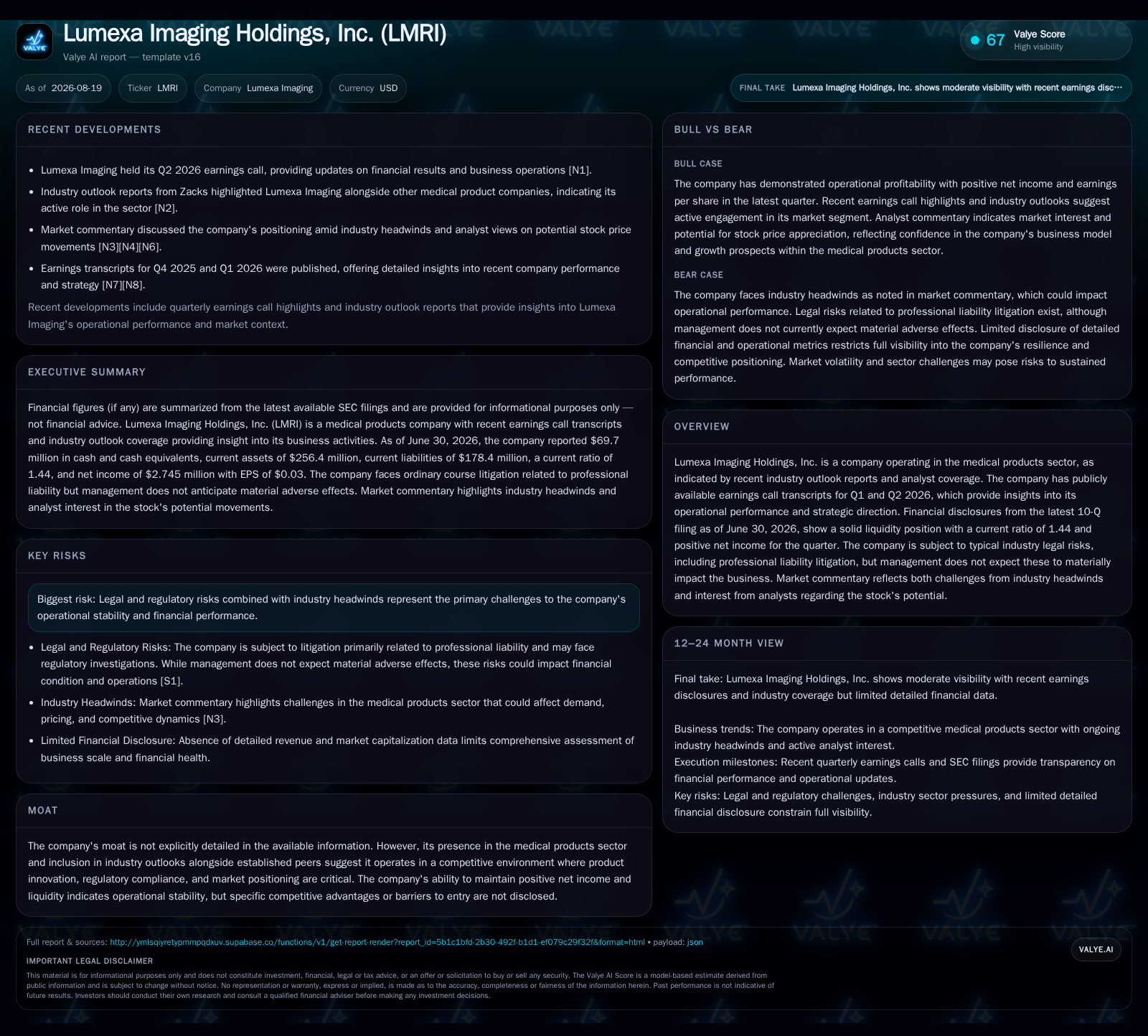
Lumexa Imaging Holdings, Inc. posted positive net income for the quarter ended June 30, 2026, reflecting operational stability despite challenges in the medical products sector. The company’s liquidity remains solid with a current ratio of 1.44, supported by $69.7 million in cash and equivalents against $178.4 million in current liabilities. Additionally, a June 2026 amendment to its credit agreement established secured term and revolving credit facilities with extended maturities, enhancing financial flexibility amid ongoing industry headwinds and regulatory risks.
Q2 2026 Operating and Financial Results
Lumexa Imaging Holdings, Inc. reported positive net income for the quarter ended June 30, 2026, signaling operational profitability during a challenging medical products environment [S2]. While the company did not disclose specific revenue or margin figures in its latest quarterly filing, the positive net income outcome suggests effective cost management and revenue generation during the period. As of the quarter-end, Lumexa held current assets of $256.4 million against current liabilities of $178.4 million, yielding a current ratio of 1.44, which indicates sufficient liquidity to meet short-term obligations [F1]. Cash and cash equivalents totaled $69.7 million, providing a readily available liquidity buffer [F1].
Despite a substantial total debt load of $844.85 million as of June 30, 2026, the company’s net debt—total debt minus cash—stood at approximately $775.15 million, reflecting leverage consistent with capital-intensive operations in the medical products sector [F1]. This level of leverage is typical for companies in this industry, where significant investment in research, development, and manufacturing infrastructure is required to maintain competitive product offerings and comply with regulatory standards.
The company’s working capital position, as reflected by the current ratio of 1.44 based on current assets of $256.4 million and current liabilities of $178.4 million as of June 30, 2026, indicates positive working capital [F1]. This supports ongoing business activities and provides a cushion against short-term financial disruptions, which is particularly important in the medical products sector where payment cycles and reimbursement timing can affect cash flow dynamics.
Debt Refinancing and Capital Structure
In June 2026, Lumexa completed an amendment to its credit agreement, which established a secured term loan facility of approximately $823 million and a secured revolving credit facility of $250 million, with maturities extending to December 2032 and December 2030, respectively [S14]. The refinancing reflects a strategic effort to extend debt maturities and secure favorable borrowing terms during a complex financial environment.
Interest rates on these facilities are set at either SOFR plus 2.50% or the Prime Rate plus 1.50%, with potential reductions contingent on achieving specified senior secured net leverage ratios [S14]. This structure incentivizes the company to manage leverage prudently, aligning debt costs with financial performance.
The amended credit agreement includes restrictive covenants that limit the ability of Lumexa’s subsidiaries to incur additional debt, pay dividends or other distributions, and engage in certain transactions without lender approval [S14]. Failure to comply with these covenants could constitute an event of default.
This refinancing enhances Lumexa’s financial flexibility by providing access to a revolving credit facility that can be drawn upon as needed for working capital or other corporate purposes. The extended maturities reduce near-term refinancing risk, allowing management to focus on operational execution and strategic initiatives.
Business Model and Industry Context
Lumexa Imaging operates in the medical products sector, supplying medical imaging products and related consumables primarily to healthcare providers such as hospitals and medical imaging centers [S1]. Revenue is generated through the sale of these products, with key drivers including procedure volume, installed base of equipment, reimbursement rates, and salesforce productivity.
Margins and cash conversion are influenced by operational efficiency, product innovation, regulatory compliance, and working capital management. The company’s ability to innovate and maintain clinical utility in its product offerings is critical to sustaining demand and competitive positioning in a sector characterized by rapid technological advancement and stringent regulatory oversight.
The medical products industry exhibits structural demand driven by ongoing healthcare needs, including diagnostic imaging and related procedures. However, it is also subject to cyclical factors such as hospital purchasing cycles and changes in reimbursement policies, which can impact revenue timing and growth trajectories. Peers in this sector typically compete on clinical utility, reimbursement status, installed base, channel access, and switching friction, all of which influence market share and profitability.
Risks and Legal Considerations
Lumexa faces typical industry legal and regulatory risks, including professional liability litigation and government investigations related to regulatory compliance [S1, S2]. The company’s insurance coverage and self-insured liabilities may not fully cover all potential claims, which introduces a degree of financial uncertainty.
Requests for information from government agencies and subpoenas are periodically received and reviewed, with appropriate actions taken as needed. Ongoing monitoring of these risks remains important given the potential for regulatory changes or litigation outcomes to impact financial results.
This liquidity position indicates operational stability and effective management of working capital in a competitive and regulated environment.
The recent amendment to the credit agreement, establishing secured term and revolving credit facilities with extended maturities, reflects active debt management to support financial flexibility. This refinancing reduces near-term refinancing risk and aligns borrowing costs with leverage targets, enhancing the company’s capacity to invest in growth and innovation.
Watchpoints
Investors and analysts should monitor future quarterly earnings releases for disclosures on revenue trends, margin performance, and any changes in operational metrics such as procedure volumes or installed base growth. These indicators will provide deeper insight into Lumexa’s ability to navigate sector headwinds while sustaining operational and financial stability.
Additionally, updates on legal or regulatory risks that could materially impact operations warrant close attention. Changes in debt levels or further refinancing activity may affect leverage and liquidity profiles, influencing credit risk and capital allocation decisions.
In summary, Lumexa Imaging’s Q2 2026 financial results and recent refinancing activity demonstrate a company maintaining operational profitability and financial flexibility amid the typical challenges of the medical products industry. Continued vigilance on industry dynamics and risk factors will be essential to assess the company’s ongoing performance and strategic positioning.
Disclaimer: This is research-only, informational analysis and not investment advice. It may include AI-generated interpretation and general industry context. Always verify important details using primary sources.

Comments