
Skye Bioscience’s Strategic Transition and Peripheral CB1 Antibody Differentiation
The latest quarter spotlights Skye Bioscience navigating critical Nasdaq compliance challenges while advancing nimacimab development and securing transformative Redx Pharma acquisition terms.
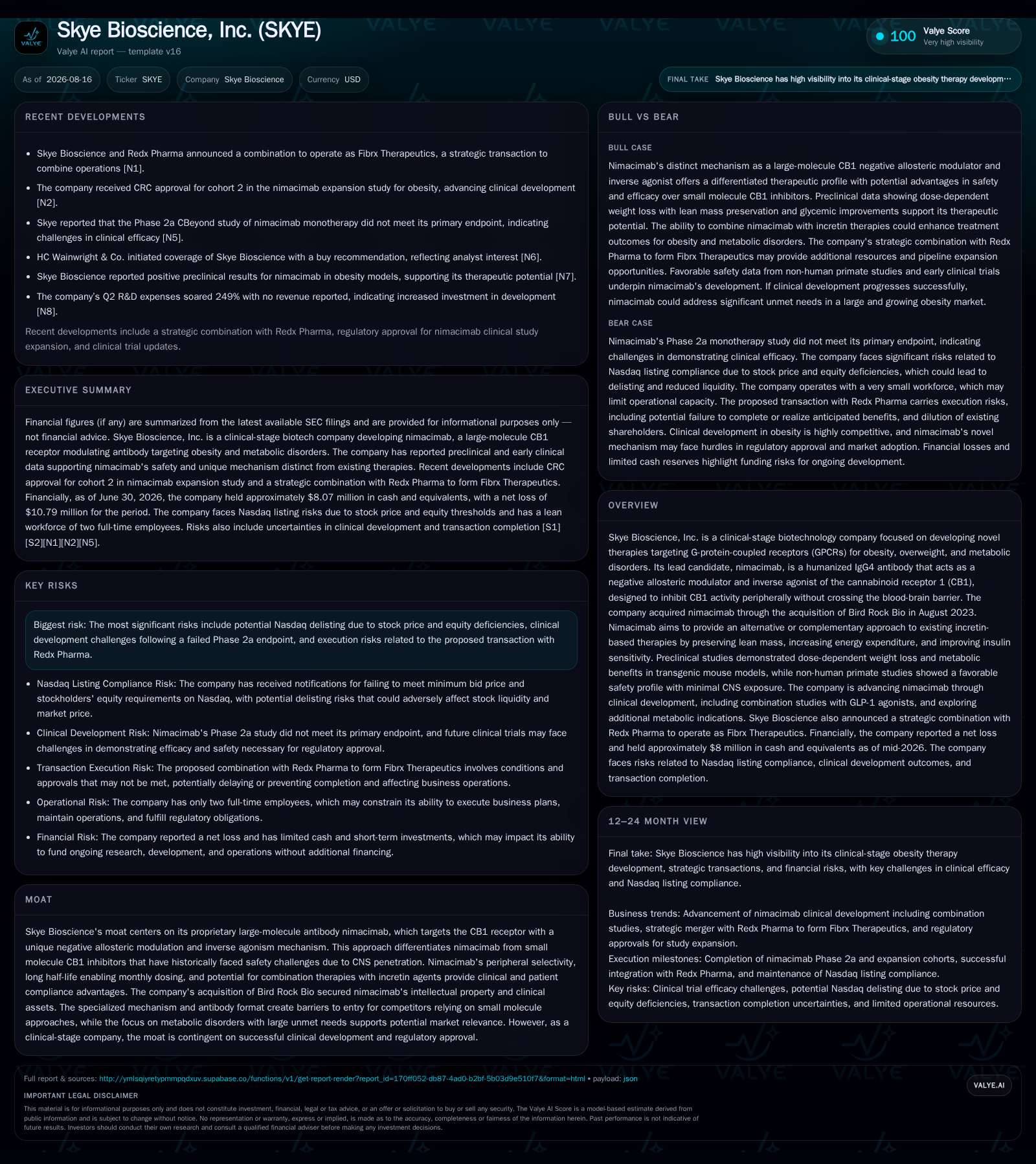
Skye Bioscience faces an urgent Nasdaq listing compliance deadline due to persistent share price and equity deficiencies, threatening delisting risk and liquidity constraints as of mid-2026 [S2]. Concurrently, the company disclosed a definitive agreement to acquire Redx Pharma, aiming to bolster its metabolic disorder pipeline and capital base, albeit with integration uncertainties [S3][N1]. Skye’s lead clinical candidate, nimacimab, is a novel peripherally selective IgG4 antibody targeting CB1 receptors via negative allosteric modulation, distinct from historic small molecule approaches challenged by CNS safety issues [S1]. The company’s near-term viability hinges on successful execution across regulatory milestones, trial enrollment acceleration, and capital management given limited cash reserves and ongoing operating losses [F1].
Nasdaq Listing Risk Highlights Urgency for Operational Execution
Skye Bioscience is contending with significant Nasdaq listing challenges after failing to sustain the minimum $1.00 bid price required under Rule 5450(a)(1) for continued listing. Although transferring its common stock to the Nasdaq Capital Market on June 23, 2026 resolved a prior stockholders’ equity deficiency issue, the company remains under pressure to regain bid price compliance by September 14, 2026 [S2]. Failure to do so risks delisting or necessitates corrective actions such as a reverse stock split. This situation heightens liquidity concerns as diminished market presence could deter investor participation and complicate access to vital equity financing needed for costly clinical development programs
Nasdaq's recent rule changes mandating issuers maintain a minimum Market Value of Listed Securities of $5 million continuously further tighten regulatory oversight. This intensified scrutiny underscores the imperative for Skye to stabilize its trading metrics to preserve shareholder value and maintain capital market access during this critical developmental phase.
Strategic Acquisition of Redx Pharma: Catalyzing Scale but Introducing Execution Complexity
On August 14, 2026, Skye announced a definitive agreement to acquire Redx Pharma Limited pending requisite shareholder approvals [S3]. The transaction values Redx at approximately $14.5 million subject to adjustments based on net cash at closing. Notably, unresolved adjustments could materially reduce this valuation down to $2 million if not settled prior to closing
The acquisition aims to broaden Skye's metabolic disorder pipeline beyond nimacimab by incorporating complementary assets aligned with GPCR-targeted therapeutics. It also has potential to enhance research capabilities and geographic diversification. However, integration risks include aligning corporate cultures, consolidating operations efficiently without disrupting ongoing programs, and managing incremental expenses prior to realizing revenue synergies—all while navigating uncertain valuation outcomes.
For shareholders and investors accustomed to Skye's clinical-stage focus reliant on equity raises rather than product revenues, this acquisition represents both an opportunity for accelerated growth through expanded pipeline assets and a significant execution challenge requiring careful operational management [N1][S3]
Clinical Progress of Nimacimab Against Metabolic Disorder Challenges
Nimacimab is Skye’s lead clinical candidate—a humanized IgG4 monoclonal antibody functioning as a negative allosteric modulator (NAM) and inverse agonist specifically targeting the peripheral cannabinoid receptor 1 (CB1). CB1 plays a central role in regulating energy balance and metabolism.
Unlike earlier small molecule CB1 antagonists withdrawn due to central nervous system penetration causing neuropsychiatric adverse effects (e.g., rimonabant), nimacimab’s design emphasizes peripheral selectivity intended to avoid blood-brain barrier crossing. This reduces CNS safety risks while preserving therapeutic modulation of metabolic pathways.
Preclinical studies demonstrated dose-dependent weight reduction alongside improvements in insulin sensitivity in animal models including transgenic mice and non-human primates with favorable safety profiles consistent with peripheral action hypotheses [S1]. Clinical development priorities include advancing enrollment rates in pivotal trials while assessing nimacimab’s efficacy both as monotherapy in overweight/obese patients and in combination with incretin-based agents such as GLP-1 receptor agonists—strategies aimed at enhancing efficacy through complementary mechanisms addressing appetite regulation and energy expenditure.
Antibody Modality Differentiation: Peripheral CB1 Targeting Versus Competitors
Nimacimab’s antibody modality confers several advantages over traditional small molecule approaches targeting GPCRs like CB1. Its large molecular size restricts CNS penetration enhancing safety; allosteric modulation allows fine-tuned receptor activity attenuation potentially improving tolerability by avoiding complete blockade; extended half-life supports less frequent dosing favorable for patient adherence.
This pharmacokinetic/pharmacodynamic profile establishes intellectual property barriers differentiating nimacimab within an increasingly competitive obesity therapeutics landscape where few antibodies target GPCRs peripherally via NAM mechanisms. Manufacturing outsourcing agreements facilitate scalable production but also create dependencies on third-party contract manufacturing organizations (CMOs), representing standard industry operational risks [S1]
Growth Opportunities Through Combination Therapy and Indication Expansion Pathways
Beyond obesity treatment, Skye is exploring nimacimab's utility in broader metabolic disorders characterized by inflammation and fibrosis such as non-alcoholic steatohepatitis (NASH) or diabetic kidney disease—areas of high unmet medical need where existing therapies offer limited benefit.
Combination regimens pairing nimacimab with incretin therapies could yield synergistic effects enhancing weight loss efficacy while mitigating side effects like lean mass loss common under monotherapies. Such multi-modal approaches align well with payer demands for durable improvements in metabolic health outcomes that reduce long-term comorbidities.
Strategic collaborations remain an integral part of Skye's approach to accelerate clinical timelines while sharing development costs—reflecting standard biotech sector practices given lengthy R&D cycles and significant capital requirements associated with novel first-in-class agents [S1].
Risks from Trial Enrollment, Regulatory Hurdles, and Financing Constraints
Patient enrollment delays remain a material risk impacting trial completion timelines—a common challenge in specialized metabolic disorder studies requiring specific patient populations. Outsourced manufacturing dependencies introduce potential supply chain or quality control vulnerabilities during scale-up phases.
Regulatory agencies may demand extensive safety data given nimacimab’s novel mechanism involving cannabinoid pathways; demonstrating neuropsychiatric tolerability remains paramount considering historical precedents in this drug class.
Financially, persistent operating losses driven by high R&D spend without revenue generation necessitate ongoing equity financing [S2][S1]. However, depressed share prices linked to Nasdaq non-compliance pose obstacles to raising capital efficiently without excessive dilution or unfavorable terms
What To Watch: Key Milestones Through Late 2026 And Beyond
Investors should closely monitor (i) Skye’s ability to maintain a closing bid price above $1.00 for ten consecutive trading days before the September 14 deadline ensuring continued Nasdaq listing; (ii) successful completion of shareholder votes enabling Redx Pharma acquisition closure expanding pipeline assets; (iii) acceleration in clinical trial patient enrollment indicating operational progress; (iv) announcements regarding regulatory submissions or interim clinical data reinforcing nimacimab’s safety-efficacy profile—all collectively shaping near-term valuation inflection points [S2][S3][N1]
Financial Profile Discussion: Capital Position Shapes Near-Term Viability
As of June 30, 2026, Skye held approximately $8.07 million in cash equivalents against negligible debt (~$45 thousand), yielding a current ratio just below one at approximately 0.95—highlighting tight working capital conditions amid ongoing operational expenditures typical of clinical-stage biotechs without commercial revenue streams [F1]
Operating losses remain substantial reflecting sustained investment into nimacimab’s clinical advancement with no offsetting income sources yet realized. The constrained liquidity position underscores urgency for successful capital raises or strategic partnerships required to extend runway sufficiently through critical upcoming milestones including pivotal trial readouts and transaction closings.
This financial context frames both constraints limiting discretionary spending flexibility and motivators driving inorganic growth initiatives like the Redx acquisition aimed at broadening asset base while seeking scale efficiencies supportive of longer-term sustainability.
Disclaimer: This is research-only, informational analysis and not investment advice. It may include AI-generated interpretation and general industry context. Always verify important details using primary sources.

Comments