
IB Acquisition Corp.’s Transition to de-SPAC with GNQ Insilico: Redemption Risks and Deal Viability
Significant redemption-driven depletion of IB Acquisition Corp.’s trust account challenges the feasibility of closing its AI drug discovery merger by late September 2026.
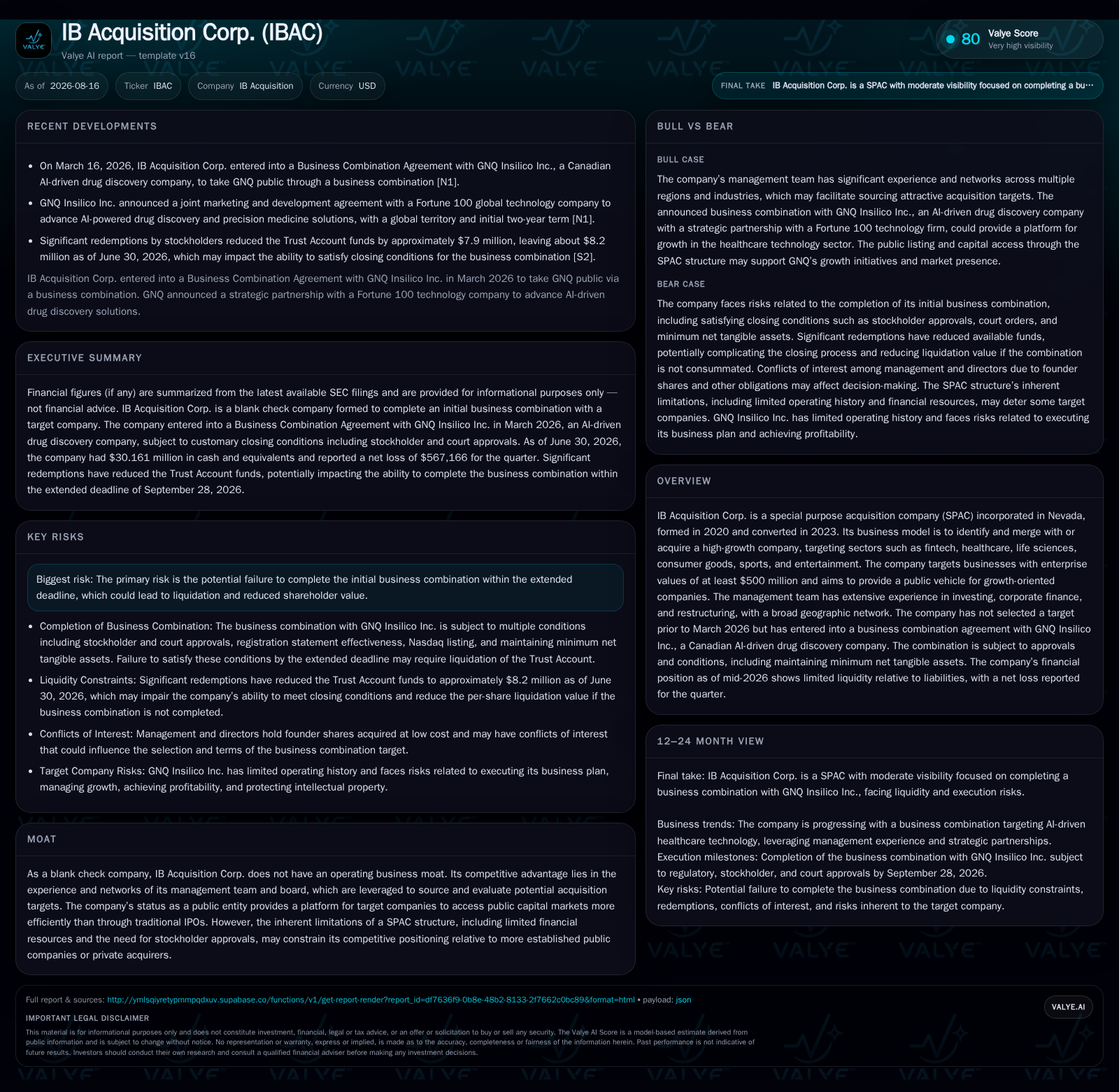
IB Acquisition Corp. is navigating a critical phase as substantial stockholder redemptions have reduced available cash in its trust account to approximately $8.2 million, risking compliance with minimum net tangible asset requirements needed to consummate its business combination with GNQ Insilico. The SPAC’s management team, experienced in private investing and corporate finance, is leveraging its network to secure regulatory and shareholder approvals amid tightening financial constraints. Success hinges on timely completion of this de-SPAC transaction before the September 28, 2026 deadline, underscoring redemption dynamics and approval milestones as key near-term indicators.
This activity reduced the trust account’s liquid funds to about $8.2 million as of June 30, 2026 [S2], [F1]. Since the trust account constitutes the primary funding reservoir for completing the SPAC’s business combination financing needs, this depletion poses a direct threat to satisfying the net tangible assets precondition stipulated by the merger agreement with GNQ Insilico Inc.
The timing is sensitive as IBAC must close by the extended deadline of September 28, 2026. The reduction in trust funds challenges the ability to maintain sufficient regulated minimum net tangible assets after accommodating redemption payouts and any additional cash contributions such as PIPE financing or sponsor capital injections [S2]. Failure here risks forcing liquidation at values below initial IPO price levels.
SPAC Model at Work: Understanding IBAC’s Capital Structure and Sponsor Alignment
IB Acquisition Corp. operates as a classic blank check company structured around an initial public offering (IPO) completed on March 28, 2024 that raised gross proceeds of $115 million plus an additional $6.1 million via private placement to sponsors at $10 per unit [S1]. These funds were placed into a segregated trust account which preserves capital pending a qualifying business combination.
Prior to merger completion, IBAC generates no operating revenues; instead interest income mainly from this trust bolsters reported net income [S1]. Operating expenses primarily reflect due diligence costs and public company administrative overheads required to sustain SEC compliance
Management's sponsor promote interests — founder shares typically granted at nominal prices — create strong alignment incentives toward timely deal closure because these shares appreciate substantially only post de-SPAC transaction execution.
Investor redemption rights enable shareholders to withdraw their pro-rata share from the trust before closing if they disapprove of a proposed target or seek liquidity; however, high redemption levels reduce capital available for acquisition consideration or other closing requirements [S1], [S2].
Target Profile and Due Diligence: Strategic Focus on GNQ Insilico’s AI-Driven Drug Discovery
IBAC signed its definitive business combination agreement with GNQ Insilico Inc., a Canadian company specializing in artificial intelligence–powered drug discovery platforms aimed at expediting life sciences research [S2], [S1]. This reflects IBAC’s broader stated strategy targeting enterprises valued over $500 million in high-growth verticals like healthcare technology and fintech where AI integration fosters competitive differentiation.
The management team leverages diverse expertise — spanning investing, corporate restructuring and global networks — to conduct multi-dimensional due diligence including meetings with target managements, financial audits, operational reviews, and sector-specific evaluation aligned with announced target criteria [S1]. This approach aims both to mitigate execution risks typical in SPAC deals and ensure strategic fit across geographies including North America, Asia-Pacific and Europe.
Competitive Backdrop: Positioning Against Peer SPACs Amid Redemption Waves
Redemption waves are endemic headwinds confronting many contemporary SPACs attempting de-SPAC transactions within constrained timeframes. Comparable entities such as Pershing Square Tontine Holdings have demonstrated similar patterns where elevated redemptions impair trust liquidity forcing either supplementary financing rounds or renegotiation of deal terms.
IBAC’s situation mirrors these dynamics but is nuanced by its sector targeting towards AI-enabled healthcare technologies which maintain investor interest despite broad market volatility. The company must balance managing diminishing post-redemption cash against preserving shareholder confidence through transparent communications about deal progress and PIPE financing commitments.
Growth Potential Post Merger: Market Trends in AI Healthcare Technologies
GNQ Insilico sits within an accelerating segment where artificial intelligence applications transform traditional biotech paradigms through enhanced computational models for drug molecule identification. Market demand drivers include rising healthcare innovation budgets, growing acceptance of digital tools in pharma R&D cycles, and increasing venture capital flows focused on next-generation life sciences technologies.
This tailwind supports IBAC's strategic rationale for selecting this target given projected secular growth trajectories within healthcare AI platforms contributing favorably towards investor return potential post-merger execution [S1].
Risks Surrounding Transaction Closure: Deadlines, Approvals, and Adequate Funding
The paramount risk faced by IB Acquisition Corp. remains failure to consummate its business combination within the stipulated extension period that expires September 28, 2026 [S2]. The filing highlights multiple closing conditions:" stockholder approvals from both IBAC and GNQ Insilico shareholders; interim/final court orders issued by the Ontario Superior Court; Nasdaq listing effectiveness; registration statement clearance; plus maintaining minimum net tangible assets greater than $5 million after accounting for redemptions and PIPE inflows"
Given current redemptions' sizable impact reducing funds to just over $8 million versus prior capital pools exceeding $100 million post-IPO—and factoring potential further redemptions—there exists tangible danger that these thresholds may not be met requiring intervention through sponsor contributions or supplemental PIPE financing.
An inability to satisfy these preconditions triggers mandatory liquidation protocols likely resulting in public shareholders receiving less than IPO unit prices creating reputational detriment for management credibility.
What To Watch Next: Crucial Milestones Toward Closing by September 2026
Several key milestone events will serve as barometers for validating transaction viability over coming weeks:
- Outcome of final shareholder votes scheduled around merger approval,
- Status updates regarding Ontario Superior Court interim/final order issuance,
- Effectiveness notice for Form S-4 registration statement enabling new stock issuance,
- Public disclosures confirming PIPE investment amounts secured,
- Nasdaq confirmation for listing qualification following regulatory scrutiny. Monitoring these signs will provide actionable insights into whether IB Acquisition maintains momentum or faces increasing pressure leading up to deadline expiry.
Financial Profile Discussion: Trust Account Status and Liquidity Constraints
As per latest data accompanying Q2 ended June 30, 2026 filing: IBAC holds negligible unrestricted cash ($30 thousand) outside escrowed trust funds intended solely for business combination financing purposes; total debt approximates half a million dollars; current ratio stands at a distressed level (0.14) driven largely by short-term liabilities exceeding current assets [F1]. These figures underscore limited operational liquidity independent of trust balances.
Crucially though, it is the depletion of the segregated trust account — originally funded via IPO proceeds — from approximately $122 million gross raise down to roughly $8.2 million post-redemptions that defines existential financial risk profiles pending successful closing. This constriction alongside ongoing operating overhead magnifies urgency around securing required approvals and additional capital injections (e.g., PIPE) necessary to meet net tangible asset tests preventing forced liquidation scenarios.
Disclaimer: This analysis does not constitute investment advice or research views but offers an informed examination based on SEC filings and industry context as of August 16, 2026.
Disclaimer: This is research-only, informational analysis and not investment advice. It may include AI-generated interpretation and general industry context. Always verify important details using primary sources.

Comments