
Track Group Advances GPS Tracking with Patent Edge and Acquisition Challenges
The company’s August 2026 quarterly disclosures reveal the balancing act between leveraging intellectual property and managing integration and network upgrade pressures shaping growth.
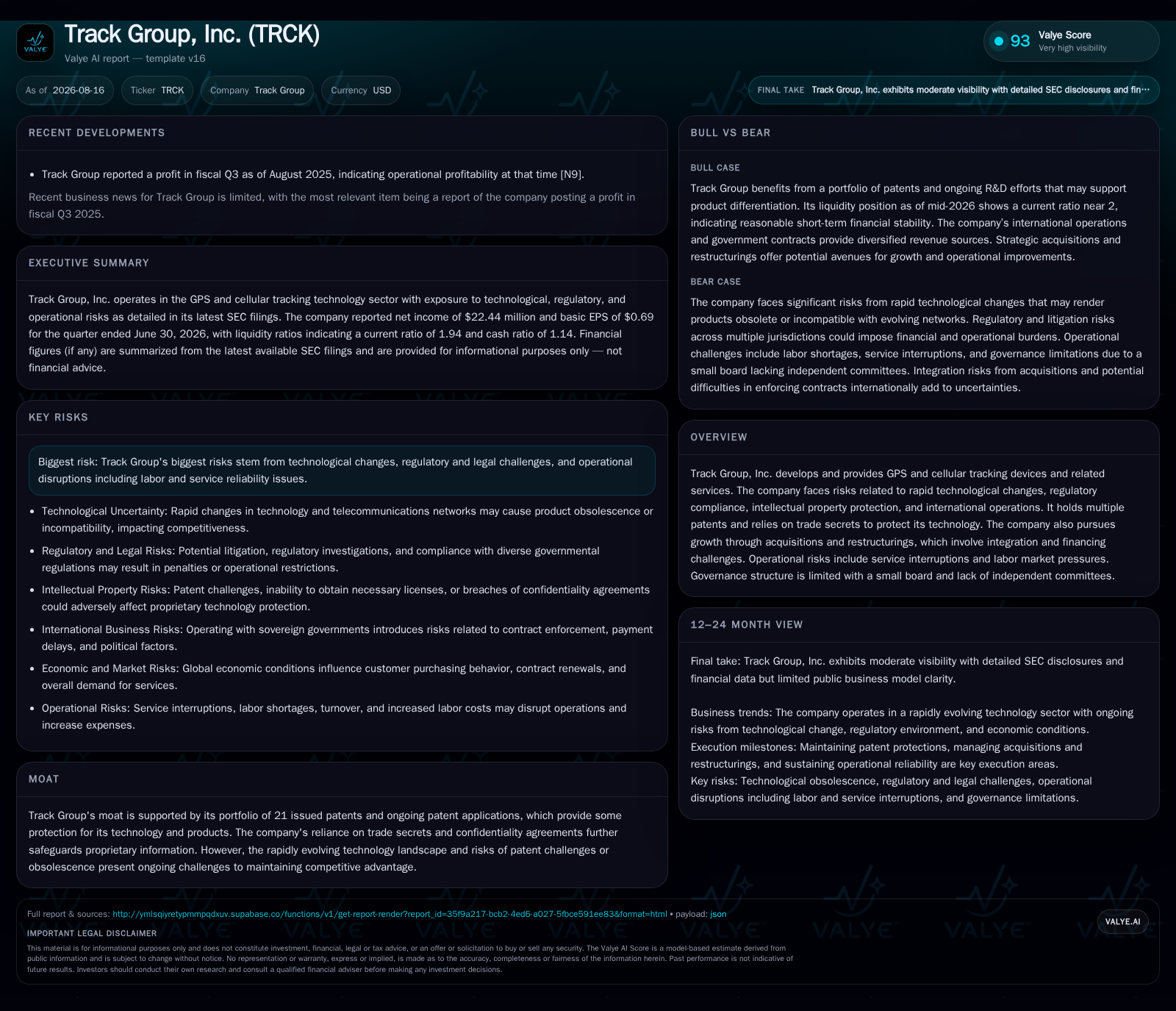
Track Group, Inc.’s latest quarter highlighted operational pressures stemming from acquisition restructuring costs and necessary technology upgrades to maintain compatibility with evolving cellular networks. Its business model centers on a mix of GPS tracking hardware sales and growing subscription-based services, supported by a portfolio of 21 patents that provide some protection against rapid innovation cycles. The firm operates amid industry challenges including regulatory compliance, service reliability demands, and intense competition from peers such as Garmin Ltd. and CalAmp Corp. Looking forward, key demand drivers include IoT ecosystem expansion and regulatory mandates, while risks focus on technological obsolescence, labor market dynamics, and integration effectiveness.
2026 Q3 Results Surface Operational Strains Amid Acquisition Integration
Track Group's August 14, 2026 quarterly filing ([S2], [S3]) detailed operating results revealing margin compression primarily linked to charges related to acquisition restructuring efforts alongside investments needed to maintain cellular telemetry compatibility in light of evolving network standards. While the report lacked explicit disclosures on device deployment counts or recurring revenue splits for this quarter, company statements indicate substantial operational impact from integration challenges associated with recent acquisitions. These investments appear essential given the industry-wide phase-out of legacy networks (notably 3G), requiring hardware redesigns and software updates to ensure devices remain functional across diverse geographies.
Service interruptions or delays tied to these transitions have also been referenced in risk disclosures ([S1]), underscoring the fragility of service uptime as a competitive factor in GPS tracking markets where real-time monitoring reliability is paramount.
Track Group's Dual Revenue Engines: Device Sales versus Subscription Services
Track Group's business model hinges on selling GPS and cellular tracking devices complemented by subscription-based services that provide continuous monitoring, data analytics, and support ([S1], [F1]). Hardware unit sales generate upfront revenue at lower margins typical for device manufacturing segments due to component costs and integration expenses. By contrast, subscription or usage-based recurring revenues offer a steady income stream with higher gross margins once scale is achieved.
The company leverages its installed base of active tracking devices to grow its subscription footprint, endeavoring to shift towards SaaS-like economics seen in telemetry-focused peers such as CalAmp Corp. Historical financial filings show net losses offset partially by operating income gains indicative of this transition phase ([F1]). However, device compatibility challenges posed by cellular network upgrades impact average revenue per user/device (ARPU) since some legacy devices may become obsolete ahead of planned replacement cycles.
This dynamic puts a premium on efficient R&D expenditure allocation aimed at supporting new network protocols (e.g., LTE-M or upcoming 5G variants) without inflating cost of goods sold (COGS) disproportionately.
Patent Portfolio as a Competitive Moat: Protection vs. Obsolescence Risks
With 21 issued patents plus additional pending applications protecting key aspects of its GPS tracking technology ([S1]), Track Group seeks to secure intellectual property barriers against competitors replicating its device innovations or proprietary algorithms integral to monitoring solutions. This patent portfolio constitutes a meaningful moat relative to many smaller rivals lacking similar legal defenses.
Nevertheless, rapid technological shifts require ongoing patent filings and innovation cycles to sustain competitive differentiation. Furthermore, reliance on trade secrets complements patent protection but introduces risk if such confidentiality is compromised.
The company’s IP position must adapt continuously amidst threats from patent litigation or expiration exposing it to commoditization pressures common in the telecommunications hardware domain.
Industry Structure Insights: Competitive Position Amid Evolving Network Standards
Track Group operates in a midstream segment encompassing hardware design/manufacturing and services delivery within the GPS tracking value chain. It faces competition from hardware specialists such as Garmin Ltd., known for robust consumer/fleet GPS devices, alongside telemetry/IOT integrators like CalAmp Corp., which emphasize subscription services.
The phase-out of older cellular infrastructure like 3G imposes sector-wide product upgrade demands causing elevated capital spending and complexity around maintaining device compatibility across shifting network landscapes ([S1]). Such network transitions impact customer buying decisions favoring vendors able to assure seamless real-time monitoring without interruption.
Geographic coverage limitations inherent in cellular networks additionally restrict growth potential in less connected regions absent satellite linkages or alternative telemetry technologies.
Drivers Catalyzing Demand Growth: Subscription Models, IoT Expansion, Regulatory Mandates
Expanding IoT ecosystems drive uptake of real-time asset/personnel tracking solutions across logistics/fleet management domains where operational efficiency gains are measurable. Regulatory mandates—particularly in law enforcement contexts requiring electronic monitoring—further underpin device deployment growth ([S1]).
Subscription-based models capturing recurring service fees from customers present scalable margin upsides compared with one-off hardware sales. Increasing sophistication in software analytics enhances value propositions enabling clients to optimize asset utilization or compliance adherence through integrated data platforms.
These dynamics foster durable demand signals visible through growing active device counts paired with rising recurring revenues—a KPI nexus central to industry valuation metrics.
Risk Factors Elevated by Technological Change, Regulatory Complexity, and Labor Tightness
Rapid technological obsolescence compels sustained R&D investment while exposing Track Group to risks that devices become outdated before full amortization ([S1], {valye_report_excerpt}). Regulatory scrutiny spanning data privacy, export controls, and product certifications constrains design agility yet is unavoidable given global operational footprints.
Operational reliability concerns arise amid potential service interruptions affecting client satisfaction critical in real-time monitoring sectors. Labor market tightness further constrains capacity especially within specialized engineering functions essential for upgrading hardware/software portfolios effectively.
While prior litigation matters have been settled or remain immaterial ([S26], [S27]), continuous legal vigilance remains necessary given inherent risks linked to electronic monitoring technologies involving personal data sensitive use cases.
Milestones To Monitor: Subscription Churn, R&D Spending Levels, Network Compatibility Updates
Key performance indicators warrant close attention including subscription churn rates which gauge stickiness of recurring revenue streams essential for long-term margin improvement. R&D expenditure levels as a percentage of revenue signify commitment to innovation but require balancing against profitability targets.
Progress on deploying devices compatible with emerging cellular standards (LTE-M / 5G) will serve as critical proof points evidencing successful adaptation to network transitions which underpin ongoing usability—directly influencing customer retention practicability.
Integration success rates following acquisitions also merit observation given historical operating pressures linked to restructuring charges reported recently ([S2]).
Financial Profile Discussion: Leverage Headwinds Versus Cash Liquidity Buffer
As of June 30, 2026, Track Group held approximately $21 million in total debt against about $8 million cash & equivalents resulting in net debt near $13 million; meanwhile current assets stood around $14 million versus current liabilities about $7.2 million yielding a healthy current ratio near 1.94 ([F1]).
The debt structure arises notably from an April 2026 $21 million term loan facility bearing elevated interest rates (~13.5% annually) with covenants including minimum EBITDA thresholds tested quarterly ([S6], [S7]). The company's ability to manage these leverage commitments will critically influence financial flexibility especially given past pressures related to interest payment extensions on legacy borrowings ([S13]).
Free cash flow generation remains challenged given recent earnings pressure from acquisition-related expenses and necessary capital outlays supporting network compatibility improvements ([S2]). Liquidity appears sufficient presently but deeper refinancing capabilities or cash flow enhancements will be needed over the medium term to mitigate refinancing risk ahead of debt maturities approaching late decade timelines ([S4]).
This analysis is based solely on publicly available information up through August 16, 2026. It does not constitute investment advice or research views regarding Track Group or any related securities.
Disclaimer: This is research-only, informational analysis and not investment advice. It may include AI-generated interpretation and general industry context. Always verify important details using primary sources.

Comments