
WinVest Acquisition's Sponsor Support and Redemption Dynamics Shape Its Window for Initial Business Combination
WinVest Acquisition Corp. faces critical liquidity constraints and an expiring extended deadline to finalize its Initial Business Combination, relying heavily on sponsor funding and shareholder redemption behavior.
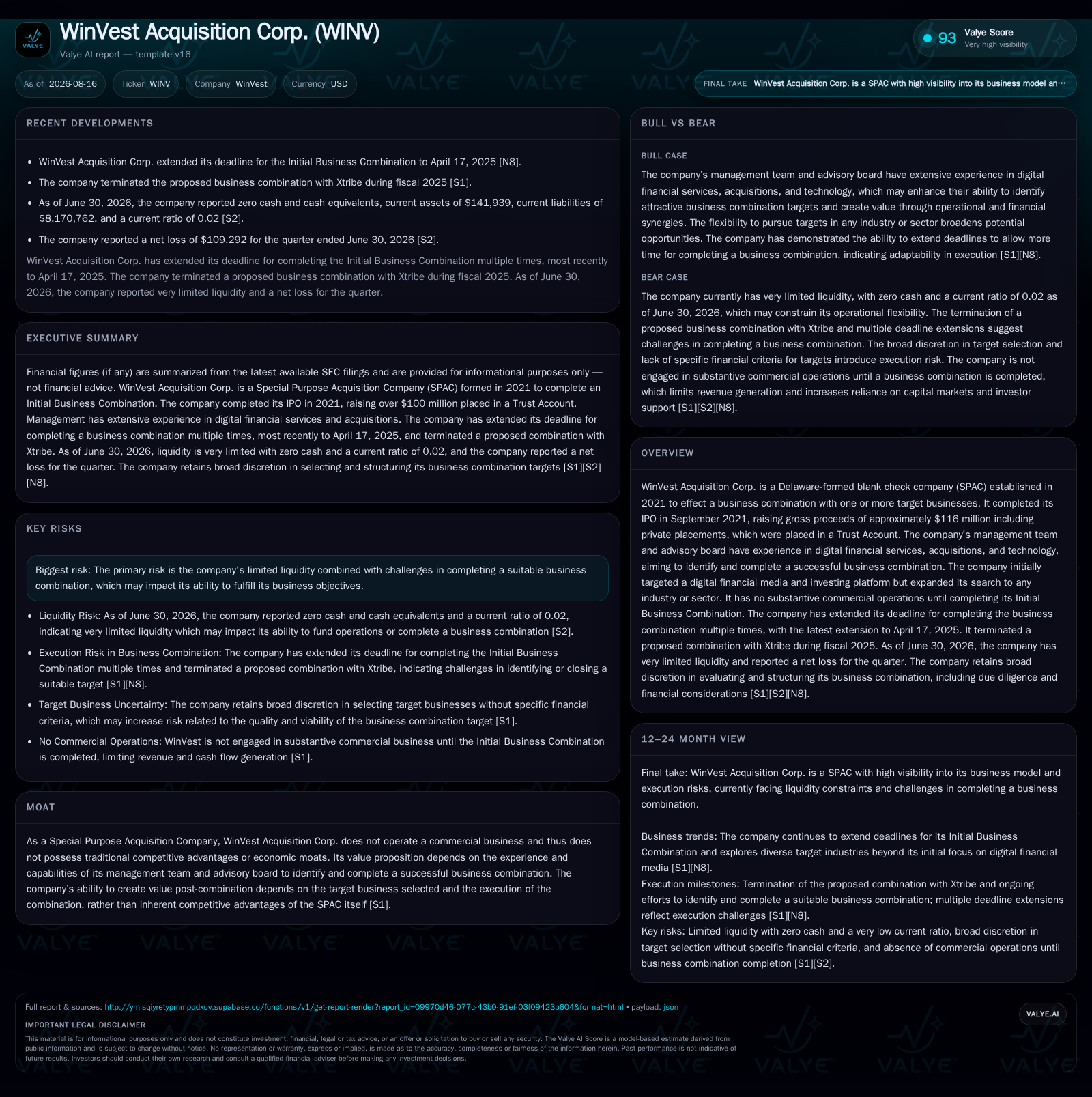
As of mid-2026, WinVest Acquisition Corp., a blank check SPAC formed in 2021, confronts acute financial pressures with nearly no cash and minimal current assets against liabilities exceeding $8 million. The company has extended its Termination Date multiple times, now set to expire in September 2026, depending on incremental sponsor advances to sustain operations. Significant shareholder redemptions have materially reduced trust funds, challenging the viability of closing a business combination. The path forward hinges on management’s execution capability, sponsor and PIPE funding availability, and investor redemption trends within a shrinking timeframe.
Acute Liquidity Pressure Amplifies Urgency Ahead of Final Business Combination Deadline
WinVest Acquisition Corp.'s latest quarterly report filed August 14, 2026, underscores a critical liquidity crunch: cash and equivalents are effectively zero as of June 30, 2026, with current assets totaling only approximately $142,000 versus current liabilities exceeding $8.17 million [S2][F1]. Given WinVest's status as a blank check company with no commercial operations or revenue streams prior to consummation of its Initial Business Combination (IBC), the firm's survival depends on finalizing a de-SPAC transaction before its Termination Date.
Management has leveraged multiple shareholder-approved amendments to extend the original December 17, 2022 deadline through incremental monthly extensions funded by Sponsor deposits into the Trust Account—each extension carrying operational cost implications while providing limited runway. The current Termination Date stands at September 17, 2026 [S1][S7]. These repeated extensions reflect both strategic attempts to preserve option value and growing pressure from dwindling resources.
SPAC Business Model: Capital Raised via IPO and Private Placements Held in Trust Pending De-SPAC Completion
WinVest follows the conventional SPAC model: it raised gross proceeds of approximately $116 million from its September 2021 Initial Public Offering (IPO) and associated private warrant placements [S1]. The IPO units comprised common stock shares paired with redeemable warrants exercisable at $11.50 per share (half-share per warrant) plus rights entitling holders to fractional shares upon successful business combination. These proceeds were deposited into a segregated Trust Account designed to safeguard investor capital until deployment toward an acquisition or eventual return upon failure.
Without revenues or commercial operations pre-combination, operating losses primarily stem from administrative expenses funded outside the Trust Account [S1]. Value creation depends entirely on successfully identifying an attractive private target company for merger or acquisition within prescribed timeframes; failure results in liquidation protocols returning remaining trust funds net expenses.
Sponsor Funding and Redemption Impact: Managing Cash Flow Amid Investor Skepticism
Investor redemption activity profoundly affects available deployment capital. Recently, over 11 million shares were redeemed at aggregate redemption prices approximating $116 million [S1], substantially reducing funds accessible from the Trust Account for acquisition financing. Elevated redemptions typically indicate declining public investor confidence in management’s ability to close a deal or skepticism about disclosed targets’ attractiveness—introducing material execution risk compounded by shrinking capital reserves.
Industry Context: Extended Search Periods and Redemption Trends Reflect Broader SPAC Market Dynamics
WinVest’s repeated deadline extensions mirror a broader pattern among SPACs launched during the robust IPO environment of 2020–2022 facing delayed deal execution amid tougher market conditions post-SPAC boom. Many peers targeting similar sectors like technology or financial services have required staged extensions conditioned on incremental sponsor funding injections.
High redemption rates parallel sector-wide retail investor shifts away from speculative shell vehicles lacking transparent target details or clear growth prospects. Conversely, SPACs with deeply aligned sponsors providing continuous capital support or strategic PIPE investors tend to maintain stronger positioning to complete de-SPAC transactions despite adverse cycles.
Failure to consummate deals within extended deadlines often results in forced wind-downs; thus, WinVest’s ability to navigate these pressures amidst near depletion of cash assets distinguishes it within this competitive landscape.
Growth Prospects Hinged Entirely on Post-Combination Target Execution
With no definitive target details publicly disclosed beyond terminated efforts such as the abandoned Xtribe PLC transaction in fiscal year 2025 [S1][S6], WinVest’s growth outlook remains speculative pre-combination. Value creation will depend heavily on selecting a compelling private company with sustainable fundamentals capable of benefiting from public market access post-merger.
Investor valuation will focus intensely on management’s track record sourcing attractive deals along with their ability to steer regulatory approvals, shareholder voting processes, and financing negotiations including potential PIPE raises where necessary.
Key Risks: Balance Sheet Strain, Execution Uncertainty, Dilution Risk, and Market Volatility Effects
WinVest faces significant risks including failure to close an Initial Business Combination by September 17th triggering mandatory liquidation with shareholders recovering residual Trust Account balances net costs [S1]. The absence of operating revenues means fixed costs—primarily administrative fees—are borne amid declining liquidity evidenced by large working capital deficits versus minimal liquid assets [F1]. High redemption levels exacerbate capital shrinkage.
Additional risks include dilution stemming from warrants linked to sponsor equity incentives and regulatory challenges related to blank check company compliance including disclosure adequacy and conflict-of-interest scrutiny.
Market volatility impacts share prices influencing redemption rates—a critical KPI affecting acquisition war chest—and contributes uncertainty regarding investor appetite for SPAC investments broadly.
What To Watch: Extension Approvals, Redemption Outcomes, Sponsor Financing, PIPE Activity
Upcoming milestones warrant monitoring include any further extension amendment approvals (currently capped at September 17th), stockholder vote outcomes on merger proposals once announced, additional sponsor capital infusions beyond existing promissory notes sustaining operations temporarily [S2], and announcements concerning PIPE investments supplementing buyout financing where trust proceeds fall short due to redemptions.
Management communications around target evaluations amid deteriorating liquidity constraints will be critical signals indicating whether expedited decisions or abandonment scenarios are likely.
Financial Profile Discussion
Disclaimer: This is research-only, informational analysis and not investment advice. It may include AI-generated interpretation and general industry context. Always verify important details using primary sources.

Comments